
The Ten Gods (十神) in BaZi: The Complete Guide
The Ten Gods (十神, Shí Shén) — also called the Ten Representatives — are the core classification system that BaZi (Four Pillars of Destiny) uses to label every Heavenly Stem in a natal chart in relation to the Day Master, the stem of the Day pillar that represents you. Each stem is assigned one of ten labels based on how its element relates to the Day Master’s element and whether its polarity (Yin or Yang) matches yours. This turns abstract elemental forces into practical archetypes for career, wealth, family, talent and authority.
To see the Ten Gods in your own chart and map every stem as you read through this guide, use the Baguame BaZi calculator, which labels each visible and hidden stem automatically.
Because the Ten Gods are built from elemental relationships, they sit directly on top of the Wood, Fire, Earth, Metal and Water cycles explained in the general BaZi guide.
How the Ten Gods Are Built
Every Ten God is determined by two independent axes combined. The first is the type of elemental relationship between a stem and the Day Master; the second is polarity — whether the stem shares the same Yin/Yang nature or is its opposite.
There are five elementary relationships, which mirror the five cycles of the elements:
Resource — the element produces the Day Master. It feeds and nourishes you, like a parent.
Output — the Day Master produces the element. It is what you create and express, like a child.
Wealth — the Day Master controls the element. It is what you manage and own, like material gain.
Authority — the element controls the Day Master. It disciplines and regulates you, like an officer or employer.
Peer — the element is identical to the Day Master. It represents equals, siblings and rivals.
Multiply these five relationships by the two polarities — same or opposite — and you arrive at the full set of ten gods.
The Yin/Yang Rule
A simple way to remember the pattern: direct gods carry the opposite polarity and tend toward stability and convention, while indirect gods share your polarity and tend toward intensity and the unconventional. This applies to Resource, Wealth and Authority. For Peer and Output, the naming runs the other way, with the same-polarity versions being the gentler ones (Direct Companion and Eating God).
The Ten Gods Table
The table below shows all ten gods, arranged by relationship and polarity, with the standard 十神 Chinese names used across BaZi literature. Each god is then explained in its own section.
| Relationship | Same polarity | Opposite polarity |
|---|---|---|
| Resource (element produces you) | Indirect Resource — 偏印 Piān Yìn | Direct Resource — 正印 Zhèng Yìn |
| Output (you produce the element) | Eating God — 食神 Shí Shén | Hurting Officer — 伤官 Shāng Guān |
| Wealth (you control the element) | Indirect Wealth — 偏财 Piān Cái | Direct Wealth — 正财 Zhèng Cái |
| Authority (element controls you) | Seven Killings — 七杀 Qī Shā | Direct Officer — 正官 Zhèng Guān |
| Peer (same element) | Direct Companion — 比肩 Bǐ Jiān | Rob Wealth — 劫财 Jié Cái |
Resource Gods: the Nourishing Energy
Resource gods appear when a stem’s element generates the Day Master — they are the energy that feeds, educates and protects you. In a chart they point to parents, mentors, education, reputation and support. The two Resource gods differ in how orthodox and how stable that support is.
Direct Resource (正印 Zhèng Yìn)
Direct Resource is the warm, conventional mother energy. Its element produces the Day Master with the opposite polarity, making it the orthodox, nurturing and scholarly god. A strong Direct Resource signals a supportive upbringing, a good education, and a reputation built on learning and character. People with a well-placed Direct Resource are often protective, studious and respected.
In career terms Direct Resource favours roles involving knowledge, teaching, literature, medicine and service to a cause. Its excess, however, can make a person overly dependent on others, passive, or so comfortable and protected that ambition fades. Balanced, it brings wisdom and a steady supply of help.
Indirect Resource (偏印 Piān Yìn)
Indirect Resource is the same generating element but with the same polarity as the Day Master — the unorthodox guardian. It represents mentorship, intuition, spirituality and unconventional thinking. Where Direct Resource is the steady teacher, Indirect Resource is the brilliant but sometimes eccentric mentor who shows a new way.
People ruled strongly by Indirect Resource tend to be intuitive, original, abstract and drawn to esoteric subjects, research or innovation. The shadow side is aloofness, eccentricity, overthinking and a tendency to withdraw from practical matters. In health readings, an excess of Indirect Resource is sometimes linked to anxiety or worry — the mind that never rests.
Output Gods: Expression and Talent
Output gods appear when the Day Master produces the element — they describe how you express, create and manifest. They are the gods of talent, speech, creativity and children. How you produce matters: gently and joyfully, or boldly and rebelliously.
Eating God (食神 Shí Shén)
Eating God is the same-polarity child — the god of relaxed talent, creativity and enjoyment. Its element is produced by the Day Master calmly, so it represents easy self-expression, a gift for cooking, writing, performance and craftsmanship, and a cheerful, generous temperament. It is called the “Eating God” because it produces the Earth that yields food and pleasure.
A strong Eating God signals talent that flows naturally and an easy way with people. It also moderates the pressure of Authority gods by releasing it through expression. When excessive, it can lead to overindulgence, laziness or scattering one’s abilities across too many hobbies instead of deepening one.
Hurting Officer (伤官 Shāng Guān)
Hurting Officer is the opposite-polarity child — the god of bold, unrestrained expression. The Day Master produces it forcefully, so it represents brilliance, wit, showmanship and a refusal to be boxed in. People with a strong Hurting Officer are often exceptionally talented and articulate, but they can challenge authority, rebel against rules and speak before thinking.
Because it “hurts the officer”, this god tends to clash with career discipline and bosses. Its gifts are innovation, originality and a magnetic personality; its risk is arrogance, impulsiveness and burning bridges. Well managed, Hurting Officer drives great creative and entrepreneurial success. Overpowering, it can damage reputation and stability.
Wealth Gods: Money and Ownership
Wealth gods appear when the Day Master controls the element — they describe money, property and what you manage and possess. Wealth is traditionally one of the most valued gods in BaZi because it represents tangible gain, and the two Wealth gods differ sharply in how that gain is made.
Direct Wealth (正财 Zhèng Cái)
Direct Wealth is the opposite-polarity wealth — stable, hard-earned, conventional money. It is the element the Day Master controls in a measured way, so it represents salary, savings, property and disciplined management. For a man, Direct Wealth is traditionally associated with the wife; for a woman it can point to financial stability and a steady partnership.
A strong Direct Wealth indicates reliability, common sense with money and the ability to build assets patiently. Its weakness arises when overstrong: obsessing over security, becoming miserly, or tying self-worth too closely to possessions and routine.
Indirect Wealth (偏财 Piān Cái)
Indirect Wealth is the same-polarity wealth — windfall, speculative and opportunistic money. It is the element the Day Master controls forcefully, so it represents quick gains from investment, business deals, luck and taking risks. It is generous, sociable and entrepreneurial; for a man it is traditionally linked to a father figure and romantic interests beyond the wife.
People with a strong Indirect Wealth are often good at spotting opportunity and handling several income streams. The drawback is a taste for risk and short-term gain that can undermine stability. Balanced with other gods, Indirect Wealth brings flair, charisma and the courage to act fast.
Authority Gods: Discipline and Career
Authority gods appear when a stem’s element controls the Day Master — they describe discipline, regulation, career, law and the forces that keep a person in line. They are the gods of responsibility and status, and again the two differ in whether that regulation is fair or fierce.
Direct Officer (正官 Zhèng Guān)
Direct Officer is the opposite-polarity authority — proper, lawful and measured regulation. It is the element that controls the Day Master in an orthodox way, so it represents career, status, reputation, law and a sense of duty. For a woman, Direct Officer is traditionally associated with the husband.
A well-balanced Direct Officer gives integrity, discipline, respectability and the ability to hold responsibility and climb steadily in a structured career. Its shadow is excessive conformity, rigidity, or fear of breaking rules. In health terms an excess of Authority is often associated with pressure and stress.
Seven Killings (七杀 Qī Shā)
Seven Killings is the same-polarity authority — fierce, demanding and unrelenting pressure. It is the element that controls the Day Master forcefully, so it represents a stern or aggressive boss, fierce ambition, competition and high-stakes responsibility. It is the “double-edged sword” of the chart: it can forge greatness or crush it.
When the Day Master is strong, Seven Killings fuels extraordinary drive, courage and the ability to overcome obstacles and rivals — the making of leaders and achievers. When the Day Master is weak, it brings anxiety, chronic stress, conflict with authority and a sense of being pressured from every side. Seven Killings is often tamed by a strong Resource or Eating God that can absorb it.
Peer Gods: Self and Rivals
Peer gods appear when a stem’s element is identical to the Day Master. They represent the self, siblings, equals and those who compete for the same resources. The two Peer gods ask whether your equals are allies or rivals, and how much you keep of what you earn.
Direct Companion (比肩 Bǐ Jiān)
Direct Companion is the same element with the same polarity — your mirror image. It represents siblings, close friends, colleagues and the sense of self. A balanced Direct Companion gives independence, loyalty and the ability to stand on your own two feet while working alongside others.
Because it shares your exact element, it neither helps nor harms the Day Master’s strength; it simply makes you more “you”. When weakly placed it may indicate a solitary nature, and when excessive it can make a person stubborn, self-centred, or so bound to peers that it is hard to stand apart or receive help.
Rob Wealth (劫财 Jié Cái)
Rob Wealth is the same element with the opposite polarity — the rival. It is called “Rob Wealth” because, being close to you but not identical, it competes for the same money, business and partners. It represents siblings who compete, business rivals, or colleagues who contend for what you have.
A strong Rob Wealth can show a competitive, gregarious and charismatic personality, but it also signals that wealth must be shared or can be taken away — earnings may drain through rivals, partners or careless spending. It tests how well you hold boundaries around money and relationships.
Reading Ten Gods in a Chart
In practice, every Heavenly Stem of the four pillars — and every hidden stem inside the Earthly Branches — is labelled with one of the ten gods relative to the Day Master. Where a god appears reveals which life area is active: wealth stars in the Year pillar may point to income and family background; an officer in the Hour pillar to career and children; abundant Resource stars to education and support.
The balance of the ten gods is read together with the strength of the Day Master. A strong chart can carry Seven Killings or Rob Wealth productively; a weak Day Master may be overwhelmed by too many Authority stars. The interplay of these gods is a major theme of the full BaZi framework.
Ten Gods vs Shen Sha (Symbolic Stars)
The Ten Gods are frequently confused with the symbolic stars of BaZi, known as Shen Sha (神煞). They are two different layers of the same chart. The Ten Gods are built purely from the five elemental relationships and polarity to the Day Master, which makes them systematic and predictable.
Shen Sha, by contrast, are assigned by fixed mnemonic formulas — such as the Tian Yi Nobleman or Peach Blossom — and do not follow the elemental cycles. The distinction is covered in detail in the dedicated article on Symbolic Stars in BaZi. When a reading mentions a “star”, it is a Shen Sha; when it uses names like Direct Officer or Eating God, it is one of the Ten Gods.
Apply the Ten Gods to Your Own Chart
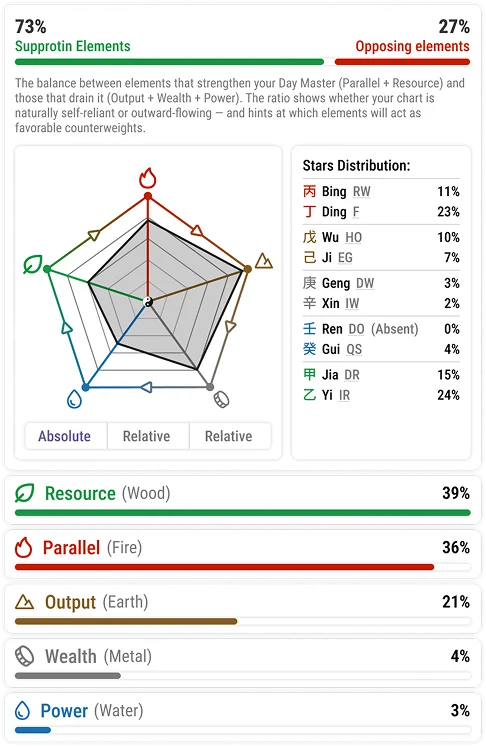
Reading the Ten Gods by hand is instructive, but it is far faster and less error-prone to let software map every stem for you. The Baguame BaZi calculator generates a complete Four Pillars chart and labels every stem — visible and hidden — with its Ten God, alongside the five-element balance and supporting and opposing influences.
The Ten Gods (十神) are the ten labels BaZi assigns to every Heavenly Stem based on its relationship to the Day Master. There are five elemental relationships — Resource, Output, Wealth, Authority and Peer — each doubled by polarity (same or opposite Yin/Yang) to yield ten gods. They describe career, wealth, family, talent and power.
Direct gods (Direct Resource, Direct Wealth, Direct Officer) arise when the other stem has the opposite polarity to the Day Master and favour stability, rules and conventional success. Indirect gods (Indirect Resource, Indirect Wealth, Seven Killings) arise with the same polarity and bring intensity, risk and unconventional paths.
Every god is defined by how its element interacts with the Day Master’s element. A stem that produces the Day Master is a Resource; one the Day Master produces is an Output; one the Day Master controls is Wealth; one that controls the Day Master is Authority; one of the same element is a Peer. Polarity then splits each into two.
Direct Wealth (正财) is the god of stable, hard-earned money, property and disciplined management — the opposite-polarity Wealth star. It indicates conventional income and savings, and for a man is traditionally associated with the wife. It is contrasted with Indirect Wealth, the quicker windfall and speculative gain.
Direct Officer (正官) is proper, law-abiding authority that disciplines the Day Master in a measured way — career, status and reputation. Seven Killings (七杀) is the same controlling element with the same polarity, bringing fierce and demanding pressure, ambition and a stern boss. Both control you, but with very different intensity.
Resource gods generate the Day Master and represent what feeds and educates you — parents, mentors, reputation and support. Wealth gods are controlled by the Day Master and represent what you manage, own and earn — money and property. One nourishes you from within; the other is what you go out and command.
Eating God (食神) is the same-polarity child: relaxed, generous and joyful talent that releases pressure gently. Hurting Officer (伤官) is the opposite-polarity child: bold, witty and rebellious brilliance that expresses fiercely and may challenge authority. Both are gods of creation, but one flows easily and the other burns intensely.