
Horse (午 Wu): The Seventh Earthly Branch, Element & Interactions
午 Wu is the seventh of the 12 Earthly Branches and the central branch of Summer. Where 巳 Si (Snake) marked the start of Summer’s ascent, Wu is the apex — the Summer Solstice, the moment Yang energy reaches its absolute maximum before the inevitable turn toward Yin begins. Its element is Fire, its polarity is Yang, and its zodiac animal is the Horse.
In BaZi (Four Pillars of Destiny), Wu holds a unique position: it is the only branch in the system where the principal hidden stem and the branch’s surface polarity differ. Wu is a Yang branch, yet its principal hidden stem is 丁 Ding (Yin Fire). This internal tension between outer Yang and inner Yin is fundamental to understanding the Horse’s character.
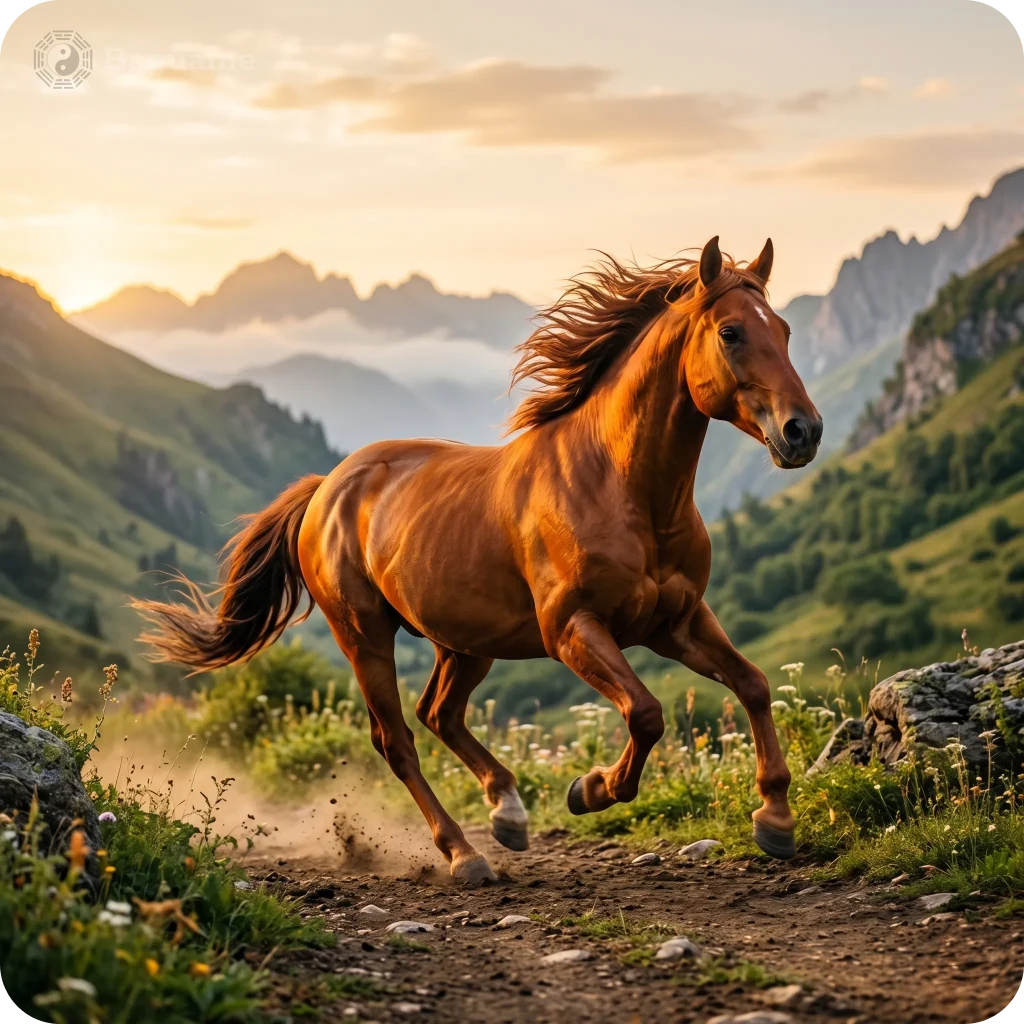
| Attribute | Value |
| Chinese Character | 午 |
| Romanization | Wu |
| Position in Cycle | 7th of 12 |
| Polarity | Yang |
| Element | Fire |
| Zodiac Animal | Horse |
| Season | Mid-Summer |
| Solar Month | 5th month (approx. June) |
| Hours | 11:00 – 13:00 |
| Direction | South (180°) |
| Principal Hidden Stem | 丁 Ding (Yin Fire) — 60% |
| Residual Hidden Stem | 己 Ji (Yin Earth) — 40% |
Hidden Stems: Two Layers Inside Wu
Wu contains two hidden Heavenly Stems — both Yin, despite Wu being a Yang branch. This polarity inversion is unique in the system: Wu is the only Yang branch whose hidden stems are entirely Yin. The result is a branch that projects Yang energy outward — bold, expansive, visible — while its inner nature is softer, warmer, and more emotionally complex than the surface suggests.
丁 Ding — Yin Fire (60%)
The Principal Qi of Wu. 丁 Ding is the Yin Fire of candles, hearths, and stars — intimate, warm, and deeply humanizing. Where 丙 Bing radiates like the Sun outward, Ding burns inward — illuminating what is close, nurturing what it touches, and holding its light through the night. This is the fire of civilization’s hearth, not the fire of conquest. Its presence as Wu’s dominant stem gives the Horse its passionate warmth and emotional depth beneath the galloping exterior.
己 Ji — Yin Earth (40%)
The Residual Qi of Wu. 己 Ji is the Yin Earth of fertile farmland — soft, absorptive, and productive. Fire generates Earth in the Five Element cycle, so Ji’s presence inside Wu is the natural product of Ding Fire’s warmth ripening the soil. In chart analysis, this hidden Ji Earth can serve as a resource for Earth Day Masters and provides a moderating, grounding influence within Wu’s otherwise intense Fire energy. At 40%, Ji Earth has significantly more weight in Wu than residual stems typically carry in other branches.
Elemental Nature and Symbolic Meaning
Wu represents the absolute peak of Yang energy in the annual cycle. The Summer Solstice — the longest day of the year — falls within Wu month. Everything is at maximum: light, heat, growth, outward activity. And yet, paradoxically, this is also the moment when Yang reaches its limit and Yin begins to be born. The seed of the next cycle is always planted at the peak of the current one — a principle Wu embodies perfectly.
In the cycle of the Five Elements, Fire at its Yang peak is the noon sun: total, blinding, and without shadow. The Horse — the animal of speed, freedom, and open terrain — captures this energy precisely. The Horse does not operate in enclosed spaces or measured steps. It needs open ground and full gallop. Its power is not in strategy or patience but in the complete commitment to motion.
In classical Feng Shui, due South is governed by the Li Trigram (☲ Fire) — the trigram of clarity, fame, and illumination. Wu sits at the very center of South (180°), making it the purest compass expression of Li’s energy. On the 24 Mountains Luo Pan, the South zone contains: 丙 Bing, 午 Wu, and 丁 Ding — with Wu occupying the central 15° of South (172.5°–187.5°).
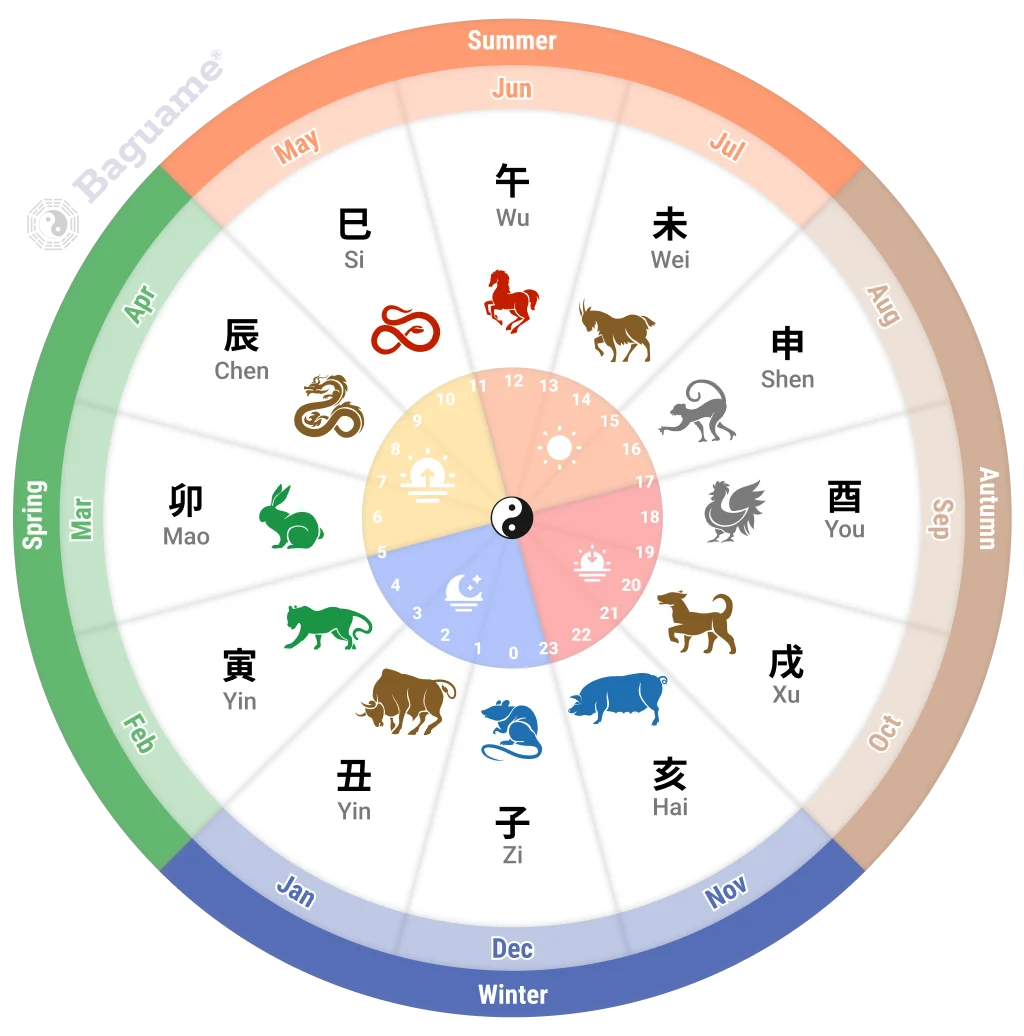
Branch Interactions
Wu participates in a wide range of interactions — most notably as the central node of the Fire Three Combination, and as the direct clash partner of 子 Zi (Rat) — one of the most significant clashes in the system. In BaZi analysis, Wu’s self-punishment is also worth noting: it is one of four branches that punish themselves when doubled.
Six Combination (六合): Wu + Wei → Fire
午 Wu combines with 未 Wei (Goat) to produce Fire energy — a natural combination as both are Summer branches sharing the same elemental character. In a chart, Wu–Wei combination amplifies Fire and creates a deeply warm, Summer-dominant energy. It also reinforces the hidden 己 Ji Earth shared by both branches, potentially strengthening Earth as a secondary effect.
Three Combination (三合): Yin + Wu + Xu → Fire Frame
寅 Yin (Tiger), 午 Wu (Horse), and 戌 Xu (Dog) form the Fire Three Combination (三合火局). Wu acts as the central node at the peak of Fire energy, anchored by its principal stem 丁 Ding Fire. When all three branches appear in a chart, Fire energy is powerfully amplified. Even partial combinations (Yin–Wu or Wu–Xu) produce significant Fire strengthening.
Seasonal Combination (三會): Si + Wu + Wei → Fire Season
巳 Si (Snake), 午 Wu (Horse), and 未 Wei (Goat) form the Seasonal Fire Frame — the three branches of Summer. Wu sits at the center as the peak Fire branch, giving the frame its greatest concentration of Fire energy. The Seasonal Frame is considered the strongest Fire combination when all three branches are present together.
Six Clash (六沖): Wu ↔ Zi
午 Wu (Yang Fire) clashes directly with 子 Zi (Rat) — the Water–Fire opposition along the South–North axis. This is one of the most elemental and symbolically potent clashes in the system: the noon sun against midnight water, maximum Yang against maximum Yin. Water controls Fire in the Five Element cycle, so the clash is structurally weighted against Wu when Zi is stronger. In annual afflictions and time-based forecasting, Wu–Zi clashes are among the most activating and destabilizing interactions to watch for.
Self-Punishment (自刑): Wu ↔ Wu
Wu is one of four branches capable of self-punishment (自刑). When two Wu branches appear in the same chart, they punish each other. The self-punishment of Wu manifests as an excess of outward energy with no internal direction — burning intensely but without a coherent focus. In practice this can surface as impulsiveness, scattered effort, or a tendency to exhaust resources through overextension before any single goal is achieved.
Harm (害): Wu ↔ Chou
午 Wu and 丑 Chou (Ox) form a Harm relationship (六害). The scorching Yang Fire of midsummer and the cold Yin Earth of midwinter sit at maximum seasonal distance from each other. Rather than clashing directly, they undermine each other through quiet incompatibility — draining interactions, misaligned timing, and situations where the energy of one consistently works against the other without open confrontation.
Destruction (破): Wu ↔ Mao
午 Wu and 卯 Mao (Rabbit) form a Destruction relationship (破). The Wu–Mao destruction involves a Fire branch and a Wood branch in a configuration where Wood normally generates Fire, but the relationship erodes rather than supports. It tends to manifest as situations that start with genuine momentum but gradually lose coherence — energy invested without sustainable return.
Penalty (刑): Wu ↔ Zi — Ungrateful Punishment reversed
午 Wu and 子 Zi (Rat) also form an Ungrateful Punishment (無恩之刑) in addition to their direct clash. This layering of clash and punishment between the same two branches is unusual and intensifies the destructive potential of the Wu–Zi interaction. When both appear in a chart, both interactions are assessed — the clash operates on the elemental level, while the punishment operates on the relational and behavioral level.
Wu in the BaZi Chart: Four Pillar Positions
The meaning of Wu shifts depending on which pillar it occupies in a BaZi chart. Use the Baguame BaZi calculator to identify where Wu appears across your Year, Month, Day, and Hour pillars.
Year Pillar
Relates to ancestry and early life. Wu in the Year Branch suggests an upbringing marked by warmth, visibility, and high energy — an environment where expression, movement, and passion were valued. Early life may have involved constant change or an atmosphere of social vitality.
Month Pillar
Reflects career context. Wu in the Month Branch places Fire’s radiating energy in the professional sphere — natural domains include performance, leadership, sales, public-facing roles, sports, and any career requiring visible energy and the ability to inspire others through presence and enthusiasm.
Day Pillar
Describes the self and closest relationships. Wu as a Day Branch indicates a person with 丁 Ding Fire as their inner core — passionate, warm, and deeply loyal beneath the outward boldness. In relationships, they give fully but need freedom; they are emotionally intense but may resist being contained or defined.
Hour Pillar
Governs later life and private desires. Wu in the Hour Branch places Fire’s open, outward energy in the realm of inner aspiration — a person who cannot truly rest, whose private world is as active and intense as their public one, and whose later years are characterized by continued visibility and outward engagement rather than withdrawal.
Wu as a Time Marker: Month, Hour, and Direction
Wu Month
Wu governs the 5th lunar month — containing the Summer Solstice (夏至 Xia Zhi, approximately June 6 – July 6 in the solar calendar). This is the longest day of the year and the peak of Yang energy in the cycle. From this point, days begin to shorten and Yin energy slowly begins its return. Wu month energy is intense, outward, and fully expressed — a time of maximum activity, visibility, and outward engagement.
Wu Hour
Wu governs 11:00–13:00 — solar noon, when the sun is at its highest point in the sky and shadows are at their shortest. This is the most Yang moment of the day, mirroring Wu’s position as the most Yang branch of the year. Births during this window are recorded as the Wu Hour in a BaZi chart. It is associated with maximum outward energy, visibility, and the quality of attention that operates best in the full light of day.
Wu Direction: South
Wu corresponds to due South (180°) — the direction of maximum sunlight, governed by the Li Trigram (☲ Fire) in classical Feng Shui. On the 24 Mountains Luo Pan, Wu occupies the central 15° of South (172.5°–187.5°), flanked by 丙 Bing and 丁 Ding. In Flying Stars natal chart analysis, the South sector at Wu carries the purest expression of Fire energy — relevant for fame, recognition, and clarity in a property.
Horse Years in the 60-Year Cycle: Wood, Fire, Earth, Metal, Water Horse
In the BaZi calendar, every Horse year pairs 午 Wu with a different Heavenly Stem. Because Wu is a Yang Branch, it always pairs with Yang Stems — completing its full cycle of 5 variations every 60 years.
| Stem + Branch | Name | Stem Element | Recent Years |
| 甲午 | Wood Horse | 甲 Jia — Yang Wood | 1954, 2014, 2074 |
| 丙午 | Fire Horse | 丙 Bing — Yang Fire | 1906, 1966, 2026 |
| 戊午 | Earth Horse | 戊 Wu — Yang Earth | 1918, 1978, 2038 |
| 庚午 | Metal Horse | 庚 Geng — Yang Metal | 1930, 1990, 2050 |
| 壬午 | Water Horse | 壬 Ren — Yang Water | 1942, 2002, 2062 |
| Note: Wu always pairs with Yang Stems only (甲, 丙, 戊, 庚, 壬) — Yang Branch pairs with Yang Stem. There is no Yin Stem Horse year. | |||
Horse Symbolism and Character in Chinese Culture
The Horse occupies a singular place in Chinese civilization — not as a wild creature but as the partner that made civilization possible. Horses carried armies, connected cities, plowed fields, and extended the reach of human ambition across the continent. The famous Terracotta Army’s cavalry, the Han Dynasty’s obsession with “celestial horses” from the West, the Silk Road’s mounted trade routes — all testify to the Horse’s central role in Chinese history and its association with power, freedom, and the expansion of human possibility.
In Chinese metaphysics, the Horse represents the South, the Summer Solstice, and the full expression of Yang energy. It is also one of the four Traveling Horse branches — a designation that aligns perfectly with its cultural character. The Horse is always moving, always covering ground, always oriented toward the next horizon.
Core Horse Traits in BaZi
Wu’s hidden stems — Ding Fire and Ji Earth — produce a distinctive character profile when Wu appears prominently in a chart:
- Boundless energy — operates at high intensity for sustained periods
- Magnetic warmth — the hidden Ding Fire creates genuine, passionate connection with others
- Need for freedom — cannot be confined; thrives in open-ended roles and environments
- Impatience — moves faster than most; struggles with waiting, planning, or operating at others’ pace
- Traveling Horse restlessness — associated with relocation, travel, and major pivots in direction
- Inner Yin beneath Yang surface — more emotionally sensitive than the confident exterior suggests
What the Horse Symbolizes
- The Summer Solstice — maximum Yang, the apex of the annual cycle
- Solar noon — governs 11:00–13:00, the highest point of the day
- Freedom and open terrain — the animal that expanded civilization’s reach
- The Traveling Horse — movement, relocation, and pivotal life transitions
- Yang without shadow — the noon sun at its zenith, before the long descent begins
- The seed of return — peak Yang always contains the hidden birth of Yin; the cycle turns here
Frequently Asked Questions
Wu is Yang Fire. Its principal hidden stem is 丁 Ding (Yin Fire) at approximately 60%, with 己 Ji (Yin Earth) contributing around 40%. Wu is unique in the system: it is the only Yang branch whose hidden stems are entirely Yin, creating a branch that projects Yang energy outward while its internal composition is entirely Yin.
Wu clashes with 子 Zi (Rat). This is the direct Fire–Water opposition along the South–North axis — maximum Yang against maximum Yin, noon against midnight. It is one of the most symbolically potent clashes in the system. Water controls Fire in the Five Element cycle, so the clash tends to be weighted against Wu when Zi is stronger. Notably, Wu and Zi also form an Ungrateful Punishment in addition to their clash — layering two simultaneous interactions.
Wu participates in the Fire Three Combination (三合火局): 寅 Yin (Tiger) + 午 Wu (Horse) + 戌 Xu (Dog). Wu acts as the central node at the peak of Fire energy. When all three branches appear in a BaZi chart, Fire energy is powerfully amplified. Note that 巳 Si (Snake) does NOT appear in this combination — Si combines for Metal (Si–You–Chou), not Fire.
Wu sits at the absolute peak of Yang energy in the annual cycle — the Summer Solstice. In Chinese cosmological thinking, maximum expression of any quality always contains the seed of its opposite. Wu is Yang at its fullest, which means Yin is being born inside it. This is reflected structurally in its hidden stems: 丁 Ding (Yin Fire) and 己 Ji (Yin Earth) — both Yin. The peak Yang branch holds Yin within, just as the Winter Solstice’s peak Yin branch (Zi) holds Yang’s seed. This structural mirroring between Wu and Zi is one of the most elegant symmetries in the Earthly Branch system.
The Fire Horse year is 丙午 — pairing 丙 Bing (Yang Fire) with 午 Wu (Horse). Recent Fire Horse years: 1906, 1966, 2026. In Japanese and Chinese folk tradition, the Fire Horse year (especially for women born in it) was considered particularly intense — a double Fire configuration believed to produce individuals of exceptional willpower and transformative energy. The next Fire Horse year is 2026. In BaZi terms, 丙 Bing sitting above Wu Fire creates a same-element Stem–Branch relationship, amplifying Fire to an exceptional degree. To see how 2026 interacts with your personal chart, use the Baguame BaZi calculator.