
Tiger (寅 Yin): The Third Earthly Branch, Element & Interactions
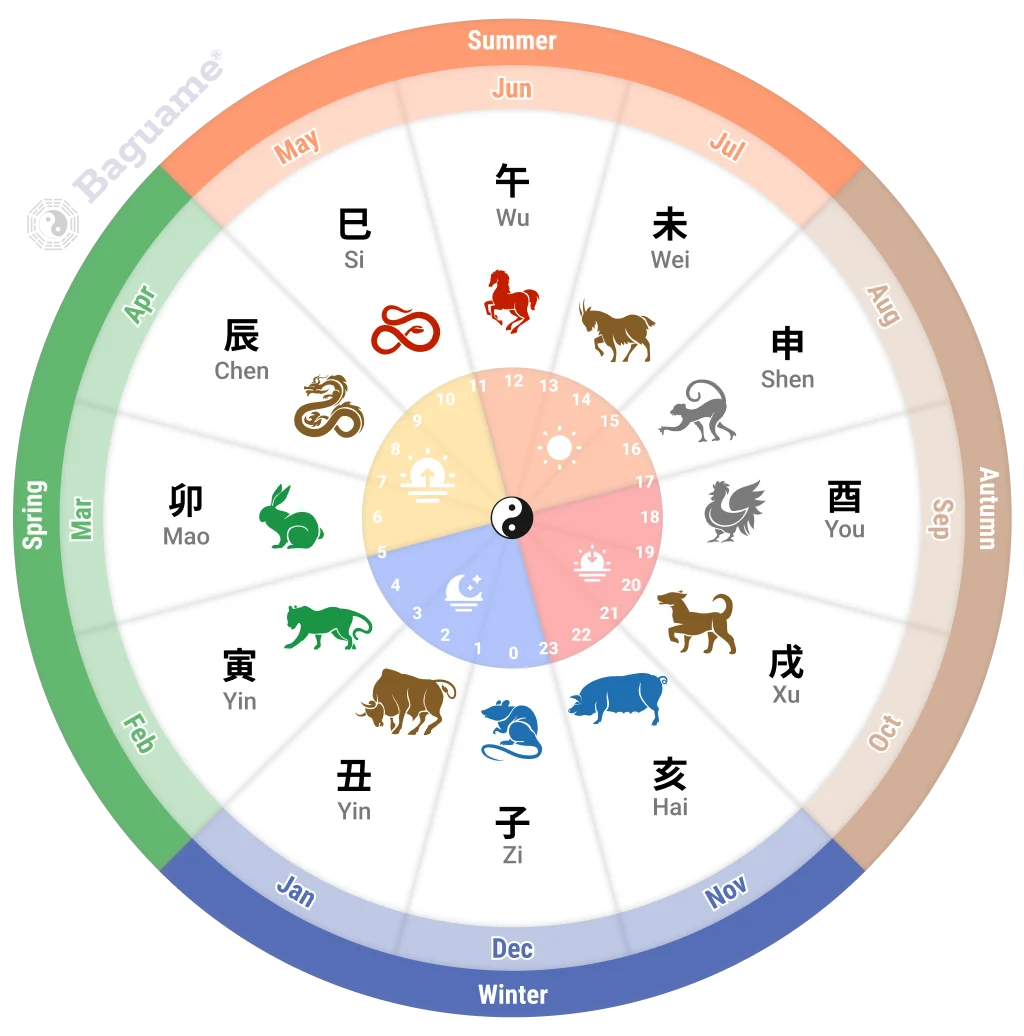
寅 Yin is the third of the 12 Earthly Branches and the first branch of Spring. Where 丑 Chou (Ox) held Winter’s energy in place, Yin breaks it open. The Tiger is the moment Yang Qi bursts through the frozen earth — explosive, directional, unstoppable. Its element is Wood, its polarity is Yang, and it governs the direction of ENE (60°).
In BaZi (Four Pillars of Destiny), Yin is one of the four “Traveling Horse” branches and carries three hidden Heavenly Stems — making it one of the most energetically complex and dynamic branches in the entire system. Understanding Yin is essential for reading charts where drive, ambition, and momentum are in play.

| Attribute | Value |
| Chinese Character | 寅 |
| Romanization | Yin |
| Position in Cycle | 3rd of 12 |
| Polarity | Yang |
| Element | Wood |
| Zodiac Animal | Tiger |
| Season | Early Spring |
| Solar Month | 1st month (approx. February) |
| Hours | 03:00 – 05:00 |
| Direction | ENE (60°) |
| Principal Hidden Stem | 甲 Jia (Yang Wood) — 60% |
| Middle Hidden Stem | 丙 Bing (Yang Fire) — 20% |
| Residual Hidden Stem | 戊 Wu (Yang Earth) — 20% |
Hidden Stems: Three Layers Inside Yin
Yin contains three hidden Heavenly Stems, all Yang — making it the only branch where every hidden stem shares the same polarity as the branch itself. This creates an unusually unified, forceful energy: there is no Yin counterbalance inside Yin, nothing to moderate or soften its drive.
甲 Jia — Yang Wood (60%)
The Principal Qi of Yin. 甲 Jia is the Yang Wood of towering trees — upward, pioneering, relentlessly growth-oriented. It is the first of the ten stems and the purest expression of new beginnings. In Yin, Jia defines the branch’s dominant character: ambition, directness, and the capacity to break through obstacles through sheer upward momentum. Jia does not bend — it grows or it breaks.
丙 Bing — Yang Fire (20%)
The Middle Qi of Yin. 丙 Bing is the Yang Fire of the Sun — radiant, generous, and impossible to ignore. Its presence inside Yin explains the Tiger’s magnetic charisma and natural leadership quality. Wood generates Fire in the Five Element cycle, so the relationship between Jia and Bing inside Yin is generative: the Wood feeds the Fire, giving Yin its inner warmth and outward brightness. When activated, this stem brings visibility, enthusiasm, and the ability to inspire others.
戊 Wu — Yang Earth (20%)
The Residual Qi of Yin. 戊 Wu is the Yang Earth of mountains and high ground — stable, vast, and immovable. Its presence inside Yin adds a structural foundation beneath the explosive Wood and Fire energy. Without Wu Earth, Yin would be pure combustion with no anchor. In chart analysis, this hidden Earth can serve as a resource for Earth Day Masters and adds a quality of strategic thinking beneath the Tiger’s boldness.
Elemental Nature and Symbolic Meaning
Yin is the first branch of Spring and the moment the entire cycle shifts direction. After two months of Winter’s inward contraction — Zi (Rat) at the peak of Water, Chou (Ox) holding the frozen ground — Yin is the eruption. Yang Qi, which was born silently at the Winter Solstice and gestated through Chou month, now breaks through the surface with full force. In the solar calendar, Yin month begins with 立春 Li Chun (Start of Spring) — the most important transition point in the Chinese year, the moment the new annual cycle officially begins.
The symbolic image is of bamboo shoots forcing their way through concrete, or of a river breaking through an ice dam. The Tiger — the largest and most powerful predator of the forest — embodies this perfectly: absolute confidence in motion, complete commitment to direction, no hesitation.
In classical Feng Shui, the ENE direction where Yin sits on the compass falls at the boundary of the Zhen Trigram (☳ Thunder) — the trigram of sudden movement, awakening, and the shock that initiates growth. Zhen and Yin share this quality of explosive initiation. On the 24 Mountains Luo Pan, the ENE zone contains: 甲 Jia, 寅 Yin, and 乙 Yi — with Yin occupying the central 15° of ENE (52.5°–67.5°).
Branch Interactions
Yin participates in a rich set of interactions — including one of the most powerful cross-element combinations in the system and a notable three-branch punishment. In BaZi analysis, activating Yin’s combinations can dramatically amplify Wood energy; triggering its clashes and punishments can create turbulence and sudden reversals.
Six Combination (六合): Yin + Hai → Wood
寅 Yin combines with 亥 Hai (Pig) to produce Wood energy. This is one of the most natural Six Combinations in the system — Water (Hai) generates Wood (Yin), and their combination reinforces that generative relationship. In a chart where Wood is needed, Yin–Hai combination is a reliable amplifier. Where Wood is already excessive, this combination can tip the balance further.
Three Combination (三合): Yin + Wu + Xu → Wood Frame
寅 Yin, 午 Wu (Horse), and 戌 Xu (Dog) form the Wood Three Combination (三合木局). Yin acts as the opening node, anchored by its principal stem 甲 Jia Wood. When all three branches appear in a chart, Wood energy is powerfully amplified — often enough to dominate the entire elemental balance. Even partial combinations (Yin–Wu or Yin–Xu) produce significant Wood strengthening.
Seasonal Combination (三會): Yin + Mao + Chen → Wood Season
寅 Yin, 卯 Mao (Rabbit), and 辰 Chen (Dragon) form the Seasonal Wood Frame — the three branches of Spring. This is considered the strongest Wood combination in the system, as it reflects a natural seasonal concentration rather than a cross-season alignment. When all three are present together, Wood dominance is at its most intense and difficult to control or balance.
Six Clash (六沖): Yin ↔ Shen
寅 Yin clashes directly with 申 Shen (Monkey). This is a Wood–Metal clash across the ENE–WSW axis — two of the four “Traveling Horse” branches in direct opposition. The clash is fierce: Metal controls Wood in the Five Element cycle, so Shen’s Metal energy attacks Yin’s Wood. Both branches are destabilized, their hidden stems scattered. In time-based forecasting, a Yin–Shen clash year often brings sudden travel, relocation, major career shifts, or unexpected confrontations.
Punishment (刑): Yin → Si → Shen — Ungoverned Punishment
寅 Yin, 巳 Si (Snake), and 申 Shen (Monkey) form the three-branch Ungoverned Punishment (無制之刑) — named for the sense of uncontrolled force running in a cycle with no resolution. Each branch punishes the next in a triangle: Yin punishes Si, Si punishes Shen, Shen punishes Yin. This creates a pattern of self-defeating action, repeated mistakes, and situations that escalate beyond the original intent. It is considered one of the more disruptive punishments in BaZi.
Harm (害): Yin ↔ Si
寅 Yin and 巳 Si (Snake) form a Harm relationship (六害). The Yin–Si harm is a Wood–Fire interaction that is subtly draining rather than openly destructive. Where Wood normally generates Fire, in this Harm configuration the relationship turns corrosive — energy is expended without productive return. It often manifests as situations where effort and investment are continuously absorbed without clear results.
Yin in the BaZi Chart: Four Pillar Positions
The meaning of Yin shifts depending on which pillar it occupies in a BaZi chart. Use the Baguame BaZi calculator to identify where Yin appears across your Year, Month, Day, and Hour pillars.
Year Pillar
Relates to ancestry, social environment, and early life. Yin in the Year Branch suggests a background characterized by energy, movement, and early exposure to ambition or leadership. The family or social environment may have been dynamic, competitive, or marked by significant change.
Month Pillar
Reflects career context and the adult working environment. Yin in the Month Branch places explosive Wood energy in the professional sphere — often indicating careers driven by initiative, pioneering, and the desire to build something new. Natural domains: entrepreneurship, leadership roles, exploration, creative direction.
Day Pillar
Describes the self and closest relationships. Yin as a Day Branch indicates a person with 甲 Jia Wood as their core energy — bold, direct, growth-driven, and often magnetic. In relationships, they lead naturally but may struggle with flexibility and the need to always move forward.
Hour Pillar
Governs later life, children, and private desires. Yin in the Hour Branch places Wood’s expansive energy in the realm of inner drive and aspiration — a person whose private goals are ambitious and whose later years are likely to involve continued forward movement rather than rest or withdrawal.
Yin as a Time Marker: Month, Hour, and Direction
Yin Month
Yin governs the 1st lunar month — beginning with 立春 Li Chun (Start of Spring, approximately February 4). This is the most important date in the Chinese metaphysical calendar: the official start of the new year in BaZi, the moment the annual Heavenly Stem and Earthly Branch change. Yin month energy is expansive, initiating, and forward-moving — the ideal time to begin new projects and launch new directions.
Yin Hour
Yin governs 03:00–05:00 — the pre-dawn hours when darkness is giving way to the first light. In classical Chinese timekeeping this is the hour of the Tiger’s hunt: the world is still quiet, but movement has begun. Births in this window are recorded as the Yin Hour in a BaZi chart. It is associated with early rising, independent action, and the capacity to see clearly before others do.
Yin Direction: ENE
Yin corresponds to ENE at 60° on the compass, within the broader territory of the Zhen Trigram (☳ Thunder) in classical Feng Shui. On the 24 Mountains Luo Pan, the ENE zone contains: 甲 Jia, 寅 Yin, and 乙 Yi. Yin occupies the central 15° of ENE (52.5°–67.5°). In Flying Stars analysis, the ENE sector carries the energy of Spring initiation and Wood growth — activating this sector can amplify momentum and new beginnings.
Tiger Years in the 60-Year Cycle: Wood, Fire, Earth, Metal, Water Tiger
In the BaZi calendar, every Tiger year pairs 寅 Yin with a different Heavenly Stem. Because Yin is a Yang Branch, it always pairs with Yang Stems — completing its full cycle of 5 variations every 60 years.
| Stem + Branch | Name | Stem Element | Recent Years |
| 甲寅 | Wood Tiger | 甲 Jia — Yang Wood | 1914, 1974, 2034 |
| 丙寅 | Fire Tiger | 丙 Bing — Yang Fire | 1926, 1986, 2046 |
| 戊寅 | Earth Tiger | 戊 Wu — Yang Earth | 1938, 1998, 2058 |
| 庚寅 | Metal Tiger | 庚 Geng — Yang Metal | 1950, 2010, 2070 |
| 壬寅 | Water Tiger | 壬 Ren — Yang Water | 1962, 2022, 2082 |
| Note: Yin always pairs with Yang Stems only (甲, 丙, 戊, 庚, 壬) — Yang Branch pairs with Yang Stem. There is no Yin Stem Tiger year. | |||
Tiger Symbolism and Character in Chinese Culture
The Tiger is the king of the forest in Chinese tradition — not the dragon, not the lion, but the Tiger. It holds the rank of “the mountain’s god” (山神) and is considered the ruler of all land animals. Its roar was said to make mountains tremble and evil spirits flee. In Chinese homes, images of the Tiger were placed at doorways not as decoration but as protective talismans, capable of driving away demons and illness.
Unlike the Rat’s cleverness or the Ox’s endurance, the Tiger’s power is immediate and total. It does not calculate, it does not accumulate — it acts, completely, in the moment. This is both its greatest strength and its greatest vulnerability: the Tiger can break through anything, but it can also burn everything down, including itself.
Core Tiger Traits in BaZi
Yin’s three Yang hidden stems — Jia Wood, Bing Fire, Wu Earth — produce a distinctive character profile when Yin appears prominently in a chart:
- Bold initiative — acts first, assesses second
- Natural authority — commands attention without trying
- Impatience — difficulty tolerating slow processes or bureaucratic delay
- Generosity — the hidden Bing Fire gives warmth and a desire to inspire others
- Restlessness — one of the four Traveling Horse branches; thrives in motion, suffers in stagnation
- All-or-nothing energy — fully committed or fully absent; rarely operates at half-strength
What the Tiger Symbolizes
- The start of Spring — the rupture that ends Winter and begins the active half of the year
- Protection and courage — guardian against evil, symbol of military valor
- The Traveling Horse — associated with movement, journeys, and major life transitions
- Pure Yang force — three Yang stems, no internal moderation
- Initiation without hesitation — the branch that begins, not the branch that sustains
- Pre-dawn clarity — governs 03:00–05:00, the hour of sharpest instinct and earliest action
Frequently Asked Questions
Yin is Yang Wood. Its principal hidden stem is 甲 Jia (Yang Wood) at approximately 60%, with 丙 Bing (Yang Fire) and 戊 Wu (Yang Earth) each contributing around 20%. Uniquely, all three hidden stems in Yin are Yang — creating one of the most forceful, one-directional branch energies in the system.
Yin clashes with 申 Shen (Monkey). This is a Wood–Metal clash along the ENE–WSW axis — both are Traveling Horse branches, which makes this clash particularly activating. Metal controls Wood in the Five Element cycle, so the clash involves Shen’s Metal energy attacking Yin’s Wood. In forecasting, a Yin–Shen clash often triggers major movement, sudden changes, and confrontations between opposing forces.
Yin participates in the Wood Three Combination (三合木局): 寅 Yin (Tiger) + 午 Wu (Horse) + 戌 Xu (Dog). Yin acts as the opening node, anchored by its principal stem 甲 Jia Wood. When all three branches appear in a BaZi chart, Wood energy is powerfully amplified.
The four Traveling Horse branches (驛馬) are Yin (Tiger), Si (Snake), Shen (Monkey), and Hai (Pig) — the four branches that open each seasonal quarter. They are associated with movement, travel, relocation, and major life transitions. A person with a prominent Traveling Horse in their chart often experiences significant geographical or situational mobility. When a Traveling Horse is clashed (as Yin is by Shen), its energy of movement is activated — sometimes forcefully.
In classical BaZi, the year begins with 立春 Li Chun (Start of Spring) — the solar term that falls around February 4 and marks the start of Yin month. This is different from the Chinese New Year (lunar calendar), which can fall anywhere between January 21 and February 20. For BaZi chart calculation, the Year Pillar changes at Li Chun, not at Chinese New Year. If you were born in January or early February before Li Chun, your Year Pillar belongs to the previous year. Confirm this with the Baguame BaZi calculator, which uses solar terms for precise pillar calculation.