
Dragon (辰 Chen): The Fifth Earthly Branch, Element & Interactions
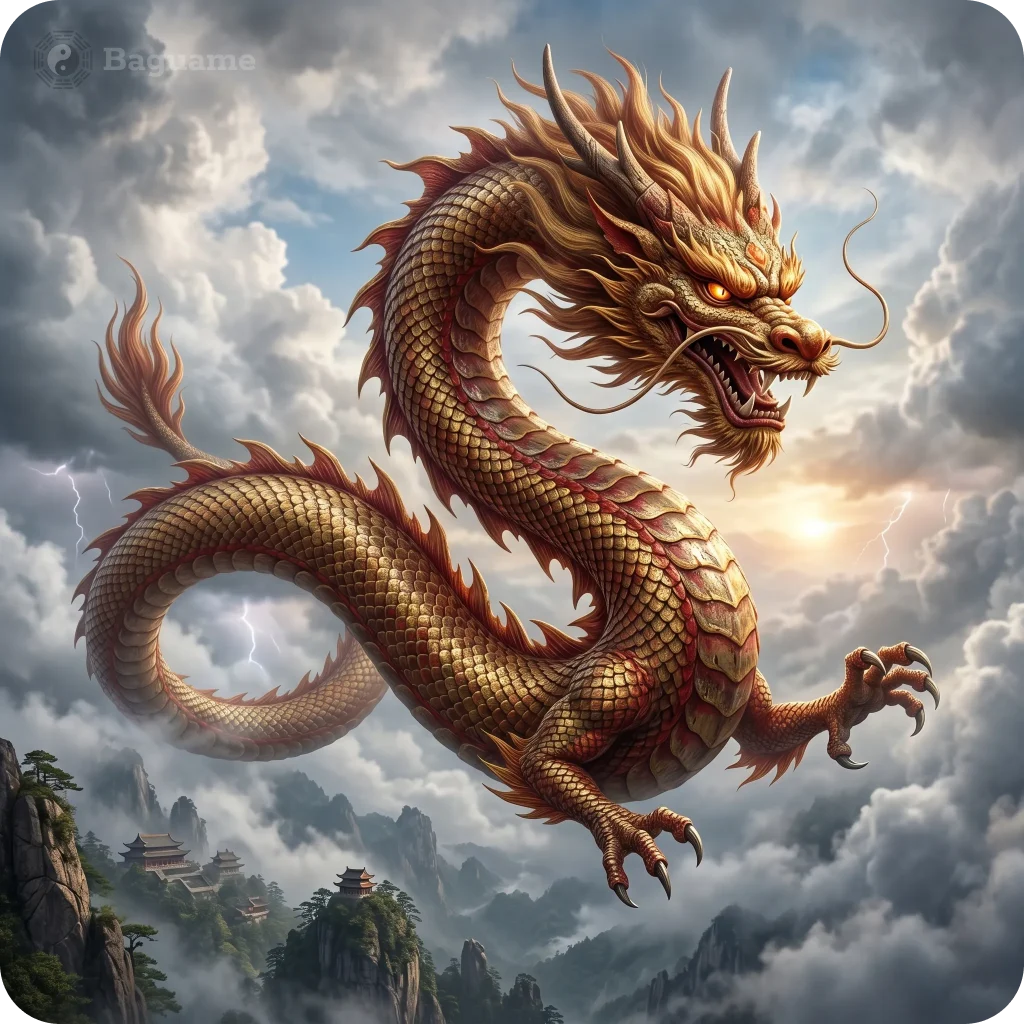
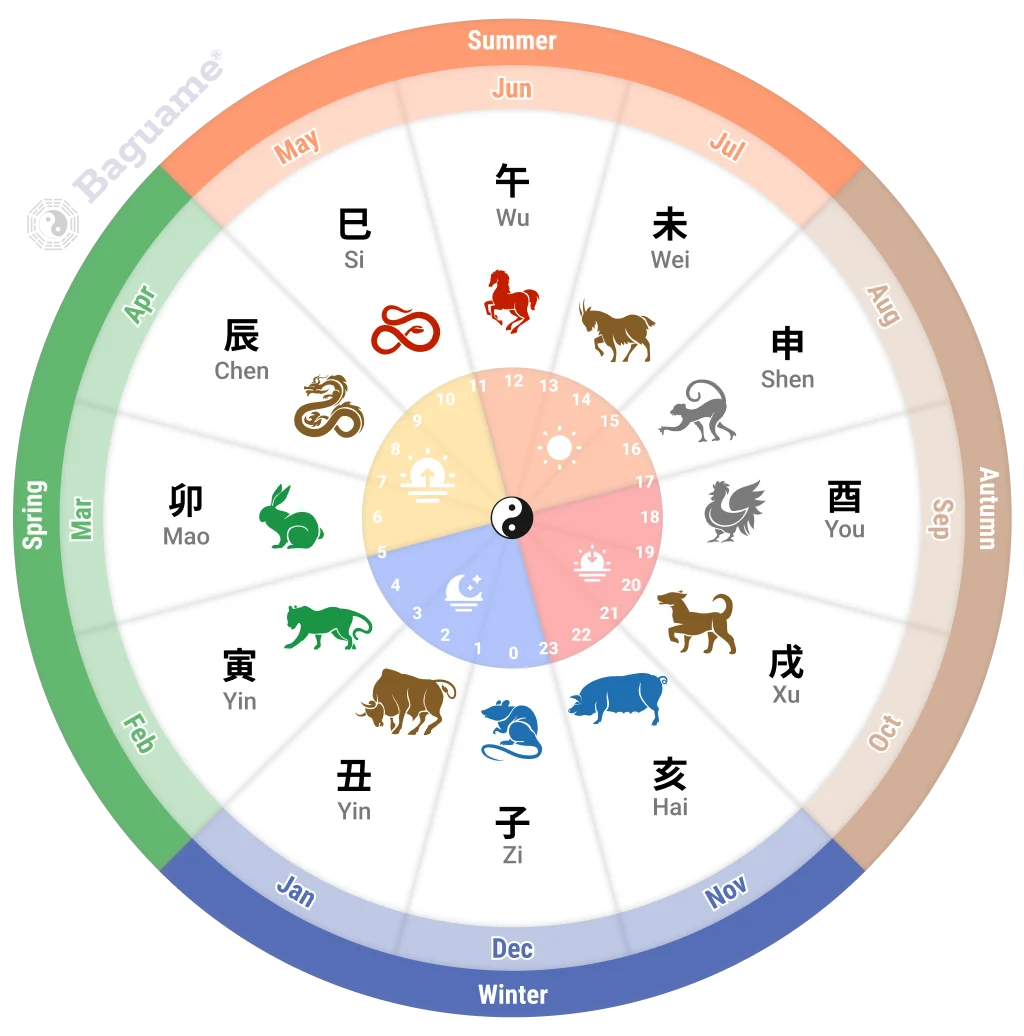
辰 Chen is the fifth of the 12 Earthly Branches and the closing branch of Spring. Where 卯 Mao (Rabbit) expressed Wood energy at its most pure and sustained, Chen is the transition — the seasonal bridge that gathers and stores Spring’s energy before Summer breaks through. Its element is Earth, its polarity is Yang, and its zodiac animal is the Dragon.
In BaZi (Four Pillars of Destiny), Chen is one of the four “Earth Reservoir” branches (土庫) — also called Storage or Grave branches. These branches hold enormous amounts of elemental energy inside them, making them among the most complex and powerful in the system. Chen specifically is the Reservoir of Water, and its hidden stems reflect the layered complexity of a season in transition.
| Attribute | Value |
| Chinese Character | 辰 |
| Romanization | Chen |
| Position in Cycle | 5th of 12 |
| Polarity | Yang |
| Element | Earth |
| Zodiac Animal | Dragon |
| Season | Late Spring |
| Solar Month | 3rd month (approx. April) |
| Hours | 07:00 – 09:00 |
| Direction | ESE (120°) |
| Principal Hidden Stem | 戊 Wu (Yang Earth) — 60% |
| Middle Hidden Stem | 乙 Yi (Yin Wood) — 20% |
| Residual Hidden Stem | 癸 Gui (Yin Water) — 20% |
Hidden Stems: Three Layers Inside Chen
Chen carries three hidden Heavenly Stems that tell the story of a season in transition: Yang Earth on the surface, Spring’s residual Wood in the middle, and a hidden reservoir of Water beneath. This combination makes Chen uniquely versatile — and uniquely complex — in BaZi analysis.
戊 Wu — Yang Earth (60%)
The Principal Qi of Chen. 戊 Wu is the Yang Earth of mountains, high plateaus, and vast open terrain — immovable, encompassing, and foundational. As the dominant stem in Chen, it gives the branch its reputation for scale and ambition. Wu Earth does not hold small things; it holds entire landscapes. In a chart, Chen’s Wu Earth is a powerful resource for Earth Day Masters and can anchor an otherwise unstable elemental balance.
乙 Yi — Yin Wood (20%)
The Middle Qi of Chen. 乙 Yi — the same Yin Wood that fills Mao (Rabbit) entirely — lingers inside Chen as Spring’s residual energy. The season has not fully ended; Wood is still present, still growing, but giving way. This hidden Yi Wood means Chen can support Wood Day Masters, and explains why Chen participates in the Spring Seasonal Frame (Yin–Mao–Chen) despite being an Earth branch.
癸 Gui — Yin Water (20%)
The Residual Qi of Chen. 癸 Gui — the same Yin Water that fills Zi (Rat) entirely — sits deep inside Chen as its hidden reservoir. This is what makes Chen the Water Reservoir (水庫) of the four Earth branches. Spring rain has soaked into the mountain earth; the Water is stored, invisible but present. In a chart, this hidden Gui enables Chen to anchor the Water Three Combination (Shen–Zi–Chen) and the Seasonal Water Frame (Hai–Zi–Chou).
Elemental Nature and Symbolic Meaning
Chen is the transitional Earth of late Spring — the moment when green growth reaches its fullest expression before the heat of Summer begins to transform it. The ground is rich, moist, and alive with stored potential. Rain has fallen, seeds have rooted, and the landscape holds more energy than is visible on the surface. This is the essence of the Dragon: a being of enormous accumulated power, capable of moving between worlds — sky, earth, and water — because it belongs fully to none of them.
In the cycle of the Five Elements, transitional Earth acts as a bridge between seasons. Chen specifically bridges Spring (Wood) and Summer (Fire), holding the energy of both while belonging to neither entirely. This gives the Dragon its mythological quality of transcendence — it does not fit neatly into any single category, and that is precisely its power.
In classical Feng Shui, the ESE direction at 120° sits within the territory of the Xun Trigram (☴ Wind) — the trigram of gentle penetration, growth, and the eldest daughter. On the 24 Mountains Luo Pan, the ESE zone contains: 乙 Yi, 辰 Chen, and 巽 Xun — with Chen occupying the central 15° of ESE (112.5°–127.5°).
Branch Interactions
Chen is one of the most interaction-rich branches in the entire system. As a Storage branch, its clashes are particularly significant — they can release hidden elemental energy into the chart. In BaZi analysis, Chen’s interactions must always be read with awareness of what is stored inside it.
Six Combination (六合): Chen + You → Metal
辰 Chen combines with 酉 You (Rooster) to produce Metal energy. Earth generates Metal in the Five Element cycle, and You’s pure 辛 Xin Metal completes this interaction. In a chart, Chen–You combination can significantly boost Metal where it is needed — or tip an already Metal-heavy chart into imbalance.
Three Combination (三合): Shen + Zi + Chen → Water Frame
申 Shen (Monkey), 子 Zi (Rat), and 辰 Chen form the Water Three Combination (三合水局). Chen acts as the closing node — its hidden 癸 Gui Water anchors the combination. When all three branches appear in a chart, Water energy is dramatically amplified. This is also why Chen is called the Water Reservoir: it provides the stored Water that completes this combination.
Seasonal Combination (三會): Yin + Mao + Chen → Wood Season
寅 Yin (Tiger), 卯 Mao (Rabbit), and 辰 Chen form the Seasonal Wood Frame — the three branches of Spring. Despite being an Earth branch, Chen participates through its hidden 乙 Yi Wood. When all three are present, Wood energy dominates the chart — though Chen’s Earth nature also creates internal tension within this combination that a pure Wood branch would not.
Six Clash (六沖): Chen ↔ Xu
辰 Chen clashes directly with 戌 Xu (Dog) — both are Yang Earth branches, but from opposite seasons: Spring Earth vs Autumn Earth. This is an Earth–Earth clash between two Storage branches. When Chen and Xu clash, both release their stored elemental energy simultaneously — Chen releases its hidden Water (癸 Gui), and Xu releases its hidden Fire (丁 Ding and 辛 Xin). The result is an eruption of multiple hidden elements into the chart, which can dramatically reshape the elemental balance.
Self-Punishment (自刑): Chen ↔ Chen
Like Mao (Rabbit), Chen is one of four branches capable of self-punishment (自刑). When two Chen branches appear in the same chart, they punish each other. The self-punishment of Chen is associated with over-accumulation and inability to release — the Reservoir holds so much that it becomes stagnant. In practice this manifests as hoarding behavior, difficulty making decisions, or situations where accumulated resources or energy cannot be put to productive use.
Harm (害): Chen ↔ Mao
辰 Chen and 卯 Mao (Rabbit) form a Harm relationship (六害) — notable because they are adjacent branches that also appear together in the Spring Seasonal Frame. The coexistence of Seasonal Combination and Harm between Chen and Mao is a well-known complexity in BaZi: the combination can form, but the underlying Harm creates friction within it. Classical practitioners assess which interaction dominates based on the full chart context.
Chen in the BaZi Chart: Four Pillar Positions
The meaning of Chen shifts depending on which pillar it occupies in a BaZi chart. Use the Baguame BaZi calculator to identify where Chen appears across your Year, Month, Day, and Hour pillars.
Year Pillar
Relates to ancestry and early life. Chen in the Year Branch suggests a background of scale and complexity — a family environment that was multi-layered, powerful, or marked by hidden depths. Early life may have involved significant transitions or the management of accumulated resources.
Month Pillar
Reflects career context. Chen in the Month Branch places the energy of ambition, accumulation, and versatility in the professional sphere. Natural domains: leadership, large-scale enterprise, roles requiring the management of complex or multi-layered systems. Chen’s hidden Water also brings strategic intelligence to bear in the career context.
Day Pillar
Describes the self and closest relationships. Chen as a Day Branch indicates a person with 戊 Wu Earth as their core energy — expansive, ambitious, and capable of holding enormous complexity without losing direction. In relationships, they may be difficult to fully know, as their inner life is as layered as the branch itself.
Hour Pillar
Governs later life and private desires. Chen in the Hour Branch places the Reservoir’s energy in the realm of long-term accumulation — a person whose later life involves the management or release of resources built over decades. The hidden Water inside Chen suggests private depths that may only become visible in the final chapters of life.
Chen as a Time Marker: Month, Hour, and Direction
Chen Month
Chen governs the 3rd lunar month — containing the Qingming (清明) and Grain Rain (穀雨) solar terms (approximately April 5 – May 5). This is the fullest expression of late Spring: everything is green, the air is warm, and the land holds its maximum moisture before the heat of Summer. Chen month energy is expansive and accumulative — favorable for consolidating what has been built during Yin and Mao months and preparing for Summer’s transformation.
Chen Hour
Chen governs 07:00–09:00 — the early morning hours when the day is fully underway. The sun is rising steadily, activity has begun, and the world’s energy is building toward its daily peak. Births during this window are recorded as the Chen Hour in a BaZi chart. It is associated with practical momentum, methodical action, and the capacity to sustain effort across a full day.
Chen Direction: ESE
Chen corresponds to ESE at 120° on the compass, within the territory of the Xun Trigram (☴ Wind) in classical Feng Shui. On the 24 Mountains Luo Pan, Chen occupies the central 15° of ESE (112.5°–127.5°). In Flying Stars analysis, the ESE sector and its Dragon mountain carry the layered energy of a Storage branch — activating or disturbing this sector can release hidden elemental forces, particularly Water.
Dragon Years in the 60-Year Cycle: Wood, Fire, Earth, Metal, Water Dragon
In the BaZi calendar, every Dragon year pairs 辰 Chen with a different Heavenly Stem. Because Chen is a Yang Branch, it always pairs with Yang Stems — completing its full cycle of 5 variations every 60 years.
| Stem + Branch | Name | Stem Element | Recent Years |
| 甲辰 | Wood Dragon | 甲 Jia — Yang Wood | 1904, 1964, 2024 |
| 丙辰 | Fire Dragon | 丙 Bing — Yang Fire | 1916, 1976, 2036 |
| 戊辰 | Earth Dragon | 戊 Wu — Yang Earth | 1928, 1988, 2048 |
| 庚辰 | Metal Dragon | 庚 Geng — Yang Metal | 1940, 2000, 2060 |
| 壬辰 | Water Dragon | 壬 Ren — Yang Water | 1952, 2012, 2072 |
| Note: Chen always pairs with Yang Stems only (甲, 丙, 戊, 庚, 壬) — Yang Branch pairs with Yang Stem. There is no Yin Stem Dragon year. | |||
Dragon Symbolism and Character in Chinese Culture
The Dragon is the only mythological creature in the Chinese zodiac — and its position says everything about its cultural significance. In Chinese tradition, the Dragon is not a monster to be slain but a divine being to be revered. It is the supreme symbol of imperial power, cosmic authority, and the force that brings rain and thus life itself. The Emperor was called the Son of the Dragon; his throne was the Dragon Throne; his robes bore the Dragon emblem. No other zodiac animal comes close to its symbolic weight.
The Dragon’s mythological nature reflects Chen’s elemental complexity: it lives in the sky, on the earth, and in the depths of the ocean — moving between all realms because it belongs to none exclusively. This multidimensionality is Chen’s defining quality. It is an Earth branch that holds Water, participates in Wood combinations, and generates Metal. It transcends simple categorization.
Core Dragon Traits in BaZi
Chen’s layered hidden stems — Wu Earth, Yi Wood, Gui Water — produce a distinctive character profile when Chen appears prominently in a chart:
- Visionary scale — thinks in large systems, not small steps
- Hidden depth — the surface shows Earth solidity; the interior holds Water intelligence
- Versatility — can operate effectively across multiple domains simultaneously
- Accumulation tendency — the Reservoir quality: gathers resources, knowledge, and influence over time
- Difficulty with routine — the Dragon’s scope makes repetitive or small-scale work feel constraining
- Magnetic presence — commands attention and respect without needing to assert it
What the Dragon Symbolizes
- Imperial power and divine authority — the supreme symbol of Chinese civilization
- Rain and water — the Dragon brings rainfall, governs rivers and seas
- The Water Reservoir — stores what others cannot hold; releases it when the time is right
- Transcendence of categories — sky, earth, and water; the only zodiac creature that belongs to all realms
- Late Spring fullness — the land at its most alive, before Summer’s heat transforms it
- The Storage of potential — enormous capacity held in reserve, waiting for the right moment
Frequently Asked Questions
Chen is Yang Earth. Its principal hidden stem is 戊 Wu (Yang Earth) at approximately 60%, with 乙 Yi (Yin Wood) and 癸 Gui (Yin Water) each contributing around 20%. Chen is designated the Water Reservoir (水庫) because of this hidden Gui Water — making it far more elementally complex than a simple Earth branch.
Chen is one of the four “Storage” or “Reservoir” branches (墓庫) in BaZi — branches that store a specific element in their depths. Chen stores Water through its hidden 癸 Gui Water stem. The other Storage branches are 未 Wei (Wood Storage), 戌 Xu (Fire Storage), and 丑 Chou (Metal Storage). When Chen is clashed — particularly by Xu (Dog) — the stored Water can be released into the chart.
Chen clashes with 戌 Xu (Dog). This is a Storage-branch clash — both branches hold hidden elemental energy, and when they collide, that energy is released simultaneously into the chart. Chen releases its hidden 癸 Gui Water; Xu releases its hidden Fire stems. The Chen–Xu clash is therefore one of the most elementally explosive interactions in BaZi, capable of dramatically reshaping a chart’s balance.
Because Chen contains two relevant hidden stems: 癸 Gui Water and 乙 Yi Wood. In the Water Three Combination (Shen–Zi–Chen), Chen’s Gui Water activates. In the Spring Seasonal Frame (Yin–Mao–Chen), Chen’s Yi Wood activates. Which interaction fires depends on which other branches are present and the overall chart context — a core reason why Chen is considered one of the most complex branches to analyze accurately.
2024 is the year of 甲辰 — the Wood Dragon. The Year Branch is 辰 Chen, and the Year Stem is 甲 Jia (Yang Wood). In BaZi terms, Jia Wood sitting above Chen Earth creates a configuration where Wood controls Earth (Wood restrains Earth in the Five Element cycle) — the Stem challenges the Branch beneath it. This produces a year of significant growth energy pressing against structural foundations, which aligns with the large-scale transformations characteristic of 甲辰 years historically. To see how 2024 interacts with your personal chart, use the Baguame BaZi calculator.