
Symbolic Stars in BaZi (Shen Sha 神煞): The Complete Guide
The Symbolic Stars (神煞, Shén Shà), also called “Star Gods,” “Auxiliary Stars,” or “Noble Stars,” are a distinct layer of the BaZi (Four Pillars of Destiny) chart that operates independently of the Five Elements and the Ten Gods. Where the elemental structure of a chart describes the strength and balance of a person’s Qi, the Symbolic Stars act more like quality tags attached to specific pillars — markers that highlight talents, affinities, vulnerabilities, and turning points. A well-trained BaZi reader never treats the chart as a purely elemental puzzle; the Shen Sha layer adds the color, texture, and personality that make each reading specific.
This guide explains what the Symbolic Stars are, how they are calculated, and how to interpret the most important ones — from the protective Tian Yi Nobleman to the romantic Peach Blossom and the studious Wen Chang. To see which of these stars appear in your own chart, generate it with the Baguame BaZi calculator and examine the Day Master and the four pillars against the formulas below.
1. What Are the Symbolic Stars?
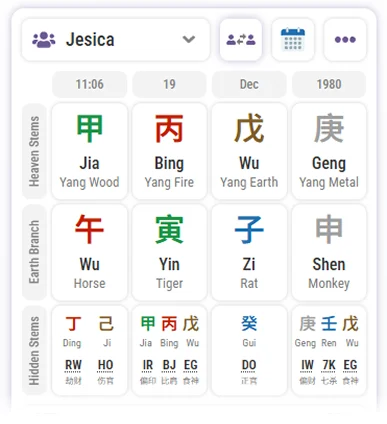
The term Shen Sha (神煞) literally means “gods and killers” — the auspicious and inauspicious symbolic stars respectively. They are a classical layer of Chinese Metaphysics used in BaZi, Zi Wei Dou Shu, and Qimen Dunjia. In BaZi practice they are computed directly from the Heavenly Stems and Earthly Branches of the chart, with no dependence on elemental strength, season, or structural balance. This is what makes them “symbolic”: they are determined by positional formulas, not by the five phases.
Each Symbolic Star is anchored to a foundation point in the chart, most commonly the Day Master (the Heavenly Stem of the Day Pillar) or the Year Branch. Once the anchor is fixed, the reader scans the other branches and stems for the specific combinations that trigger each star. When the trigger appears — perhaps tucked in the hidden stems of a branch, or as a visible stem — the star is considered present in the chart.
There is also a well-known name collision worth clearing up: the Tian Yi Nobleman (天乙贵人), a Symbolic Star in BaZi, is not the same thing as the Tian Yi direction used in Ba Zhai (Eight Mansions) Feng Shui. The feng-shui Tian Yi is a favorable sector of a building tied to the health and healing direction of the home. The BaZi Tian Yi is a person’s protective benefactor star computed from their chart. Both are auspicious, but they live in different systems.
2. How the Symbolic Stars Are Calculated
Every Symbolic Star follows a fixed lookup rule based on an anchor point — usually the Day Master or the Year Branch. The formulas are stable and memorized by practitioners; for any given chart they can be checked by hand in minutes. Below is the general logic, followed by the most common star families.
| Anchor | How It Works | Example |
|---|---|---|
| Day Master (Day Stem) | Look up the Day Master in a reference table; any occurrence of the matching stem or branch elsewhere in the chart triggers the star. | Day Master Yang Wood (甲) triggers the Tian Yi Nobleman when the branches Zi (子) or Chou (丑) appear in any pillar. |
| Year Branch | Used by stars anchored to the birth year rather than the day; common for Peach Blossom and Travel Horse. | Year Branch Zi (子) makes the branch You (酉) the Peach Blossom position. |
| Day Branch | Some stars use the Day Branch as the anchor, particularly in older classical texts. | Wen Chang is keyed off the Day Master in most schools. |
The anchor is always a single reference point, and the result is always a yes/no presence check per pillar: the star is either in the Year, Month, Day, or Hour pillar, or it is not. This binary quality is what makes the Symbolic Stars feel “symbolic” — they do not have degrees of elemental intensity, only presence and location.
Because the anchor is most often the Day Master, a solid grasp of the Ten Heavenly Stems is the prerequisite for using any of the formulas in the next sections.
3. The Auspicious Stars (Good Luck Markers)
The favorable Shen Sha are collectively called “virtue stars” or “noble stars.” They mark areas of natural protection, talent, and support. The following are the most influential and the ones a practical reader checks first.
Tian Yi Nobleman (天乙贵人) — The Protective Benefactor
The most celebrated of all Symbolic Stars, the Tian Yi Nobleman is the star of rescue and assistance. A present Tian Yi is traditionally read as a sign of protection in danger, influential patrons, and the ability to find help at the critical moment. Its formula is anchored to the Day Master:
| Day Master | Tian Yi Trigger Branches |
|---|---|
| Yang Wood (甲) / Yang Earth (戊) / Yang Metal (庚) | Chou (丑) and Wei (未) |
| Yin Wood (乙) / Yin Earth (己) | Zi (子) and Shen (申) |
| Yang Fire (丙) / Yin Fire (丁) | Hai (亥) and You (酉) |
| Yin Metal (辛) | Wu (午) and Yin (寅) |
| Yang Water (壬) / Yin Water (癸) | Mao (卯) and Si (巳) |
The classical mnemonic runs 甲戊庚牛羊 (Jia, Wu and Geng meet the Ox Chou and Goat Wei); 乙己鼠猴乡 (Yi and Ji meet the Rat Zi and Monkey Shen); 丙丁猪鸡位 (Bing and Ding meet the Pig Hai and Rooster You); 壬癸兔蛇藏 (Ren and Gui meet the Rabbit Mao and Snake Si); and 六辛逢马虎 (Xin finds the Horse Wu and Tiger Yin). When a person with present Tian Yi faces hardship, classical texts say a benefactor or unexpected opportunity appears to dissolve the difficulty. Practically, it is used to read timing — when a luck pillar or annual pillar brings the Tian Yi branch, favorable assistance tends to surface that year.
Wen Chang (文昌) — The Literary Star
The Wen Chang star governs intellect, examination success, and eloquence. It is the classic “scholar’s star,” and readers look for it in the charts of students, writers, and academics. Keyed to the Day Master: Yang Wood (甲) sees Wen Chang in Si (巳); Yin Wood (乙) in Wu (午); Yang Fire (丙) and Yang Earth (戊) in Shen (申); Yin Fire (丁) and Yin Earth (己) in You (酉); Yang Metal (庚) in Hai (亥); Yin Metal (辛) in Zi (子); Yang Water (壬) in Yin (寅); Yin Water (癸) in Mao (卯).
Jiang Xing (将星) — The General Star
The Jiang Xing (General Star) bestows leadership, command, and authority. It is anchored to the Year Branch’s Trinity (三合) group: the branches Shen (申), Zi (子) and Chen (辰) all place Jiang Xing in Zi (子); Yin (寅), Wu (午) and Xu (戌) in Wu (午); Si (巳), You (酉) and Chou (丑) in You (酉); and Hai (亥), Mao (卯) and Wei (未) in Mao (卯). It traces the Peach Blossom pattern but reads the centre branch of each Trinity rather than the far one. A strong Jiang Xing is associated with decisiveness and the ability to rally others.
Yue De (月德) and Tian De (天德) — The Monthly and Heavenly Virtues
The Yue De (Monthly Virtue) and Tian De (Heavenly Virtue) stars are protective and illness-averting markers. Tian De is found from the Year or Month Branch and its associated stems; Yue De from the seasonal element cluster. Both are read as softening misfortune and shielding health, making them welcome counters to the inauspicious stars in Section 5.
4. The Neutral and Circumstantial Stars
Not every auxiliary star is purely lucky or purely ill-fated. A large group of Shen Sha — including the famous Peach Blossom and Travel Horse — are neutral by nature: their expression depends entirely on how they sit in the chart and which element supports them. In the right structure these stars are strongly favorable; in a weak or clashing position the same star becomes a source of distraction. This is why experienced readers treat them as circumstantial markers rather than fixed omens.
Tao Hua (桃花) — The Peach Blossom
One of the most famous of the neutral Symbolic Stars, Tao Hua (Peach Blossom) rules romance, attraction, and artistic sensibility. It is anchored to the Year or Day Branch: Zi (子) sees Peach Blossom in You (酉); Chou (丑) in Wu (午); Yin (寅) in Mao (卯); Mao (卯) in Zi (子); Chen (辰) in You (酉); Si (巳) in Wu (午); Wu (午) in Mao (卯); Wei (未) in Zi (子); Shen (申) in You (酉); You (酉) in Wu (午); Xu (戌) in Mao (卯); Hai (亥) in Zi (子). Because it is a neutral star, Tao Hua’s reading depends entirely on context: well-placed and supported, it confers charm, artistic flair and relational magnetism; in excess, or inside a pillar already under stress, it is read as romantic turbulence and distraction. Its position in the Hour Pillar is traditionally considered the most relationship-sensitive placement.
Yi Ma (驿马) — The Travel Horse
The Yi Ma (Travel Horse) star signals movement, relocation, and frequent change. It is a neutral, dynamic marker — favorable for careers that depend on motion, transport, trade and travel, and demanding for those who prefer stillness. It is determined from the Year or Month Branch’s Trinity group: for the branches Zi, Chen, and Shen the Travel Horse is Yin (寅); for Chou, Si, and You it is Hai (亥); for Yin, Wu, and Xu it is Shen (申); for Mao, Wei, and Hai it is Si (巳). People with a prominent Yi Ma often work across distances, change residences, and thrive in transport, trade, or international fields.
Hua Gai (华盖) — The Flower Canopy
The Hua Gai (Flower Canopy) is a neutral star of the lone scholar and the spiritual recluse. It is found in the same Trinity-based lookup as the general: the branch that is four places (through the Trinity) ahead of the Year and Month branch. Hua Gai people tend to be introspective, drawn to metaphysics, art, and solitude, and often need quiet to function at their best. It pairs frequently with Wen Chang in the charts of researchers and mystics.
5. The Inauspicious Stars (Affliction Markers)
A smaller set of Shen Sha are genuinely unfavorable. They are not curses — they highlight stress points and vulnerabilities that, once recognized, can be managed. A chart with no inauspicious star at all is rare and arguably flat; the afflictions create the friction that drives growth, and classical readers check them to anticipate the rough edges of a life.
Yang Ren (阳刃) — The Yang Blade
The Yang Ren (Yang Blade) is a potent and aggressive star that exists only on Yang Day Masters: Yang Wood (甲) sees it in Mao (卯); Yang Fire (丙) and Yang Earth (戊) in Wu (午); Yang Metal (庚) in You (酉); and Yang Water (壬) in Zi (子). It marks raw drive, courage and combativeness — exceptional for high-pressure careers, sport and surgery, but volatile when mismanaged. Classical readers call it a double-edged sword: with strong structure it drives decisive leadership; without discipline it tips into rashness. It is read as a high-energy neutral-leaning star rather than a straightforward affliction.
Gu Chen (孤辰) and Gua Su (寡宿) — Loneliness and Solitude
The pair Gu Chen (Solitary Star) and Gua Su (Widowhood Star) are markers of emotional isolation. They are computed from the Year Branch’s Trinity group, falling into predictable positions. Their presence does not doom relationships — it indicates a temperament that values independence and may need conscious effort to sustain closeness. In balance they support self-reliance; in excess they tip into withdrawal.
6. How to Find Your Symbolic Stars and Use Them
The quickest path to your own Symbolic Stars is practical: generate your BaZi chart, note your Day Master and Year Branch, then scan the formulas in Sections 3, 4 and 5 to see which triggers appear in your four pillars. A star is “present” when its trigger branch shows up in any pillar; its position — Year, Month, Day, or Hour — tells you the life domain it governs.
Year Pillar positions reflect inherited environment and early life; Month Pillar reflects career and the social phase; Day Pillar reflects the self and intimate partnerships; Hour Pillar reflects later years, children, and the private sphere. A star in the Hour Pillar, for instance, exerts its strongest influence in maturity.
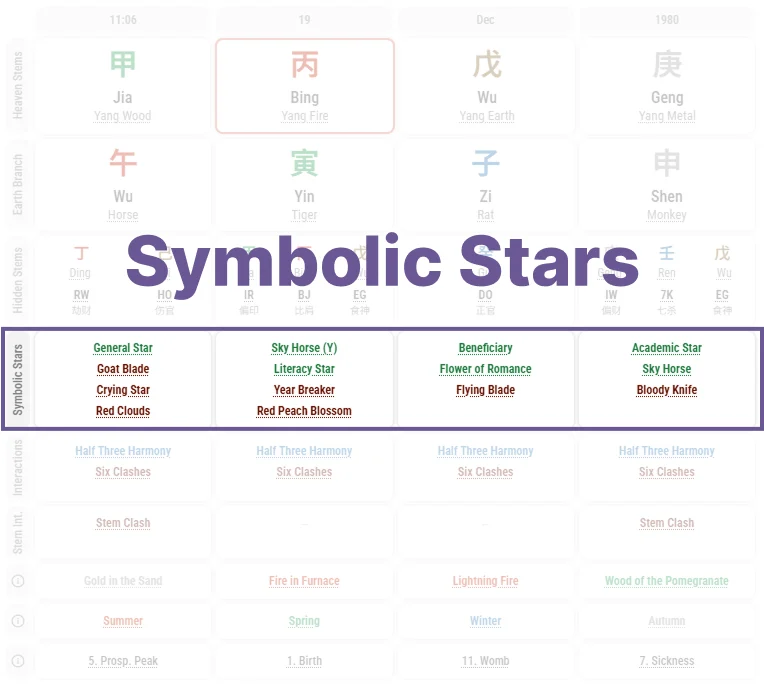
Because the stars are keyed to triggers that recur in the Earthly Branches, they also become timing tools: when the branch of a star appears in an annual pillar or luck pillar, that period activates the star’s theme. A Tian Yi-bearing year is a year of favorable assistance; a Peach Blossom-bearing year attracts romance; a Travel Horse-bearing year often brings relocation or long journeys. This makes the Symbolic Stars one of the most tractable forecasting layers in the whole chart.
For the spatial side of support, the stars can be balanced through the environment as well — for example by reinforcing the relevant element in the Feng Shui of your home. As always, treat the chart as information, not verdict: it shows the weather; you choose the umbrella.
7. Symbolic Stars vs. Flying Stars vs. Personal Direction Stars
The term “star” appears across several distinct systems in Chinese Metaphysics, and conflating them is a common source of confusion. The table below separates the three meanings a student will actually meet.
| System | What They Are | Base | Domain |
|---|---|---|---|
| Symbolic Stars (Shen Sha) | Quality tags like Tian Yi, Peach Blossom, Wen Chang | Day Master / Year Branch formulas | Natal BaZi — the person |
| Flying Stars | Numbered stars 1–9 that rotate through sectors | Lo Shu square and period/construction date | Feng Shui — the home and time |
| Ba Zhai / personal direction stars | Tian Yi, Sheng Qi, Fu Wei and other favorable sectors for a person | Kua number of the individual | Ba Zhai — direction guidance |
A common error: reading the numbered One White (1) or Two Black (2) Flying Stars and treating them as if they were personal BaZi stars. They are not — the One White belongs to the spatial chart of a building, the Tian Yi Nobleman belongs to a person’s birth chart. Likewise, the Tian Yi healing direction is a sector of the home, not the benefactor star. Using each system in its own layer is what separates clear practice from muddle.
8. Interpreting the Stars Responsibly
Three principles keep the Symbolic Stars useful rather than superstitious. First, presence is not destiny: a Peach Blossom star does not force infidelity, and a Tian Yi does not guarantee rescue — both describe tendencies that unfold through the person’s choices. Second, stars combine with structure: a favorable star inside a weak or clashing pillar behaves very differently from the same star sitting in a strong one, which is why the elemental analysis of the chart always takes precedence. Third, stars are a layer, not the whole map: they refine and color a reading guided first by the BaZi framework, the Five Elements, and the Ten Gods.
Treated this way, the Symbolic Stars become one of the most practical parts of a chart. They are easy to verify, they map cleanly onto life domains, and they give the reader and the person being read a shared vocabulary for the recurring themes of a life — protection, talent, movement, romance, and solitude.
Generate Your Own Chart
Ready to see which Symbolic Stars appear in your BaZi? Generate your full chart with the Baguame BaZi calculator, note your Day Master and Year Branch, and apply the formulas above to find your Tian Yi, Wen Chang, Peach Blossom, Travel Horse, and the rest. The chart also shows the elemental structure, Ten Gods, and luck pillars you need to put the stars in context.
Frequently Asked Questions
The Symbolic Stars (神煞, Shen Sha), also called Star Gods or Noble Stars, are a layer of the BaZi chart computed from the Heavenly Stems and Earthly Branches rather than from elemental balance. They act as quality tags attached to pillars — markers such as the Tian Yi Nobleman, Peach Blossom, and Wen Chang that highlight protection, romance, scholarship, and other life themes. See the BaZi guide for the underlying framework.
Symbolic Stars belong to a person’s natal BaZi chart and are computed from the Day Master and Year Branch. Flying Stars are numbered stars 1–9 that rotate through the sectors of a home on the Flying Star chart and describe spatial energy. One is about the person (BaZi), the other about the environment (Feng Shui). They share the word “star” but are separate systems.
The Tian Yi Nobleman is anchored to your Day Master. For example, if your Day Master is Yang Wood (甲), Yang Earth (戊) or Yang Metal (庚), the star triggers when the branches Chou (丑) or Wei (未) appear anywhere in your four pillars. Look up your Day Master in the Tian Yi table, then scan your Year, Month, Day, and Hour branches for the matching triggers.
Peach Blossom (桃花, Tao Hua) is the neutral star of romance, attraction, and artistic flair. It is anchored to the Year or Day Branch by Trinity group — for a Zi (子), Shen (申) or Chen (辰) branch the Peach Blossom is You (酉), and so on. In balance it confers charm and magnetism; in excess or poor structure it is read as romantic turbulence. Its Hour Pillar placement is traditionally seen as the most relationship-sensitive.
Yes — it is entirely possible for a chart to lack a particular star, and even to have neither a strong auspicious nor inauspicious marker in a given pillar. This is normal and not a flaw. The absence of one star simply means that life domain is not emphasized by the symbolic layer; the elemental structure of the chart still carries the reading.
Because each star is keyed to recurring Earthly Branch triggers, when that branch appears in an annual or luck pillar the star’s theme activates. A Tian Yi-bearing year brings favorable assistance, a Peach Blossom year attracts romance, a Travel Horse year often brings relocation. This makes the stars a practical, verifiable timing layer within the broader Earthly Branches system.
They share a name but belong to different systems. The BaZi Tian Yi Nobleman is a personal benefactor star computed from your Day Master. The feng-shui Tian Yi is a favorable healing sector of a building tied to the Kua number in Ba Zhai — see the Tian Yi feng-shui guide. Both are auspicious, but one speaks about the person and the other about a direction in space.