
Yang Water (壬 Ren) — The Ninth Heavenly Stem
Yang Water, written 壬 and pronounced Ren, is the ninth of the Ten Heavenly Stems and the first of the two Water stems. It represents the most expansive, untamed expression of the Water element — the open ocean, the great river, the deep sea that has no visible shore. In the natural world, Ren is not a stream or a lake. It is the vast body of water that moves on its own terms, contains unknown depths, and cannot be fully mapped or controlled.
Core Identity
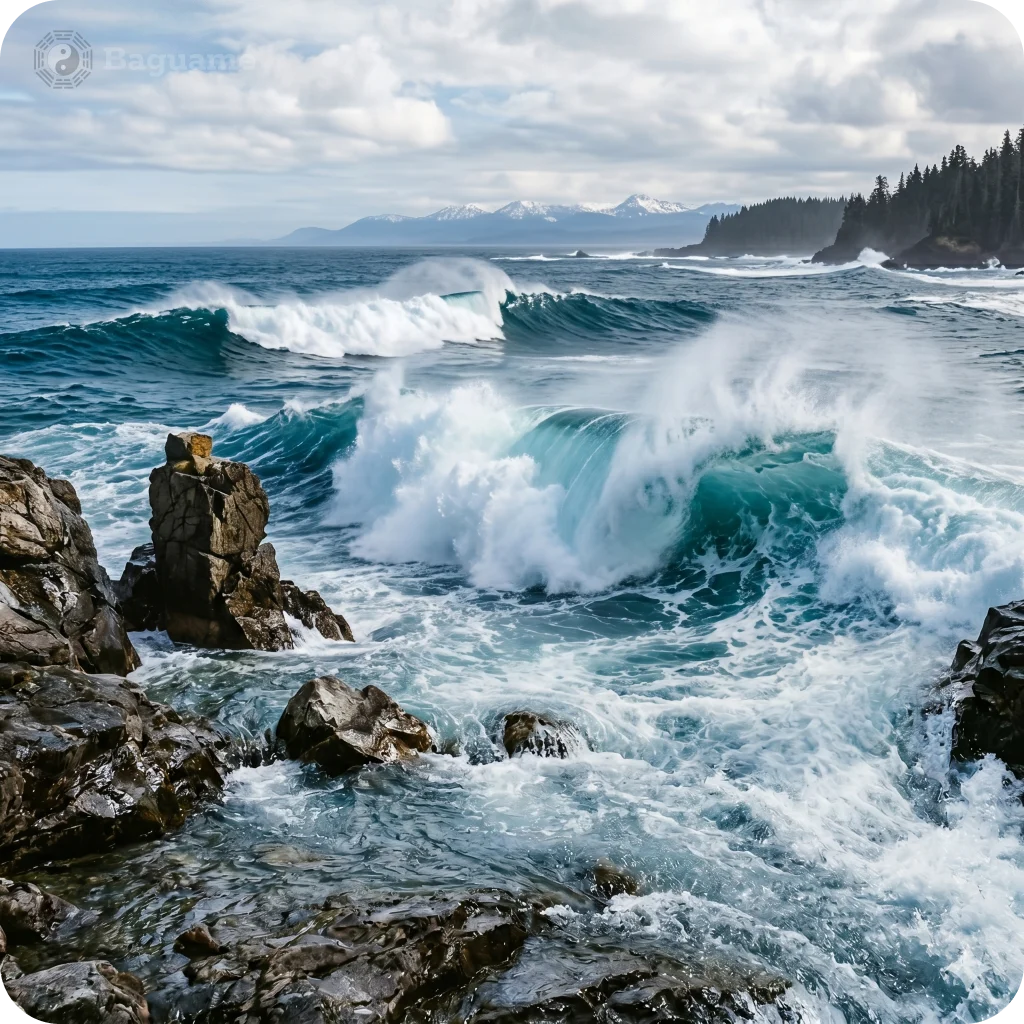
Ren is pure Yang energy within the Water element — expansive, flowing, and deeply intelligent. In contrast to Yin Water (癸 Gui), which is the gentle rain or morning dew, Yang Water is the ocean: powerful, all-encompassing, and moving according to its own internal logic. Furthermore, where Gui is still and collected, Ren is always in motion.
In classical texts, Ren is associated with wisdom, adaptability, and an almost limitless capacity for strategy. Ren people do not fight obstacles directly — they flow around them, absorb them, or wait for the right moment to overwhelm. In practice, this makes them exceptionally effective in environments that reward flexibility, pattern recognition, and long-term thinking.
Key Attributes at a Glance
Element
Water (Yang)
Natural Image
Ocean · Great River · Sea
Season / Direction
Winter · North
Polarity
Yang (odd)
The Five Element Relationships
Understanding Ren requires mapping it against all five elements. The interactions below form the foundation of BaZi analysis when Yang Water appears in any pillar.
Metal Produces Water (生)
Producing element. Metal (庚 Geng, 辛 Xin) generates Ren and acts as its resource. For Yang Water people, strong Metal in the chart means reliable support, mentor figures, and access to structure and resources. In particular, Geng Yang Metal is the preferred source — a mountain spring feeding a great ocean, steady and abundant.
Wood Drains Water (泄)
Output element. Wood (甲 Jia, 乙 Yi) is produced by Water and acts as Ren’s output. Wood represents the creative expression, subordinates, and legacy of Yang Water. Furthermore, Jia Yang Wood is the ideal output — a towering tree drinking from a great river, ambitious and upward-reaching. In a well-balanced chart, strong Wood output channels Ren’s energy productively.
Water — Same Element (比)
Parallel / Companion. Other Water stems (Ren or Gui) share the pillar. Too much Water creates a flood — direction is lost, focus dissolves, and the chart becomes difficult to read clearly. That said, a second Ren or a Gui companion can deepen intelligence and adaptability when Earth is present to contain the flow. Balance depends critically on the presence of controlling or directing elements.
Earth Controls Water (克)
Controlling element. Earth (戊 Wu, 己 Ji) restrains Ren. In a balanced chart, Earth as the Officer or Power star provides direction, discipline, and career structure. However, for Yang Water, too much Earth creates a dam — movement stops, the water stagnates, and vitality is suppressed. In classical analysis, Wu Yang Earth is the preferred controller: a great dam holding the ocean.
Water Extinguishes Fire (克)
Dominated element. Fire (丙 Bing, 丁 Ding) is dominated by Water. In BaZi, Fire represents Wealth for Ren. Yang Water people are naturally drawn to visibility, recognition, and the brilliance that Fire represents. As a result, Bing Yang Fire is the most celebrated Wealth target — the ocean reflecting the sun, creating the famous 壬丙 combination of brilliance and fame.
The Ocean and the Sun
The most celebrated pairing in classical BaZi: 壬 Ren (Yang Water, Ocean) with 丙 Bing (Yang Fire, Sun). When these two appear together — especially in adjacent pillars — the ocean reflects the sun and creates extraordinary brilliance. Consequently, this combination appears frequently in the charts of public figures, performers, and people whose intelligence becomes widely visible. It is one of the most discussed pairings in the entire Ten Stems framework.
Personality Traits
The ocean metaphor is not decorative — it is the most precise description of how Yang Water energy expresses through a person. Ren is not simply “smart” or “flexible.” It is a specific quality of intelligence: vast, deep, always in motion, and governed by its own internal tides.
Strengths
- Strategic depth. Ren people think in systems and patterns. In particular, they excel at absorbing large amounts of information, finding connections others miss, and positioning themselves advantageously over time.
- Adaptability. Water takes the shape of whatever contains it. Consequently, Ren people navigate changing environments with exceptional ease — they do not resist, they adjust.
- Charisma of depth. The ocean draws people in. Moreover, Ren people carry a quality of mystery and gravitational pull that is difficult to define but impossible to ignore in person.
- Endurance. Water wears down stone not by force but by persistence. As a result, Ren people often achieve goals that seem impossible through sustained, patient effort over long periods.
- Intuition. Yang Water has a natural sense of the unseen — undercurrents, hidden motivations, what is not being said. This perceptiveness gives Ren a significant advantage in complex social and professional situations.
Challenges
- Restlessness. The ocean is never still. In many cases, Ren people struggle with sustained focus on a single task — they are drawn to the next thing before the current one is finished.
- Manipulation risk. Water flows around obstacles rather than confronting them directly. However, this adaptability can shade into indirectness, deflection, or — at its worst — manipulation.
- Overabundance. Too much water floods everything. For this reason, Ren people without grounding (Earth in the chart, structure in life) can become scattered, inconsistent, or overwhelming to those around them.
- Emotional opacity. The ocean’s depths are hidden. Consequently, Ren people often find it difficult to express what they actually feel, creating distance in close relationships over time.
- Avoidance of confrontation. Water finds the path of least resistance — which is not always the right path. Above all, Ren people must learn to hold a position rather than always flowing around difficulty.
Ren in the Four Pillars
The position of 壬 in the BaZi chart significantly changes its expression. The same stem carries different meaning depending on whether it sits in the Year, Month, Day, or Hour pillar.
| Pillar | Domain | Expression of Yang Water |
| Year (年) | Ancestors, social environment, early life | Intellectual or mobile family background; early environment characterized by change, travel, or exposure to diverse ideas and people |
| Month (月) | Career, parents, prime years (20–40) | Career built on intelligence, strategy, and adaptability; excels in roles requiring systems thinking, research, or navigation of complex environments |
| Day (日) | Self, spouse palace | Day Master — defines core character as described above. Spouse palace suggests a partner who is grounding, structured, or provides the Earth energy that contains the ocean |
| Hour (时) | Children, later life, hidden thoughts | Perceptive or independent children; late-life wisdom and philosophical depth; inner world driven by a constant search for meaning beneath the surface of events |
Ren as Day Master — the Ocean Identity
When 壬 is the Day Master, the entire chart is read relative to the ocean. The key questions are: how contained is the water, what does it reflect, and where is it flowing? You can calculate your own chart using the Baguame BaZi calculator.
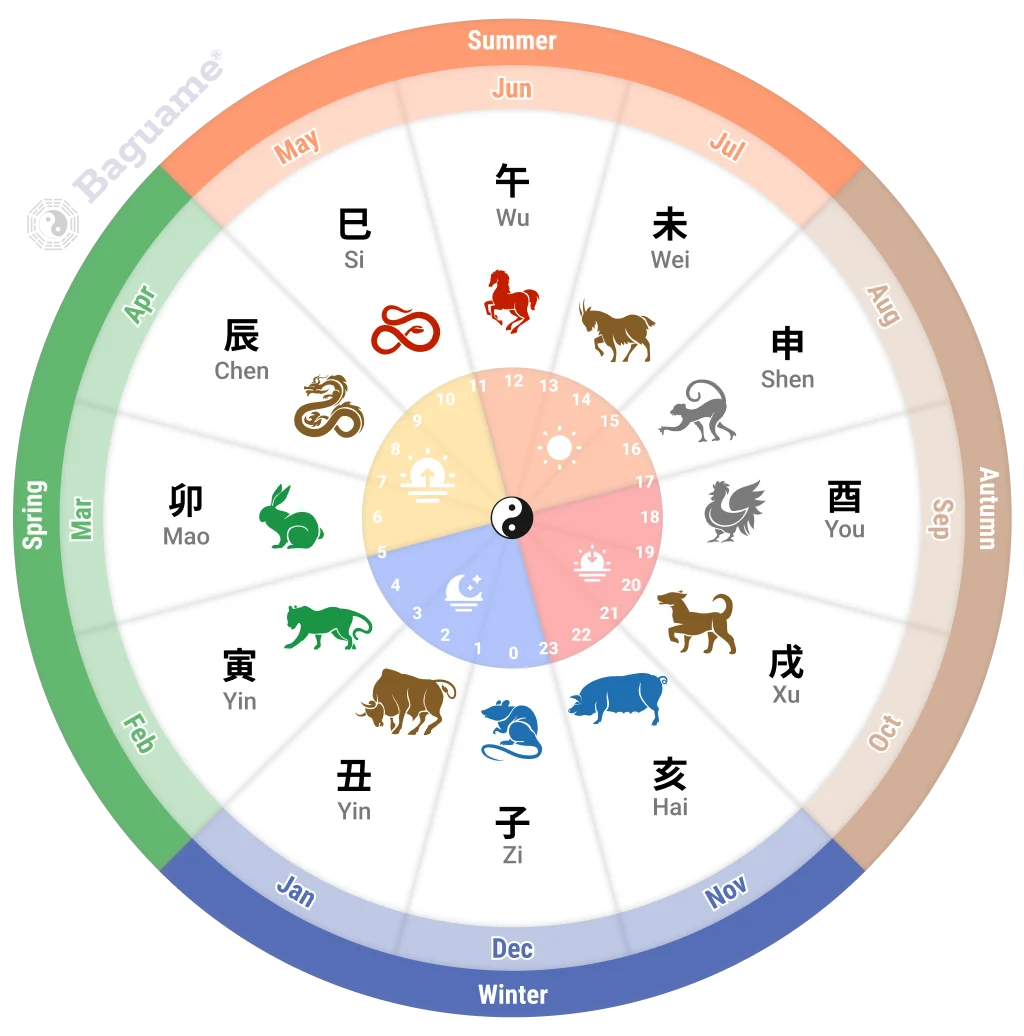
The central question for a Ren Day Master chart is: is the ocean contained and purposeful, or is it flooding everything around it? Season determines the starting point.
Winter (亥 Hai · 子 Zi · 丑 Chou)
Ren in its home season — Water is at its strongest. Consequently, this chart needs significant Earth or Fire to provide direction and warmth. Without them, the water is too cold and too vast. That said, a winter Ren with strong Wu Earth and Bing Fire is one of the most powerful BaZi configurations in classical analysis.
Summer (巳 Si · 午 Wu · 未 Wei)
Fire dominates the season, which activates Ren’s Wealth energy. As a result, summer Ren charts tend to be strongly wealth-oriented — the ocean reflecting the summer sun. However, the chart must ensure Water is not completely evaporated by excessive Fire; Metal resource is important to replenish the flow.
Spring (寅 Yin · 卯 Mao · 辰 Chen)
Wood output season — the ocean feeds forests of growth. In this configuration, Ren’s energy flows outward into expression, creativity, and influence. Furthermore, spring is an excellent time for Ren to build and expand, as the output energy is naturally productive and the chart tends toward action rather than reflection.
Autumn (申 Shen · 酉 You · 戌 Xu)
Metal produces Water, making autumn the resource season for Ren. Overall, this is a replenishing configuration — the chart receives strong support from Metal, building reserves and deepening intelligence. In particular, Geng Yang Metal in autumn strengthens Ren’s capacity for sustained strategic work.
Special Combinations Involving Ren
壬丁合 — Ren + Ding Combination
Yang Water and Yin Fire (丁 Ding) form a Heavenly Stem combination — one of the six stem combinations (天干合, Tiangan He). When these two meet, their energies merge and — if Wood season supports it — can transform into Wood. In classical interpretation, this is the ocean holding a candle: depth meeting precision, vastness meeting focus. Furthermore, this combination often produces people with extraordinary emotional intelligence and a rare capacity to connect with others on multiple levels simultaneously.
壬丙对冲 — Ren vs. Bing Clash
Yang Water and Yang Fire (丙 Bing) are in direct opposition — a Heavenly Stem clash (天干冲). This is the ocean meeting the sun in conflict rather than harmony. The result depends on the balance of the chart: if one element overwhelms the other, the weaker is damaged. However, when both are equally represented, there is dynamic tension — brilliance and depth in constant productive competition. As a result, this clash in Luck Pillars often brings dramatic visibility, public exposure, or direct confrontation with powerful figures.
Ren in Feng Shui and Annual Stars
Beyond BaZi, 壬 appears in Flying Stars and annual cycle analysis. Understanding its directional and temporal associations adds a practical layer to Feng Shui work with Water energy.
Direction
Ren corresponds to a specific mountain in the North sector of the 24 Mountains system (壬 mountain, 337.5°–352.5°). This is the leading edge of the North — the beginning of the Water zone. Activating the Ren sector brings expansive Yang Water energy into a space, supporting intellectual work, strategy, and long-range planning.
Annual Cycle
The 壬 year carries heightened Yang Water energy — expansive, intelligent, and fast-moving. Historically, 壬 years tend to bring significant shifts in information, communication, and strategy at a collective level. For individuals whose charts are strengthened by Water, 壬 years represent periods of accelerated learning, expanded networks, and new strategic opportunities.
24 Mountains
In the 24 Mountain system, Ren mountain carries the qi of Yang Water. A main door or sitting direction aligned to 壬 brings intelligent, flowing Water energy into the environment. The North sector overall is governed by the Kan trigram (☵), which represents depth, danger, and the hidden potential that lies beneath the surface.
Summary
Yang Water 壬 Ren is one of the most intellectually powerful stems in the Ten Heavenly Stems — vast, deep, adaptive, and always in motion. The ocean is not simply a metaphor; it is the most precise image for how this stem operates. Specifically, Ren does not force or push — it moves, surrounds, reflects, and ultimately shapes everything it touches through sustained, intelligent persistence.
In BaZi, a strong Ren Day Master chart belongs to someone built for strategic depth and long-range influence. However, the key is always containment — an ocean without a shoreline has no purpose. The ideal chart provides Earth to give direction, Fire to illuminate, and Metal to keep the water fresh and flowing.
Furthermore, understanding 壬 is foundational to reading Water-dominant charts, the famous Ren-Bing brilliance combination, and north-sector Feng Shui activations — including the Eight Trigrams that govern each directional zone. Overall, Ren represents the full depth of what Water can be when it is given the right container. Explore all Ten Heavenly Stems or open the BaZi calculator to see where 壬 Ren appears in your own chart.
Frequently Asked Questions
Yang Water 壬 Ren represents the ocean — the most expansive and intelligent form of Water energy. In BaZi, it is the ninth Heavenly Stem. People born with Ren as their Day Master tend to be deeply strategic, highly adaptable, and perceptive in ways that often surprise others. Like the ocean, they contain depths that are rarely fully visible on the surface.
Yang Water (Ren) is the ocean or great river — vast, expansive, and always in motion. Yin Water (Gui) is the rain, morning dew, or underground spring — gentle, nourishing, and internalized. In practice, Ren people tend to be more outwardly engaging and socially expansive, while Gui people are often more introspective, sensitive, and quietly persistent. Both carry deep intelligence, but they express it differently.
For a Ren Day Master, Wu Yang Earth (戊) as the Officer star is the most important structural element — it provides direction and containment. Additionally, Bing Yang Fire (丙) as the Wealth star creates the celebrated ocean-sun pairing. Metal as a resource keeps the water replenished. Without Earth, even a brilliant Ren chart lacks focus and can become scattered or unfocused.
The 壬丙 pairing — Yang Water and Yang Fire in the same chart — is one of the most celebrated combinations in classical BaZi. However, it is not automatically positive. When both elements are balanced and the chart has enough structure, this combination creates brilliance, public visibility, and fame. When Fire overwhelms Water (or vice versa), the result is instability. Context and balance always determine the outcome in BaZi analysis.
Ren (Yang Water) and Ding (Yin Fire) form one of the six Heavenly Stem combinations (天干合). When these two appear adjacent in a chart, their energies merge. If the seasonal qi of Wood is present, this combination can transform into Wood. On a character level, this pairing often produces people who combine vast emotional capacity (Ren) with precise, focused warmth (Ding) — a rare and powerful combination of depth and intimacy.