
Ox (丑 Chou): The Second Earthly Branch, Element & Interactions
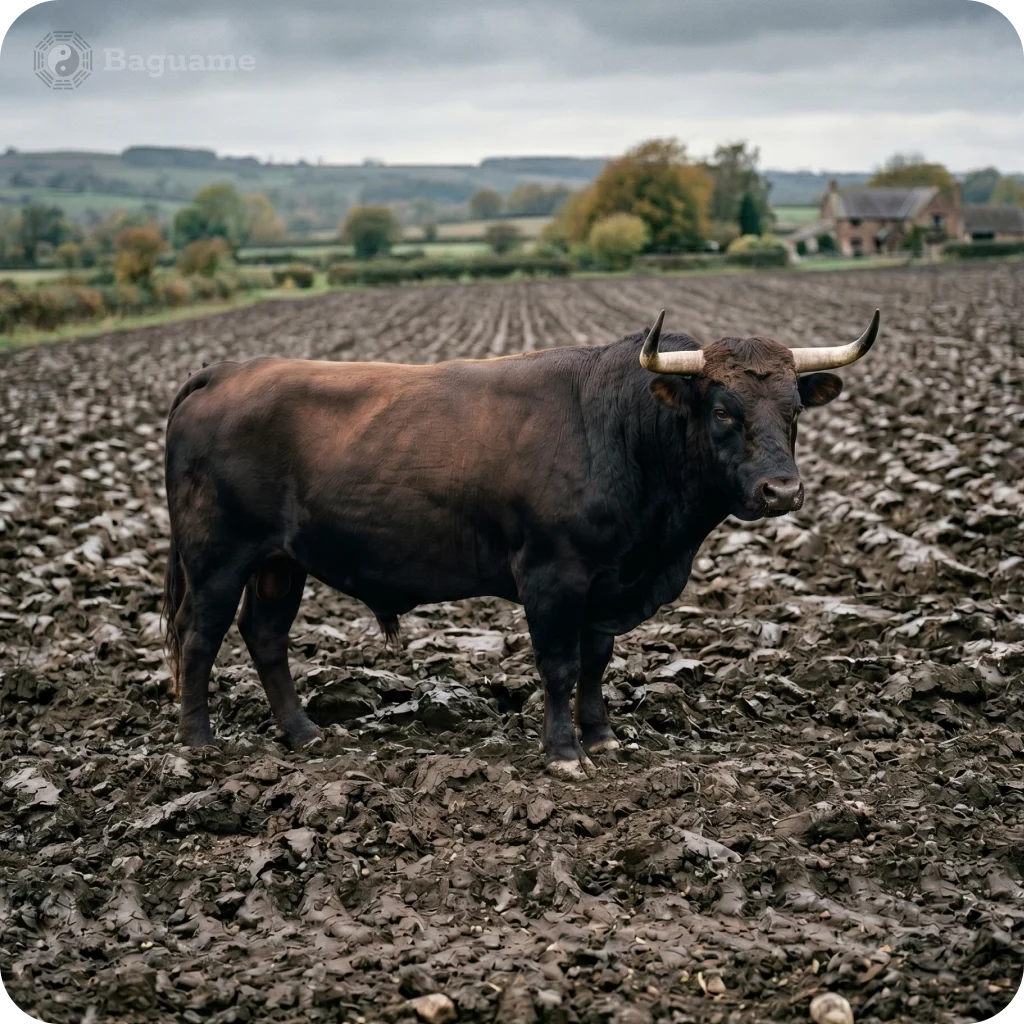
丑 Chou is the second of the 12 Earthly Branches and the closing branch of Winter. Where 子 Zi (Rat) marks the peak of Water energy at the Winter Solstice, Chou represents Winter’s final exhale — the frozen ground holding everything in place before Spring breaks through. Its element is Earth, its polarity is Yin, and its zodiac animal is the Ox.
In BaZi (Four Pillars of Destiny), Chou is one of the most complex branches in the system — it contains three hidden Heavenly Stems, carries strong seasonal Water energy despite being an Earth branch, and participates in multiple powerful combinations. Understanding Chou is essential for accurate chart reading.
| Attribute | Value |
| Chinese Character | 丑 |
| Romanization | Chou |
| Position in Cycle | 2nd of 12 |
| Polarity | Yin |
| Element | Earth |
| Zodiac Animal | Ox |
| Season | Late Winter |
| Solar Month | 12th month (approx. January) |
| Hours | 01:00 – 03:00 |
| Direction | NNE (30°) |
| Principal Hidden Stem | 己 Ji (Yin Earth) — 60% |
| Middle Hidden Stem | 癸 Gui (Yin Water) — 20% |
| Residual Hidden Stem | 辛 Xin (Yin Metal) — 20% |
Hidden Stems: Three Layers Inside Chou
Unlike Zi (Rat), which contains only one hidden stem, Chou holds three — making it one of the most layered branches in the entire system. Each stem carries a different weight and activates under different conditions.
己 Ji — Yin Earth (60%)
The Principal Qi of Chou. 己 Ji is the soft, moist earth of farmland and garden soil — receptive, fertile, and capable of absorbing and transforming whatever enters it. It is the dominant force in Chou and defines the branch’s core character: patient, grounded, accumulating. Ji Earth is also the element that gives Chou its reputation for quiet strength — it does not push, it holds.
癸 Gui — Yin Water (20%)
The Middle Qi of Chou. 癸 Gui — the same Yin Water that fills Zi (Rat) entirely — is still present in Chou, a remnant of the Winter season not yet fully absorbed. This hidden Water makes Chou a powerful node in the Seasonal Water Frame (Hai–Zi–Chou) and explains why Chou, despite being an Earth branch, amplifies Water when it combines with other Winter branches.
辛 Xin — Yin Metal (20%)
The Residual Qi of Chou. 辛 Xin is the refined, precious metal — jewelry, blades, instruments of precision. Its presence in Chou adds a quality of discernment and refinement beneath the surface. In chart analysis, this hidden Metal means Chou can serve as a resource for Metal Day Masters, and can produce Water through the Metal→Water generating cycle when activated.
Elemental Nature and Symbolic Meaning
Chou sits between the depths of Winter and the first stirrings of Spring. The ground is still frozen, but beneath it — invisible to the eye — roots are shifting and seeds are preparing. This in-between quality defines Chou’s symbolic character: it is the transitional Earth, the storehouse of energy that has not yet found its form.
In the cycle of the Five Elements, Earth at its Yin peak is dense, heavy, and cold. Unlike the warm, productive Earth of summer (Wei, 未), Chou’s Earth is frost-hardened — strong enough to contain, but not yet ready to yield. The Ox as its animal embodies this perfectly: slow, immovable, enduring. The Ox does not hurry. It carries what others cannot and outlasts what others give up on.
In classical Feng Shui, the NNE direction (30°) where Chou sits on the compass falls within the territory of the Gen Trigram (☶ Mountain) — stillness, accumulation, and the boundary between cycles. The 24 Mountains Luo Pan divides this zone into three 15° segments: 子 Zi, 丑 Chou, and 己 Ji — with Chou occupying the central 15° of NNE (22.5°–37.5°).
Branch Interactions
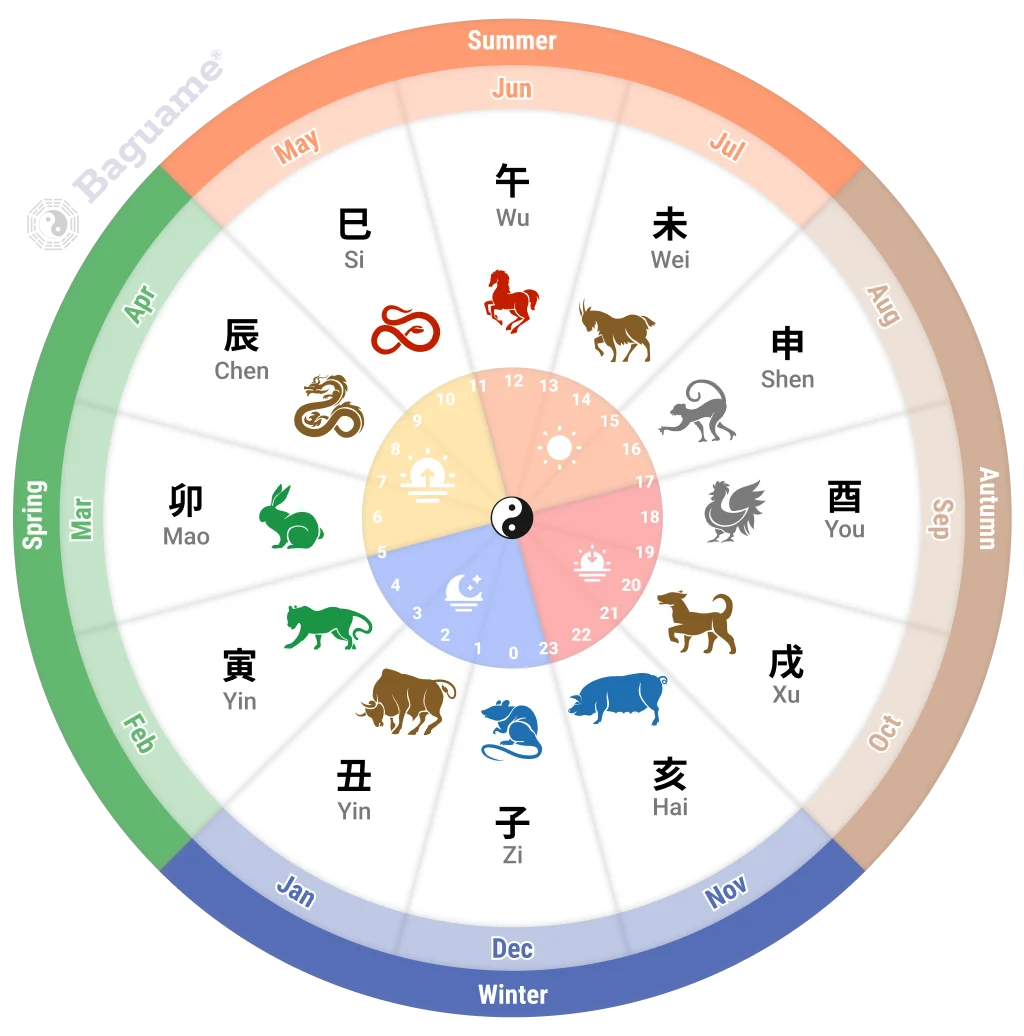
Chou is one of the most interaction-rich branches in the system. It participates in a Six Combination, two major multi-branch combinations, a direct clash, a punishment, and a harm. In BaZi analysis, understanding which interactions are active in a chart is essential to reading Chou correctly.
Six Combination (六合): Chou + Zi → Earth
丑 Chou combines with 子 Zi (Rat) to produce Earth energy. This is a stabilizing interaction: the pure Water of Zi is absorbed and grounded by Chou’s Yin Earth. The combination neutralizes Zi’s Water contribution to the chart and transforms it into something more structured. When both branches appear in the same chart, this combination often moderates excess Water — or, conversely, weakens a chart that needs Water.
Three Combination (三合): Si + You + Chou → Metal Frame
巳 Si (Snake), 酉 You (Rooster), and 丑 Chou form the Metal Three Combination (三合金局). Chou acts as the closing node — its hidden 辛 Xin Metal is what allows it to anchor this combination. When all three are present, Metal energy is dramatically amplified across the chart. Even a partial combination (Si–Chou or You–Chou) produces measurable Metal strengthening.
Seasonal Combination (三會): Hai + Zi + Chou → Water Season
亥 Hai (Pig), 子 Zi (Rat), and 丑 Chou form the Seasonal Water Frame — the three branches of Winter. Despite being an Earth branch, Chou’s hidden 癸 Gui Water enables it to participate in this combination. The Seasonal Frame is considered stronger than the Three Combination when all three branches are present together, producing intense and difficult-to-moderate Water energy.
Six Clash (六沖): Chou ↔ Wei
丑 Chou (Yin Earth) clashes directly with 未 Wei (Goat) — also Yin Earth, but belonging to Summer. This is an Earth–Earth clash between two opposing seasons: the frozen earth of Winter versus the dry, hot earth of midsummer. The clash destabilizes both branches, scattering their hidden stem energy and generating instability in the areas of life they govern. A Chou–Wei clash can be particularly disruptive because both branches contain multiple hidden stems — more elemental energy is in play when they collide.
Punishment (刑): Chou → Xu → Wei — Bullying Punishment
丑 Chou, 戌 Xu (Dog), and 未 Wei (Goat) form the three-branch Bullying Punishment (恃勢之刑) — the three Yin Earth branches in a mutual punishment cycle. Unlike a clash, this punishment is a slow, grinding friction between branches that share the same element but different seasonal energies. It tends to manifest as stubbornness, entrenched conflict, and situations where effort produces no visible result. Even two of the three branches can produce partial punishment effects.
Harm (害): Chou ↔ Wu
丑 Chou and 午 Wu (Horse) form a Harm relationship (六害). This is a quiet, corrosive incompatibility rather than an open conflict. The cold Yin Earth of Chou and the blazing Yang Fire of Wu do not clash directly — they undermine each other slowly, creating an environment of subtle friction, misunderstandings, and draining interactions in the areas of life these branches govern.
Chou in the BaZi Chart: Four Pillar Positions
The meaning of Chou shifts depending on which pillar it occupies in a BaZi chart. Use the Baguame BaZi calculator to identify where Chou appears across your Year, Month, Day, and Hour pillars.
Year Pillar
Relates to ancestry, social environment, and early life. Chou in the Year Branch suggests a background of discipline, structure, and quiet endurance. The family or social environment may have placed high value on persistence and reliability over speed or brilliance.
Month Pillar
Reflects career context and the adult working environment. Chou in the Month Branch often indicates a career path built through slow, steady accumulation — fields requiring precision, endurance, or the management of resources and assets. Finance, agriculture, real estate, and craftsmanship are natural domains.
Day Pillar
Describes the self and closest relationships. Chou as a Day Branch indicates a person whose core nature is grounded, methodical, and deeply reliable — but also one who can be inflexible and resistant to change. In relationships, loyalty runs deep; so does the tendency to hold on long after it is wise to let go.
Hour Pillar
Governs later life, children, and the inner world of thoughts. Chou in the Hour Branch places Earth’s accumulating energy in the realm of private intention — a person who plans carefully and for the long term, often pursuing goals that only pay off decades later.
Chou as a Time Marker: Month, Hour, and Direction
Chou Month
Chou governs the 12th lunar month — the final month of Winter (approximately January 6 – February 3 in the solar calendar). This is the period between the Winter Solstice and the Start of Spring (立春 Li Chun), when Yang energy is slowly building but the world is still frozen. Chou month energy favors patience, consolidation, and the final preparations before the new cycle begins with the Tiger month.
Chou Hour
Chou governs the hours from 01:00 to 03:00 — the deepest, darkest part of night. In classical Chinese timekeeping this double-hour follows the Zi hour (midnight) and precedes the Yin (Tiger) hour at 03:00. Births in this window are recorded as the Chou Hour in a BaZi chart. It is associated with deep rest, the unconscious mind, and hidden accumulation.
Chou Direction: NNE
Chou corresponds to NNE at 30° on the compass, within the sector of the Gen Trigram (☶ Mountain) in classical Feng Shui. On the 24 Mountains Luo Pan, this area divides into: 子 Zi (North), 丑 Chou (NNE, central 15°: 22.5°–37.5°), and 己 Ji. In Flying Stars analysis, activating or disturbing the Chou mountain can affect the hidden stem energies associated with it — particularly relevant when assessing the NNE sector of a Flying Stars natal chart.
Ox Years in the 60-Year Cycle: Wood, Fire, Earth, Metal, Water Ox
In the BaZi calendar, every Ox year pairs 丑 Chou with a different Heavenly Stem. Because Chou is a Yin Branch, it always pairs with Yin Stems — completing its full cycle of 5 variations every 60 years.
| Stem + Branch | Name | Stem Element | Recent Years |
| 乙丑 | Wood Ox | 乙 Yi — Yin Wood | 1925, 1985, 2045 |
| 丁丑 | Fire Ox | 丁 Ding — Yin Fire | 1937, 1997, 2057 |
| 己丑 | Earth Ox | 己 Ji — Yin Earth | 1949, 2009, 2069 |
| 辛丑 | Metal Ox | 辛 Xin — Yin Metal | 1961, 2021, 2081 |
| 癸丑 | Water Ox | 癸 Gui — Yin Water | 1973, 2033, 2093 |
| Note: Chou always pairs with Yin Stems only (乙, 丁, 己, 辛, 癸) — Yin Branch pairs with Yin Stem. There is no Yang Stem Ox year. | |||
Ox Symbolism and Character in Chinese Culture
The Ox is one of the most universally respected animals in the Chinese zodiac — not for speed or cleverness, but for something rarer: the capacity to work without complaint, carry without breaking, and persist without recognition. In agricultural China, the Ox was the backbone of civilization. Fields were plowed, harvests were brought in, and societies were fed because of the Ox’s labor. This history is inseparable from its symbolic meaning.
In classical Chinese culture, the Ox is associated with diligence, reliability, and the quiet accumulation of results over time. It does not inspire like the Tiger or dazzle like the Dragon — but it builds what others cannot sustain. The connection to Earth deepens this: Earth governs storage, stability, and the transformation of raw material into nourishment.
Core Ox Traits in BaZi
Chou’s layered hidden stems — Ji Earth, Gui Water, and Xin Metal — translate into a complex character when Chou appears prominently in a chart:
- Endurance — outlasts pressure that breaks others
- Methodical precision — works step by step, rarely cuts corners
- Stubbornness — the same quality that creates persistence can produce rigidity
- Hidden depth — the Water and Metal beneath the Earth surface create unexpected intelligence and sensitivity
- Loyalty — once committed, rarely abandons a person, cause, or path
- Slow to trust, hard to shake — relationships and decisions built over time, not in the moment
What the Ox Symbolizes
- Frozen earth before Spring — the final holding before release and renewal
- The storehouse — accumulation of resources, knowledge, and strength
- Agricultural foundation — civilization’s quiet backbone
- The boundary keeper — positioned at NNE, between the depths of Water (North) and the stillness of Mountain (Gen)
- Hidden complexity — three stems beneath a plain surface; not what it appears at first glance
- Transition without announcement — the shift from Winter to Spring happens inside Chou, invisibly, before anyone feels it
Frequently Asked Questions
Chou is Yin Earth. Its principal hidden stem is 己 Ji (Yin Earth) at approximately 60%, with 癸 Gui (Yin Water) and 辛 Xin (Yin Metal) each contributing around 20%. Despite being categorized as an Earth branch, its hidden Water content makes it behave quite differently from other Earth branches in combination interactions.
Chou clashes with 未 Wei (Goat). Both are Yin Earth branches, but they belong to opposite seasons — Winter (Chou) versus midsummer (Wei). This Earth–Earth clash is particularly turbulent because both branches contain multiple hidden stems: when they collide, multiple layers of elemental energy are disrupted simultaneously.
Chou participates in the Metal Three Combination (三合金局): 巳 Si (Snake) + 酉 You (Rooster) + 丑 Chou (Ox). Chou’s hidden 辛 Xin Metal is what enables it to anchor this combination. When all three branches appear in a BaZi chart, Metal energy is powerfully amplified.
Because Chou contains both 癸 Gui Water and 辛 Xin Metal as hidden stems. In the Metal Three Combination (Si–You–Chou), it is the Xin Metal that activates. In the Seasonal Water Frame (Hai–Zi–Chou), it is the Gui Water that activates. Which combination fires depends on context — which other branches are present and which Heavenly Stem sits above Chou in the pillar.
Chou governs 01:00–03:00 — the deepest hours of the night, following midnight’s Zi (Rat) hour and preceding the pre-dawn Yin (Tiger) hour. In classical Chinese timekeeping this double-hour was associated with deep sleep and the body’s internal restoration. Verify your Hour Pillar using the Baguame BaZi calculator.