
Rabbit (卯 Mao): The Fourth Earthly Branch, Element & Interactions
卯 Mao is the fourth of the 12 Earthly Branches and the second branch of Spring. Where 寅 Yin (Tiger) broke through the frozen earth with explosive force, Mao is the sustained growth that follows — steady, certain, and unstoppable. Its element is Wood, its polarity is Yin, and its zodiac animal is the Rabbit.
In BaZi (Four Pillars of Destiny), Mao is one of the purest branches in the system — it contains only one hidden Heavenly Stem and represents Wood energy at its most concentrated and refined. Like 子 Zi (Rat) for Water, Mao is the peak expression of its element — what you see is exactly what is there.
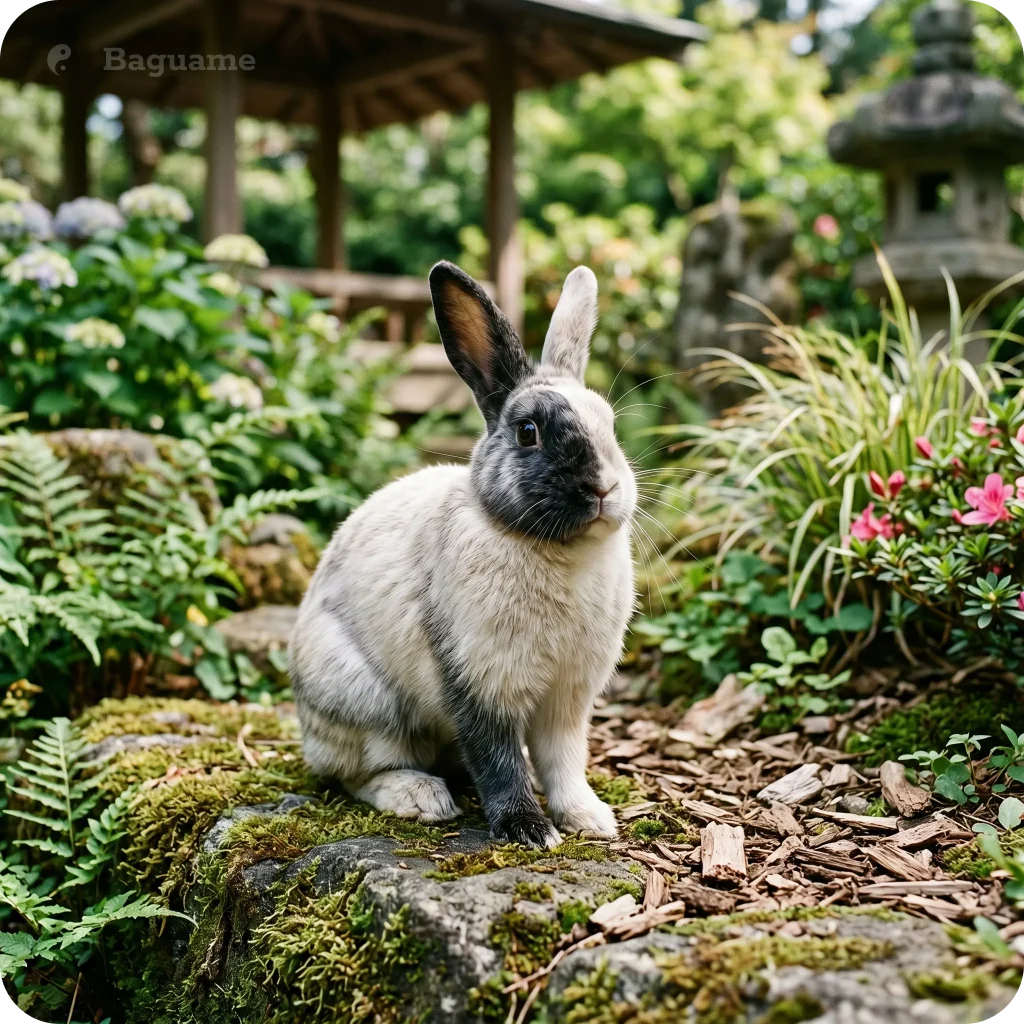
| Attribute | Value |
| Chinese Character | 卯 |
| Romanization | Mao |
| Position in Cycle | 4th of 12 |
| Polarity | Yin |
| Element | Wood |
| Zodiac Animal | Rabbit |
| Season | Mid-Spring |
| Solar Month | 2nd month (approx. March) |
| Hours | 05:00 – 07:00 |
| Direction | East (90°) |
| Hidden Stem | 乙 Yi (Yin Wood) — 100% |
Hidden Stem: 乙 Yi — Yin Wood
Like Zi (Rat) with its single Gui Water, Mao contains only one hidden stem: 乙 Yi (Yin Wood), which occupies 100% of the branch’s energy. This makes Mao one of the cleanest, most predictable branches in the system — pure Yin Wood, nothing else.
乙 Yi is the Yin Wood of vines, grass, and flexible plants — where 甲 Jia (Yang Wood) of the Tiger grows upward through force, Yi grows laterally through adaptability. It bends without breaking, finds its way around obstacles rather than through them, and spreads persistently across any surface. This quality gives Mao its distinctive character: tenacious, graceful, socially perceptive, and far more resilient than it appears.
Elemental Nature and Symbolic Meaning
Mao represents the peak of Spring — the moment Wood energy reaches its maximum expression. The Spring Equinox falls within Mao month, the point where day and night are equal and light begins to dominate. Everything is growing: fields are green, blossoms are open, and the natural world operates at full momentum. This is not the violent eruption of the Tiger — it is the effortless fullness of a season in its prime.
In the cycle of the Five Elements, Wood at its Yin peak is soft yet pervasive. Vines cover walls, roots fill soil, grass fills every crack. The Rabbit embodies this precisely: it does not confront, it does not overpower — it multiplies, spreads, and finds its way through every gap. Its speed is not aggressive but evasive; its survival strategy is awareness and agility over force.
In classical Feng Shui, due East is governed by the Zhen Trigram (☳ Thunder) — the trigram of awakening, new growth, and the eldest son. Mao sits at the very center of East (90°), making it the purest compass expression of Zhen’s energy. On the 24 Mountains Luo Pan, the East zone contains: 甲 Jia, 卯 Mao, and 乙 Yi — with Mao occupying the central 15° of East (82.5°–97.5°).
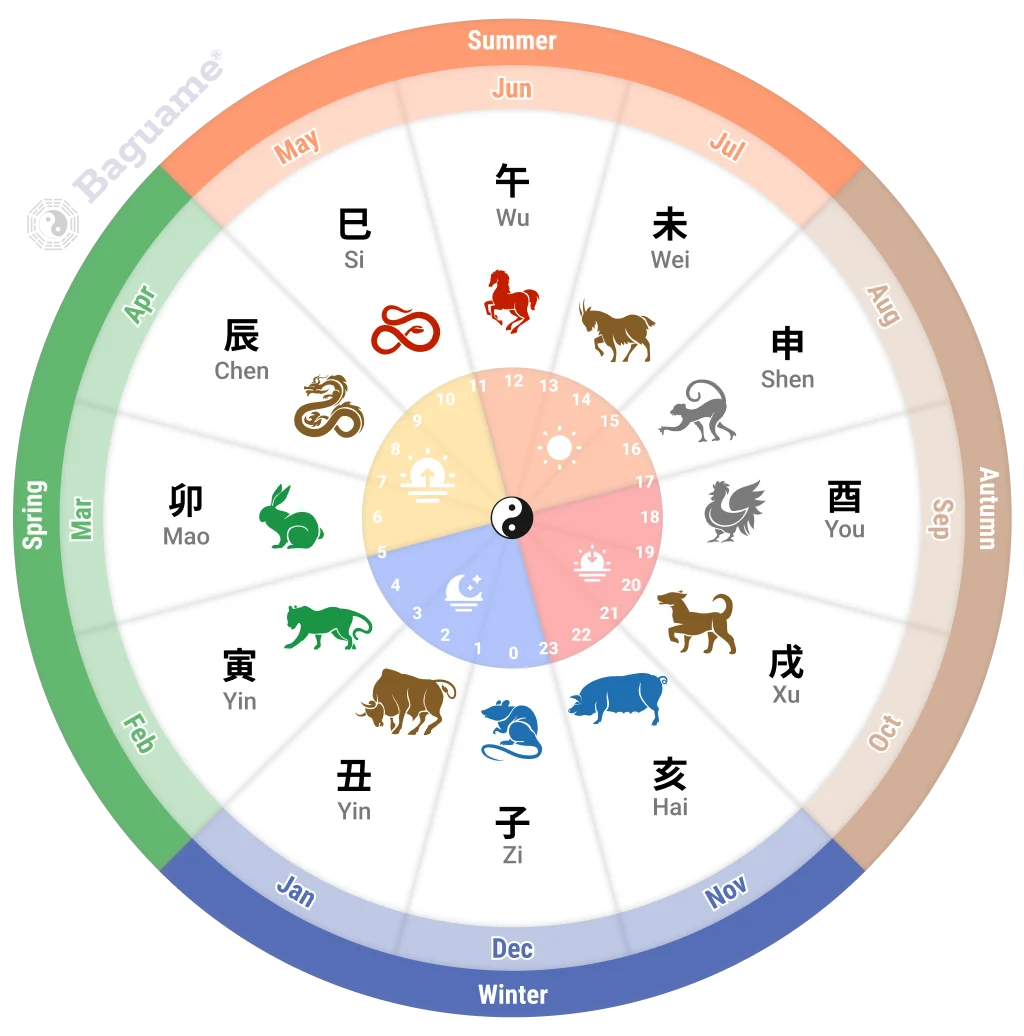
Branch Interactions
Mao participates in a distinctive set of interactions. It is part of the Spring Seasonal Frame and the Wood Three Combination, clashes with its direct opposite, and forms one of the most unusual punishments in the system — a self-punishment. In BaZi analysis, Mao’s pure Yin Wood energy makes its combinations particularly clean and its clashes particularly direct.
Six Combination (六合): Mao + Xu → Fire
卯 Mao combines with 戌 Xu (Dog) to produce Fire energy. This is a generative combination: Wood (Mao) generates Fire, and Xu’s hidden Fire stems are what complete the interaction. In a chart, Mao–Xu combination can activate Fire where it is needed — or intensify it where it is already strong. It is worth noting that Xu also clashes with 辰 Chen (Dragon), so in complex charts with multiple branches present, the combination and clash dynamics must be assessed together.
Three Combination (三合): Hai + Mao + Wei → Wood Frame
亥 Hai (Pig), 卯 Mao (Rabbit), and 未 Wei (Goat) form the Wood Three Combination (三合木局). Mao acts as the central node — its pure 乙 Yi Wood anchors the combination at its peak. When all three branches appear in a chart, Wood energy is powerfully amplified. Even partial combinations (Hai–Mao or Mao–Wei) produce significant Wood strengthening.
Seasonal Combination (三會): Yin + Mao + Chen → Wood Season
寅 Yin (Tiger), 卯 Mao (Rabbit), and 辰 Chen (Dragon) form the Seasonal Wood Frame — the three branches of Spring. Mao sits at the center of this combination as the peak Wood branch, giving the frame its greatest concentration of Wood energy. The Seasonal Frame is considered stronger than the Three Combination when all three are present together.
Six Clash (六沖): Mao ↔ You
卯 Mao (Yin Wood) clashes directly with 酉 You (Rooster) — also a single-stem branch, pure 辛 Xin (Yin Metal). This is a clean, direct Wood–Metal clash along the East–West axis. Because both branches contain only one stem each, the clash is unusually pure — two concentrated elemental forces in direct opposition, with no hidden complexity to buffer the impact. Metal controls Wood in the Five Element cycle, making this clash particularly damaging to Mao’s Wood energy when You is the stronger branch.
Punishment (刑): Zi ↔ Mao — Ungrateful Punishment
卯 Mao and 子 Zi (Rat) form the “Ungrateful Punishment” (無恩之刑). This is a two-branch punishment involving a Water branch and a Wood branch — despite Water normally generating Wood, in this punishment configuration the relationship becomes corrosive and ungrateful. It often manifests as situations where help is given but not appreciated, where loyalty is misplaced, or where a natural nurturing relationship turns into one of exploitation or resentment.
Self-Punishment (自刑): Mao ↔ Mao
Mao is one of four branches capable of self-punishment (自刑) — when two Mao branches appear in the same chart (for example, in the Day and Year pillars), they punish each other. The self-punishment of Mao manifests as internal contradiction: the person works against their own interests, repeats self-defeating patterns, or experiences a split between what they want and what they pursue. It is subtle but persistent — the energy does not explode outward but erodes inward.
Harm (害): Mao ↔ Chen
卯 Mao and 辰 Chen (Dragon) form a Harm relationship (六害). This is notable because Mao and Chen are adjacent branches — they also appear together in the Spring Seasonal Frame. The coexistence of combination and harm between the same two branches is a well-known complexity in BaZi: when Yin, Mao, and Chen all appear together, the Seasonal Frame may form, but the Mao–Chen Harm creates internal friction within that combination.
Destruction (破): Mao ↔ Wu
卯 Mao and 午 Wu (Horse) form a Destruction relationship (破). Destructions are less commonly discussed than clashes and punishments, but they represent a gradual erosion of the branches involved — like a slow leak rather than a rupture. The Mao–Wu destruction involves Wood and Fire in a configuration that drains rather than generates, often surfacing as issues with timing, missed opportunities, or situations that start well but deteriorate over time.
Mao in the BaZi Chart: Four Pillar Positions
The meaning of Mao shifts depending on which pillar it occupies in a BaZi chart. Use the Baguame BaZi calculator to identify where Mao appears across your Year, Month, Day, and Hour pillars.
Year Pillar
Relates to ancestry and early life environment. Mao in the Year Branch suggests a background that valued social grace, adaptability, and harmony — an environment where navigating relationships skillfully was more valued than direct confrontation.
Month Pillar
Reflects career context and the working environment. Mao in the Month Branch places Yin Wood energy in the professional sphere — natural domains include diplomacy, arts, communication, counseling, and fields that require reading people and situations with precision.
Day Pillar
Describes the self and closest relationships. Mao as a Day Branch indicates a person with 乙 Yi Wood as their core energy — graceful, perceptive, and socially intelligent. They attract others naturally, but may use indirectness as a defense mechanism, avoiding confrontation even when it would serve them better.
Hour Pillar
Governs later life, children, and private desires. Mao in the Hour Branch places Yin Wood’s quiet persistence in the realm of inner goals — a person whose private aspirations unfold gradually and whose later years are characterized by graceful, sustained growth rather than dramatic leaps.
Mao as a Time Marker: Month, Hour, and Direction
Mao Month
Mao governs the 2nd lunar month — containing the Spring Equinox (approximately March 6 – April 4 in the solar calendar). This is the midpoint of Spring, when Wood energy reaches its peak. Day and night are equal at the Equinox, and from this point light begins to dominate. Mao month energy is expansive and socially active — favorable for growth, outreach, and projects that require spreading influence rather than breaking through resistance.
Mao Hour
Mao governs 05:00–07:00 — sunrise and the early morning. This is the hour when darkness ends and the world becomes visible. In classical Chinese timekeeping, the Mao hour was associated with the beginning of daily activity, fresh perception, and the quality of attention that comes before the day’s demands take hold. Births during this window are recorded as the Mao Hour in a BaZi chart.
Mao Direction: East
Mao corresponds to due East (90°) — the direction of sunrise, governed by the Zhen Trigram (☳ Thunder) in classical Feng Shui. On the 24 Mountains Luo Pan, Mao occupies the central 15° of East (82.5°–97.5°), flanked by 甲 Jia and 乙 Yi. In Flying Stars natal chart analysis, the East sector at Mao carries the purest expression of Wood energy on the compass — relevant for assessing growth, health, and new beginnings in a property.
Rabbit Years in the 60-Year Cycle: Wood, Fire, Earth, Metal, Water Rabbit
In the BaZi calendar, every Rabbit year pairs 卯 Mao with a different Heavenly Stem. Because Mao is a Yin Branch, it always pairs with Yin Stems — completing its full cycle of 5 variations every 60 years.
| Stem + Branch | Name | Stem Element | Recent Years |
| 乙卯 | Wood Rabbit | 乙 Yi — Yin Wood | 1915, 1975, 2035 |
| 丁卯 | Fire Rabbit | 丁 Ding — Yin Fire | 1927, 1987, 2047 |
| 己卯 | Earth Rabbit | 己 Ji — Yin Earth | 1939, 1999, 2059 |
| 辛卯 | Metal Rabbit | 辛 Xin — Yin Metal | 1951, 2011, 2071 |
| 癸卯 | Water Rabbit | 癸 Gui — Yin Water | 1963, 2023, 2083 |
| Note: Mao always pairs with Yin Stems only (乙, 丁, 己, 辛, 癸) — Yin Branch pairs with Yin Stem. There is no Yang Stem Rabbit year. | |||
Rabbit Symbolism and Character in Chinese Culture
The Rabbit holds a uniquely gentle place in the Chinese zodiac — but gentleness should not be mistaken for weakness. In Chinese mythology, the Rabbit lives on the Moon alongside Chang’e, the Moon Goddess, endlessly grinding the elixir of immortality. This image is telling: the Rabbit is associated with the Moon, with Yin energy, with quiet persistence in service of something timeless. It is not the warrior or the pioneer — it is the one who outlasts both.
In classical Chinese culture, the Rabbit is associated with longevity, good fortune, and social harmony. Its speed — not aggressive but evasive — was admired as a form of intelligence. The Rabbit does not fight what it cannot beat; it navigates around it. This is not cowardice. It is the wisdom of Wood at its Yin expression: find the path of least resistance, grow through every available gap, and arrive where others could not.
Core Rabbit Traits in BaZi
Mao’s single hidden stem — pure 乙 Yi Wood — produces a distinctive character profile when Mao appears prominently in a chart:
- Social intelligence — reads people and rooms with exceptional precision
- Adaptability — bends without breaking; adjusts direction without losing momentum
- Aesthetic sensitivity — natural affinity for beauty, refinement, and form
- Conflict avoidance — prefers navigation over confrontation, sometimes to a fault
- Quiet persistence — does not announce its goals; simply keeps moving toward them
- Hidden resilience — far tougher than appearances suggest
What the Rabbit Symbolizes
- The Moon and Yin energy — the only zodiac animal with a mythological home on the Moon
- Spring at its peak — the Spring Equinox, Wood energy fully expressed
- Longevity and good fortune — associated with the elixir of immortality
- Pure Yin Wood — the vine that finds every crack; persistence without force
- Sunrise — governs 05:00–07:00, the hour when darkness gives way to light
- Grace under pressure — survives not by overpowering but by outlasting
Frequently Asked Questions
Mao is Yin Wood. Its only hidden stem is 乙 Yi (Yin Wood), making it 100% Wood in elemental composition. Like Zi (Rat) for Water, Mao is the purest single-element branch for Wood — entirely predictable, with no hidden complexity from other elements.
Mao clashes with 酉 You (Rooster). Both are single-stem branches — Mao holds only 乙 Yi Wood and You holds only 辛 Xin Metal — making this one of the cleanest, most direct clashes in the system. Metal controls Wood in the Five Element cycle, so the clash is structurally weighted against Mao when You is stronger in the chart context.
Mao participates in the Wood Three Combination (三合木局): 亥 Hai (Pig) + 卯 Mao (Rabbit) + 未 Wei (Goat). Mao acts as the central node at the peak of this combination, anchored by its pure 乙 Yi Wood. When all three branches appear in a BaZi chart, Wood energy is powerfully amplified.
Mao is one of four branches (along with 辰 Chen, 午 Wu, and 酉 You) that can self-punish when two identical branches appear in the same chart. When two Mao appear — for example in the Year and Day pillars — they punish each other. This manifests as internal conflict: self-defeating behavior, a tendency to undermine one’s own efforts, or difficulty aligning intention with action. It is subtle and chronic rather than dramatic, and often surfaces in decision-making patterns or in recurring relational dynamics.
This is one of the more complex interactions in the system. 卯 Mao and 辰 Chen (Dragon) are adjacent branches and participate together in the Spring Seasonal Frame (Yin–Mao–Chen). However, they also form a Harm relationship (六害). When all three Spring branches are present, the Seasonal Frame may activate — but the underlying Mao–Chen Harm creates friction within it. Classical practitioners assess which interaction dominates based on the overall chart context, the strength of each branch, and which Heavenly Stems sit above them.