
Yang Earth (戊 Wu) — The Fifth Heavenly Stem
Yang Earth, written 戊 and pronounced Wu, is the fifth of the Ten Heavenly Stems and the first of the two Earth stems. It stands at the exact center of the cycle — the midpoint between the Wood-Fire pair and the Metal-Water pair. In the natural world, Wu is the great mountain: vast, immovable, patient beyond measure, and capable of containing everything that approaches it without being changed by any of it.
Core Identity
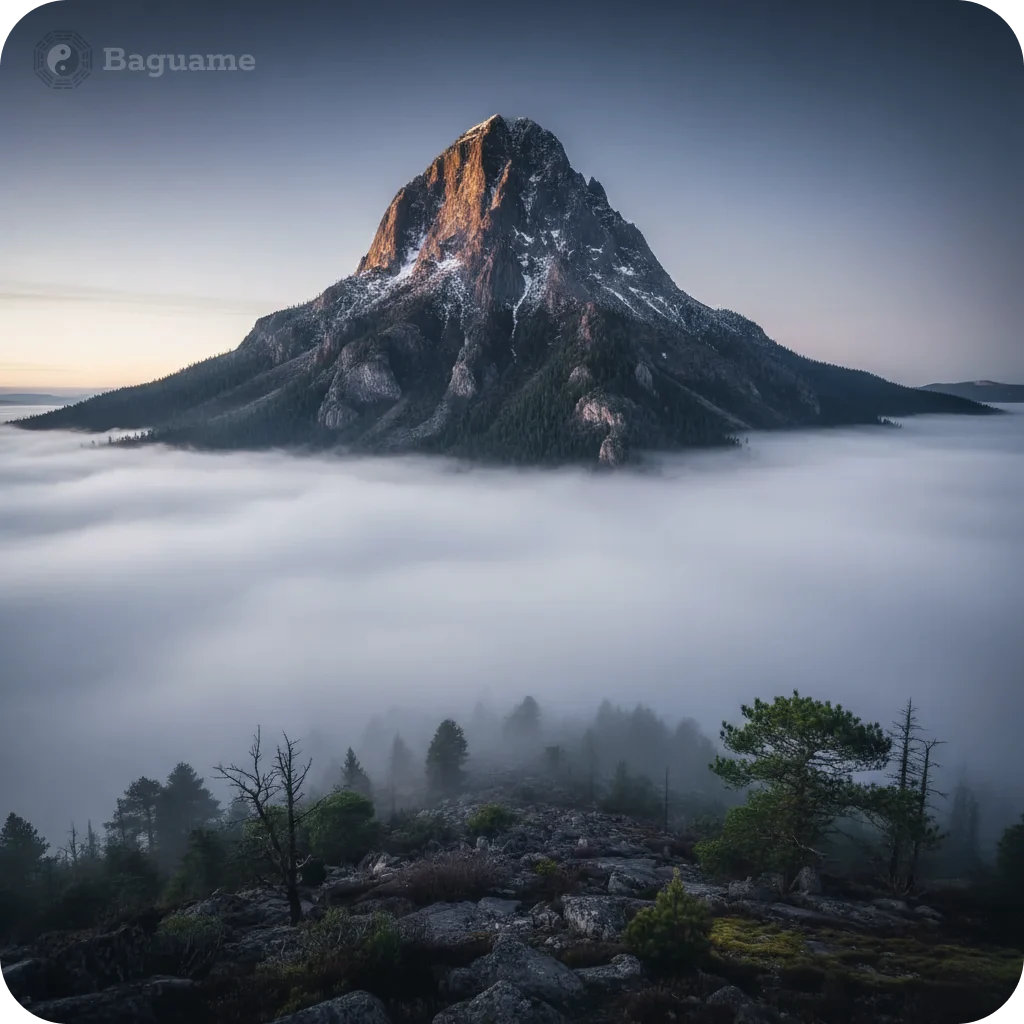
Wu is pure Yang energy within the Earth element — solid, reliable, and fundamentally stable. In contrast to Yin Earth (己 Ji), which is soft, fertile, and receptive farmland, Yang Earth is the mountain: elevated, enduring, and defined by its capacity to simply be there, unchanged, while everything around it shifts. Furthermore, where Ji nourishes through absorption, Wu stabilizes through presence.
In classical texts, Wu is associated with trustworthiness, patience, and an almost geological solidity of character. Wu people do not change their minds quickly, do not abandon commitments easily, and do not require external validation to maintain their sense of direction. In practice, this makes them the bedrock of any organization or relationship — the element that everything else can lean against without fear of it moving.
Key Attributes at a Glance
Element
Earth (Yang)
Natural Image
Mountain · Great Dam · Plateau
Season / Direction
Transitional · Center
Polarity
Yang (odd)
The Five Element Relationships
Understanding Wu requires mapping it against all five elements. The interactions below form the foundation of BaZi analysis when Yang Earth appears in any pillar.
Fire Produces Earth (生)
Producing element. Fire (丙 Bing, 丁 Ding) generates Wu and acts as its resource. For Yang Earth people, strong Fire in the chart means support, warmth, and the energy of authority and recognition flowing toward them. In particular, Bing Yang Fire is the most natural pairing — the sun warming the great mountain, bringing it into full visibility. As a result, Wu people with strong Bing in their chart often carry a quality of natural authority that is both warm and unmistakable.
Earth Produces Metal (生)
Output element. Metal (庚 Geng, 辛 Xin) is produced by Earth and represents Wu’s output and legacy. Furthermore, Geng Yang Metal is the ideal output for Wu — ore extracted from a mountain, raw mineral becoming refined material. In a well-structured chart, strong Metal output channels Wu’s solidity into precise, structured expression. In practice, Wu people who develop their output energy tend to build systems, institutions, and frameworks that outlast their own direct involvement.
Earth — Same Element (比)
Parallel / Companion. Other Earth stems (Wu or Ji) share the pillar. Multiple mountains create a range — significant and expansive, but potentially immovable to the point of blocking all passage. That said, a companion Ji alongside Wu is a classically balanced pairing: the great mountain beside fertile lowland, solidity and nourishment working together. Furthermore, too much Earth without Wood or Water to move through it creates stagnation — the same stability that is a strength becomes an obstacle to flow and change.
Wood Controls Earth (克)
Controlling element. Wood (甲 Jia, 乙 Yi) restrains Wu. In BaZi, Wood is the Officer or Power star for Wu. However, for Yang Earth, the distinction of scale matters: Jia Yang Wood is the ideal controller — a great tree rooting into the mountain, breaking it open slowly and purposefully. In contrast, small Yi Wood on a great mountain is insufficient to provide meaningful structure. As a result, Wu Day Masters tend to need authority figures and structures of real scale and substance to feel genuinely directed.
Earth Controls Water (克)
Dominated element. Water (壬 Ren, 癸 Gui) is dominated by Earth. In BaZi, Water represents Wealth for Wu. Specifically, Ren Yang Water is the most significant Wealth target — the great dam holding the ocean, the mountain containing a vast reservoir. Wu people are naturally positioned to accumulate and contain large-scale resources. However, the relationship requires careful balance: a dam that is too rigid eventually breaks under the pressure of what it contains.
The Mountain and the Ocean
The most significant pairing for Wu in classical BaZi: 戊 Wu (Yang Earth, Mountain) meeting 壬 Ren (Yang Water, Ocean). The mountain dam holding back the sea is the definitive image of Yang Earth’s power — containment at scale. Consequently, this pairing appears frequently in the charts of people who manage vast resources, lead large organizations, or occupy positions of structural authority: those whose primary function is to hold something together that would otherwise disperse or overflow.
Personality Traits
The mountain does not move for anyone. This is not arrogance — it is simply the nature of what a mountain is. Wu energy does not seek to impress, does not adapt to please, and does not require the approval of those around it to remain fully itself. Below are the core traits observed in individuals with Wu as the Day Master or prominent in the chart.
Strengths
- Unshakeable reliability. Wu people are there when they say they will be, deliver what they commit to, and remain consistent under pressure that would move most others. In particular, this makes them the most trusted members of any team or family structure.
- Natural authority. The mountain commands respect without asking for it. Consequently, Wu people often occupy positions of institutional authority not through aggression but through the simple fact of their immovable presence and long-term consistency.
- Patience. Mountains are measured in geological time. As a result, Wu people are capable of working toward long-term goals with a patience that others find remarkable — sustaining effort and direction across timescales that shorter-term personalities cannot maintain.
- Protective instinct. The mountain shelters everything in its valley. Moreover, Wu people carry a strong instinct to protect those in their care — family, colleagues, communities — providing the kind of solid, unconditional support that creates genuine security.
- Integrity under pressure. Above all, Wu does not bend. When values are tested, Wu people hold their position — not out of stubbornness alone, but because their sense of what is right is as deeply rooted as a mountain’s foundations.
Challenges
- Rigidity. Mountains do not move — but sometimes movement is exactly what is needed. In many cases, Wu people miss opportunities by holding positions too long after circumstances have clearly changed around them.
- Slowness to adapt. The same stability that makes Wu trustworthy can become sluggishness in fast-moving environments. However, this is often less a flaw than a mismatch — Wu thrives in contexts that reward consistency over agility.
- Blocking flow. A mountain can be an obstacle as easily as it can be a shelter. Consequently, Wu people can unintentionally obstruct change, new ideas, or the movement of others — not through malice but through sheer immovability.
- Emotional opacity. The mountain keeps its interior hidden. For this reason, Wu people can be difficult to read emotionally — expressing care through action and consistency rather than through words or outward warmth, which others can misread as coldness.
- Stubbornness at scale. When Wu’s rigidity combines with its natural authority, the result can be an immovable force that simply overrides others by weight. Moreover, Wu people in positions of leadership must consciously cultivate the capacity to genuinely listen rather than simply wait for objections to stop.
Wu in the Four Pillars
The position of 戊 in the BaZi chart changes its expression significantly. The same stem operates differently depending on whether it appears in the Year, Month, Day, or Hour pillar.
| Pillar | Domain | Expression of Yang Earth |
| Year (年) | Ancestors, social environment, early life | Solid, established family background; early environment characterized by stability, tradition, and the expectation of reliability — often a family that has held its position across generations |
| Month (月) | Career, parents, prime years (20–40) | Career built on institutional authority, management, and structural roles; works best as the foundational layer of an organization rather than in highly adaptive or fast-moving positions |
| Day (日) | Self, spouse palace | Day Master — defines core character as described above. Spouse palace suggests a partner who brings movement, intelligence, or Water energy — the river that gives the mountain its purpose and beauty |
| Hour (时) | Children, later life, hidden thoughts | Grounded, dependable children; late-life legacy built on what was established and protected; inner world oriented around responsibility, continuity, and the weight of what one is trusted to hold |
Wu as Day Master — the Mountain Identity
When 戊 is the Day Master, the entire chart is read through the lens of the great mountain. The key questions are: is this mountain warm and sunlit, or cold and isolated? Does it contain useful resources, or is it barren? You can calculate your own chart using the Baguame BaZi calculator.
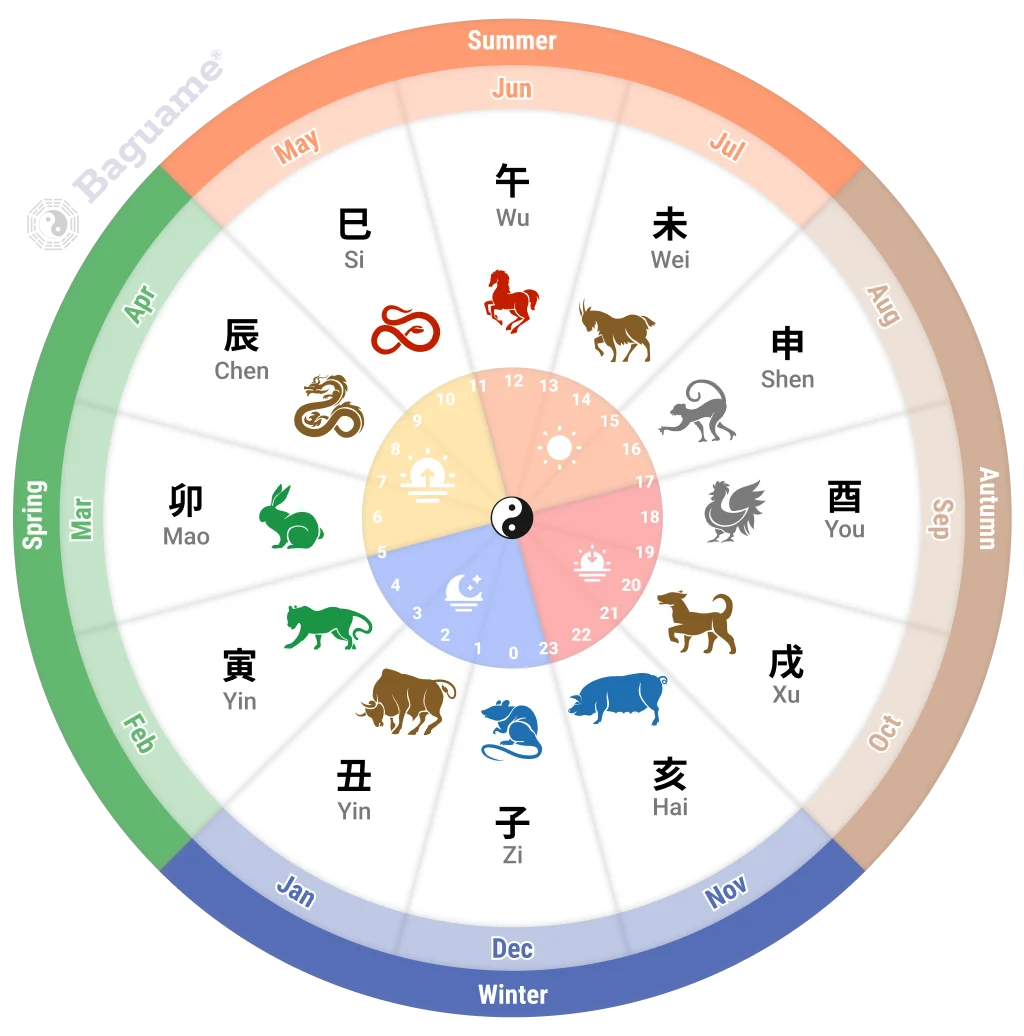
The central question for a Wu Day Master is: is this mountain warm, purposeful, and well-resourced — or cold, isolated, and blocking everything around it? Season determines the starting conditions.
Summer (巳 Si · 午 Wu · 未 Wei)
Fire season — Wu’s resource at full strength. Consequently, the mountain is warm, well-lit, and at its most welcoming. This is classically one of the strongest configurations for Wu: the sun illuminating the mountain in full, drawing out the gold and ore within it. That said, excessive Fire without Water can leave the mountain parched and barren. Therefore, Ren Yang Water as Wealth is especially important in summer Wu charts.
Winter (亥 Hai · 子 Zi · 丑 Chou)
Water season — Wu’s Wealth at full strength, but also its greatest test. As a result, the mountain must contain the rising waters without being submerged. In practice, winter Wu charts produce people of remarkable containment capacity — those who manage vast, powerful resources under sustained pressure. However, Fire is critical in winter Wu configurations to provide the warmth that keeps the mountain from becoming a cold, inhospitable barrier.
Spring (寅 Yin · 卯 Mao · 辰 Chen)
Wood season — the Officer and Power star active. In this configuration, Wu is being shaped and directed by external structure. Furthermore, spring is the season that most challenges Wu’s preference for immobility — Wood roots break into the mountain, demanding change. In particular, this configuration often produces Wu people who achieve their greatest work precisely because external discipline has given form to their natural solidity.
Autumn (申 Shen · 酉 You · 戌 Xu)
Metal output season — ore flowing from the mountain. Overall, this is the most productive configuration for Wu’s output energy: the mountain yielding its minerals, the earth producing structured, lasting things. On one hand, autumn Wu charts carry strong creative and institutional output potential. On the other hand, the chart needs Fire resource to sustain Wu’s core energy as it gives outward.
Special Combinations Involving Wu
戊癸合 — Wu + Gui Combination
Yang Earth and Yin Water (癸 Gui) form a Heavenly Stem combination — one of the six stem combinations (天干合, Tiangan He). When these two meet, their energies merge and — if Fire season supports it — can transform into Fire. In classical interpretation, this is the great mountain absorbing gentle rain: vast solidity receiving quiet nourishment from below. Furthermore, this combination often appears in people who carry both enormous structural presence and a hidden inner sensitivity — the mountain with underground springs, solid on the surface and quietly nourishing deep within.
戊壬对冲 — Wu vs. Ren Clash
Yang Earth and Yang Water (壬 Ren) are in direct opposition — a Heavenly Stem clash (天干冲). This is the dam meeting the ocean in conflict rather than containment: when the mountain and the sea clash directly, something gives way. As a result, this clash in Luck Pillars often brings dramatic confrontations with power, major financial or structural disruptions, or periods in which the very foundations that Wu has built are tested to their limits. However, when both elements are balanced, the tension produces extraordinary capacity — the dam that holds because it has been tested and held.
Wu in Feng Shui and Annual Stars
Beyond BaZi, 戊 appears in Flying Stars and annual cycle analysis. As the center element, Earth does not belong to a single compass direction — instead, it governs the transitional periods between seasons and the central axis of any space or chart.
Direction
Wu corresponds to specific mountains in the Northeast and Southwest sectors of the 24 Mountains system — the transitional Earth zones between the cardinal directions. In classical Feng Shui, these sectors carry the stabilizing, containing qi of Yang Earth. Activating a Wu mountain sector brings the energy of structural solidity, long-term stability, and reliable containment to any space or facing direction.
Annual Cycle
The 戊 year carries Yang Earth energy — consolidating, stabilizing, and fundamentally oriented toward building lasting foundations. Historically, 戊 years tend to bring periods of institutional consolidation, establishment of structures, and the kind of slow but consequential shifts that reshape the terrain for the years ahead. For individuals whose charts are strengthened by Earth, 戊 years reward long-term thinking, commitment to existing structures, and the patient accumulation of resources.
24 Mountains
In the 24 Mountain system, Wu mountain carries the qi of Yang Earth. The Northeast sector is governed by the Gen trigram (☶) — mountain, stillness, and the deep inner knowing that comes from being completely grounded. A sitting or facing direction aligned to a Wu mountain brings the most structurally solid and enduring form of Earth energy into the environment.
Summary
Yang Earth 戊 Wu is the mountain — the most structurally solid and enduring of the Ten Heavenly Stems. The mountain does not move, does not perform, and does not need to be seen to know its own value. Specifically, Wu’s power lies precisely in its permanence: it is the element that everything else can depend on, push against, and shelter beneath without ever worrying that it will shift.
In BaZi, a strong Wu Day Master chart belongs to someone built for institutional authority, long-term stewardship, and the kind of reliability that others build their lives around. However, the chart must provide movement and warmth — Water to give Wu’s containment a purpose, Fire to keep the mountain from becoming cold and isolated, and Wood to break through the surface and demand purposeful change.
Furthermore, understanding 戊 is foundational to reading Earth-dominant charts, the Wu-Ren containment dynamic, and the transitional Earth sectors in Feng Shui practice — including the Eight Trigrams that govern each directional zone. Overall, Wu represents what stability looks like when it is fully expressed: not rigidity for its own sake, but the unshakeable foundation that makes everything else possible. Explore all Ten Heavenly Stems or open the BaZi calculator to see where 戊 Wu appears in your own chart.
Frequently Asked Questions
Yang Earth 戊 Wu represents the great mountain — the most structurally solid and enduring form of Earth energy. In BaZi, it is the fifth Heavenly Stem, positioned at the exact center of the cycle. People born with Wu as their Day Master tend to be deeply reliable, naturally authoritative, and patient beyond what most others can sustain. Like the mountain, they are defined by what they hold rather than by how they move.
Yang Earth (Wu) is the mountain — vast, elevated, immovable, and defined by its structural presence. Yin Earth (Ji) is the fertile farmland — soft, nourishing, receptive, and defined by its capacity to support the growth of everything placed in it. In personality terms, Wu people tend to be more naturally authoritative, structurally minded, and steady under pressure, while Ji people are often more nurturing, adaptive, and quietly supportive of those around them. Both are Earth — but they express the element’s core quality of stability in fundamentally different ways.
For a Wu Day Master, Bing Yang Fire as resource (the sun warming the mountain into full visibility and usefulness) and Ren Yang Water as Wealth (the ocean the dam contains) are the most structurally important elements. Additionally, Jia Yang Wood as the Officer star provides the purposeful direction that prevents Wu’s stability from becoming stagnation. Without warmth and movement, even a great mountain becomes an obstacle rather than a foundation.
In classical Chinese cosmology, Earth is the central element — the axis around which the other four rotate. Wu, as Yang Earth and the fifth stem, occupies the precise midpoint of the cycle: after the Wood-Fire yang expansion and before the Metal-Water yin contraction. Furthermore, this central position reflects Wu’s functional role in BaZi charts: it is the element that stabilizes, mediates, and contains the interactions between all other elements. In classical analysis, a chart with strong Wu often carries a quality of gravitational centrality — other elements naturally orbit around it.
Wu (Yang Earth) and Gui (Yin Water) form one of the six Heavenly Stem combinations (天干合). When these two appear adjacent in a BaZi chart, their energies merge. If the seasonal qi of Fire is present, this combination can transform into Fire. On a character level, this pairing brings together the mountain’s vast structural solidity (Wu) with the quiet, penetrating sensitivity of rain (Gui) — a combination that often produces people of remarkable depth: outwardly immovable, inwardly complex, and quietly nourishing to everyone within their sphere.