
Dog (戌 Xu): The Eleventh Earthly Branch, Element & Interactions
戌 Xu is the eleventh of the 12 Earthly Branches and the closing branch of Autumn. Where 酉 You (Rooster) expressed Metal energy at its peak refinement, Xu is the transition — Autumn’s final warmth held before Winter’s cold breaks through. Its element is Earth, its polarity is Yang, and its zodiac animal is the Dog.
In BaZi (Four Pillars of Destiny), Xu is one of the four “Earth Reservoir” or Storage branches (土庫) — specifically, the Fire Reservoir (火庫). Like 辰 Chen (Water Storage) and 未 Wei (Wood Storage), Xu stores the elemental energy of a previous season deep within its Earth nature. It clashes with Chen in one of the most elementally explosive interactions in the system — two Storage branches releasing their hidden energies simultaneously.

| Attribute | Value |
| Chinese Character | 戌 |
| Romanization | Xu |
| Position in Cycle | 11th of 12 |
| Polarity | Yang |
| Element | Earth |
| Zodiac Animal | Dog |
| Season | Late Autumn |
| Solar Month | 9th month (approx. October) |
| Hours | 19:00 – 21:00 |
| Direction | WNW (300°) |
| Principal Hidden Stem | 戊 Wu (Yang Earth) — 60% |
| Middle Hidden Stem | 丁 Ding (Yin Fire) — 20% |
| Residual Hidden Stem | 辛 Xin (Yin Metal) — 20% |
Hidden Stems: Three Layers Inside Xu
Xu contains three hidden Heavenly Stems that tell the story of late Autumn: dominant Earth on the surface, the stored warmth of Summer’s Fire in the middle, and the residual Metal of Autumn’s harvest as the final layer. This combination — Earth, Fire, Metal — makes Xu the Fire Reservoir and one of the most thermally complex branches in the system. Unlike the cold Storage branches (Chou) or the wet ones (Chen), Xu is a dry, warm Earth — the scorched mountain in late October.
戊 Wu — Yang Earth (60%)
The Principal Qi of Xu. 戊 Wu — the same Yang Earth that dominates Chen (Dragon) — appears here in its Autumn expression: dry, vast, and holding the heat of a long summer within it. Wu Earth in Xu is not the moist, fertile Earth of Chen but the hardened mountain earth after months of sun — resilient, immovable, and storing warmth that radiates long after the season has turned. It gives Xu its reputation for steadfastness and its deep, unwavering loyalty.
丁 Ding — Yin Fire (20%)
The Middle Qi of Xu. 丁 Ding — the intimate Yin Fire of hearths and candles — sits inside Xu as Summer’s stored warmth. This is what makes Xu the Fire Reservoir (火庫): the heat of summer absorbed into Autumn’s Earth, held in reserve against Winter’s coming cold. This hidden Ding is activated in the Fire Three Combination (Yin–Wu–Xu), enabling Xu to close that combination despite being an Earth branch — exactly as Chen closes the Water combination through its hidden Water.
辛 Xin — Yin Metal (20%)
The Residual Qi of Xu. 辛 Xin — the same Yin Metal that fills You (Rooster) entirely — lingers inside Xu as Autumn’s residual Metal energy. The season has peaked but not fully ended; Metal is still present, still refining, but giving way to Earth’s transitional dominance. This hidden Xin means Xu can support Metal Day Masters and explains its participation in the Autumn Seasonal Frame (Shen–You–Xu) despite being an Earth branch.
Elemental Nature and Symbolic Meaning
Xu is the transitional Earth of late Autumn — the long October evenings when the air has turned cold but the earth still holds warmth from summer. Leaves have fallen, the harvest is complete, and the landscape is settling into stillness. This is not the vibrant abundance of late Summer but something quieter and more profound: the earth that has given everything, absorbed everything, and now holds it all in reserve for what comes next.
In the cycle of the Five Elements, transitional Earth bridges Autumn and Winter. Xu specifically carries the warmth of Fire stored deep within dry mountain Earth — a seemingly contradictory combination that produces Xu’s most distinctive quality: the capacity to hold warmth and loyalty long after the conditions that generated them have passed. The Dog embodies this perfectly. It does not love conditionally or seasonally. It loves absolutely, permanently, and without revision.
In classical Feng Shui, the WNW direction at 300° sits within the territory of the Qian Trigram (☰ Heaven) — the trigram of strength, leadership, and the father. Qian’s quality of steadfast, principled authority aligns with Xu’s character. On the 24 Mountains Luo Pan, the WNW zone contains: 辛 Xin, 戌 Xu, and 乾 Qian — with Xu occupying the central 15° of WNW (292.5°–307.5°).
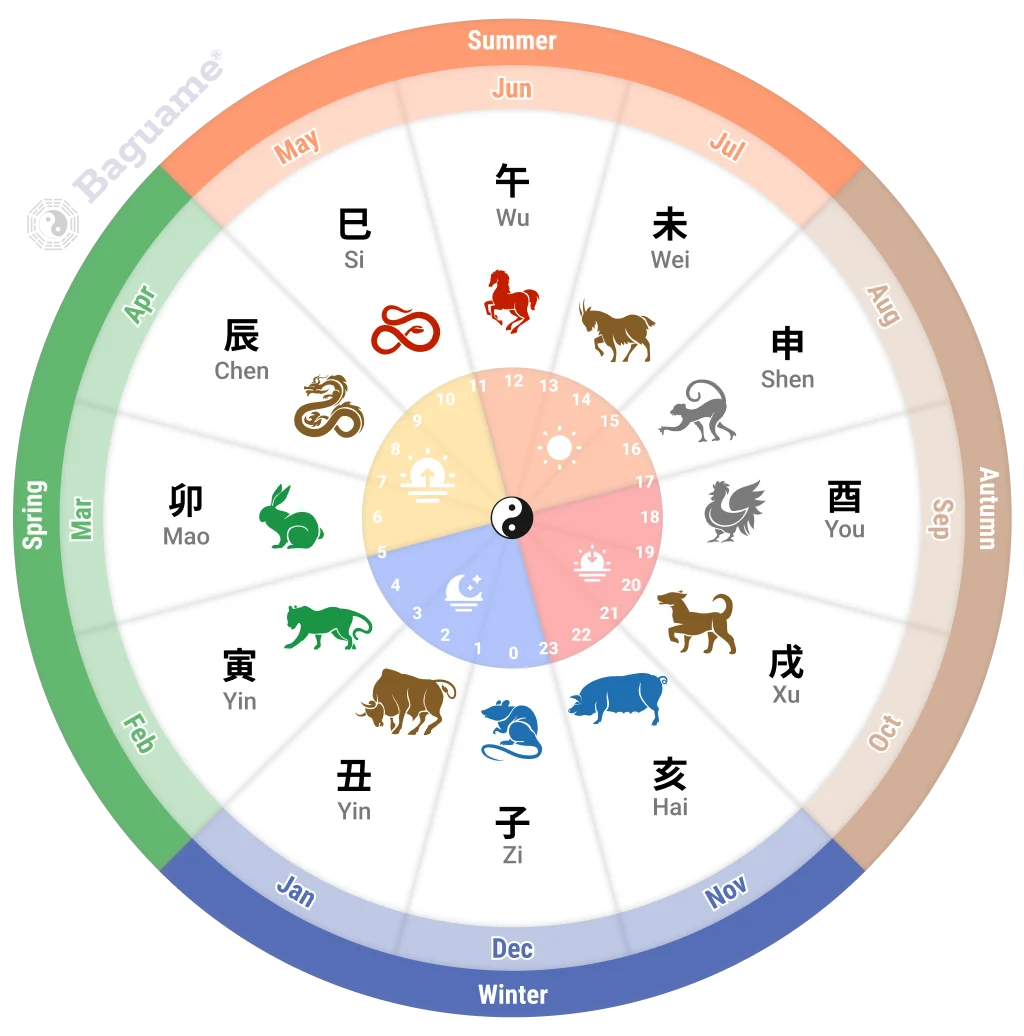
Branch Interactions
Xu carries a rich and complex set of interactions. As a Storage branch its clash with Chen is one of the most elementally explosive in BaZi. It participates in both the Fire Three Combination and the Autumn Seasonal Frame through different hidden stems, appears in the Bullying Punishment with the other Yin Earth branches, and forms a Harm with its adjacent seasonal partner You. In BaZi analysis, always determine which hidden stem is being activated.
Six Combination (六合): Xu + Mao → Fire
戌 Xu combines with 卯 Mao (Rabbit) to produce Fire energy. Wood generates Fire in the Five Element cycle, and Xu’s hidden 丁 Ding Fire completes the interaction. This combination is worth noting because Mao and Xu are not adjacent or seasonally related — yet their hidden stem interaction creates a productive Fire-generating bond. In a chart where Fire is needed, Mao–Xu combination reliably delivers it.
Three Combination (三合): Yin + Wu + Xu → Fire Frame
寅 Yin (Tiger), 午 Wu (Horse), and 戌 Xu form the Fire Three Combination (三合火局). Xu acts as the closing node, anchored by its hidden 丁 Ding Fire. When all three branches appear in a chart, Fire energy is powerfully amplified. Even partial combinations (Yin–Xu or Wu–Xu) produce significant Fire strengthening.
Seasonal Combination (三會): Shen + You + Xu → Metal Season
申 Shen (Monkey), 酉 You (Rooster), and 戌 Xu form the Seasonal Metal Frame — the three branches of Autumn. Xu acts as the closing node through its hidden 辛 Xin Metal. When all three are present, Metal dominates the chart with maximum seasonal force — though Xu’s hidden Fire creates internal tension within this combination, as Fire controls Metal in the Five Element cycle.
Six Clash (六沖): Xu ↔ Chen
戌 Xu clashes directly with 辰 Chen (Dragon) — both Yang Earth Storage branches from opposite seasons. This is the most elementally explosive clash in BaZi: Xu releases its hidden 丁 Ding Fire and 辛 Xin Metal; Chen releases its hidden 癸 Gui Water and 乙 Yi Wood. Four hidden stems erupting simultaneously — Fire, Metal, Water, Wood — into a chart that may not have had any of them visible before. In annual afflictions and time-based forecasting, a Xu–Chen clash is one of the most significant events to track.
Punishment (刑): Chou → Xu → Wei — Bullying Punishment
戌 Xu participates in the three-branch Bullying Punishment (恃勢之刑) together with 丑 Chou (Ox) and 未 Wei (Goat) — the three Yin Earth branches punishing each other in a cycle. Despite Xu being Yang Earth and the other two being Yin Earth, all three share the same elemental base and the same transitional function — and their mutual punishment reflects the grinding friction of same-element forces from different seasons that cannot harmonize with each other.
Harm (害): Xu ↔ You
戌 Xu and 酉 You (Rooster) form a Harm relationship (六害) — notable because they are adjacent branches that also appear together in the Autumn Seasonal Frame (Shen–You–Xu). As with Mao–Chen in Spring and Zi–Wei in Winter, the coexistence of Seasonal Combination and Harm between adjacent branches creates internal friction within the frame. Xu’s hidden Fire (Ding) and You’s pure Metal (Xin) are in a controlling relationship — Fire controls Metal — which underlies the Harm’s corrosive quality.
Xu in the BaZi Chart: Four Pillar Positions
The meaning of Xu shifts depending on which pillar it occupies in a BaZi chart. Use the Baguame BaZi calculator to identify where Xu appears across your Year, Month, Day, and Hour pillars.
Year Pillar
Relates to ancestry and early life. Xu in the Year Branch suggests an upbringing that valued loyalty, reliability, and principled behavior. The family environment may have been traditional, structured around clear roles and expectations, and characterized by deep if not always openly expressed emotional bonds.
Month Pillar
Reflects career context. Xu in the Month Branch places Earth’s protective, steadfast energy in the professional sphere. Natural domains include security, law enforcement, military, management, real estate, and any role requiring sustained reliability, the protection of others, and the capacity to maintain standards under pressure.
Day Pillar
Describes the self and closest relationships. Xu as a Day Branch indicates a person with 戊 Wu Earth as their core nature — loyal to a degree that can become self-sacrificing, principled in ways that can become inflexible, and capable of sustaining commitment across decades without wavering. In relationships, they are the partner who stays — for better or for worse.
Hour Pillar
Governs later life and private desires. Xu in the Hour Branch places Earth’s protective, accumulating energy in the realm of inner aspiration — a person whose later life is defined by the bonds they have built and maintained, and whose private world is warmer and more emotionally rich than their reserved exterior suggests.
Xu as a Time Marker: Month, Hour, and Direction
Xu Month
Xu governs the 9th lunar month — containing the Cold Dew (寒露 Han Lu) and Frost’s Descent (霜降 Shuang Jiang) solar terms (approximately October 8 – November 6 in the solar calendar). The nights are growing cold, frost appears on the ground in the mornings, and the last warmth of the year is being held against an advancing winter. Xu month energy is introspective, consolidating, and oriented toward what endures — a time for deepening commitments and releasing what cannot last.
Xu Hour
Xu governs 19:00–21:00 — early evening, when darkness has settled and the day’s activities wind down. In classical Chinese timekeeping this was the hour of the Dog’s watch — when households closed their gates and the loyal Dog took up its nightly vigil. Births during this window are recorded as the Xu Hour in a BaZi chart, associated with vigilance, inner warmth, and the quality of loyalty that operates best in the quiet hours.
Xu Direction: WNW
Xu corresponds to WNW at 300° on the compass, within the territory of the Qian Trigram (☰ Heaven) in classical Feng Shui. On the 24 Mountains Luo Pan, Xu occupies the central 15° of WNW (292.5°–307.5°), flanked by 辛 Xin and 乾 Qian. In Flying Stars natal chart analysis, the WNW sector carries the energy of late Autumn Earth — relevant for protection, male authority, and the consolidation of accumulated resources in a property.
Dog Years in the 60-Year Cycle: Wood, Fire, Earth, Metal, Water Dog
In the BaZi calendar, every Dog year pairs 戌 Xu with a different Heavenly Stem. Because Xu is a Yang Branch, it always pairs with Yang Stems — completing its full cycle of 5 variations every 60 years.
| Stem + Branch | Name | Stem Element | Recent Years |
| 甲戌 | Wood Dog | 甲 Jia — Yang Wood | 1934, 1994, 2054 |
| 丙戌 | Fire Dog | 丙 Bing — Yang Fire | 1946, 2006, 2066 |
| 戊戌 | Earth Dog | 戊 Wu — Yang Earth | 1958, 2018, 2078 |
| 庚戌 | Metal Dog | 庚 Geng — Yang Metal | 1910, 1970, 2030 |
| 壬戌 | Water Dog | 壬 Ren — Yang Water | 1922, 1982, 2042 |
| Note: Xu always pairs with Yang Stems only (甲, 丙, 戊, 庚, 壬) — Yang Branch pairs with Yang Stem. There is no Yin Stem Dog year. | |||
Dog Symbolism and Character in Chinese Culture
The Dog holds a position of profound and uncomplicated affection in Chinese culture — it is the zodiac’s emblem of loyalty, the animal that humans have trusted with their homes, their children, and their safety for thousands of years. In classical Chinese, 忠犬 (zhōng quǎn) — “loyal dog” — is an honorific, not an insult. The Dog does not calculate its loyalty or condition it on outcomes. It commits and it stays.
The Dog’s connection to Xu’s Earth nature deepens this symbolism: Earth holds, accumulates, and protects. The Fire stored within Xu — Summer’s warmth carried through Autumn — gives the Dog its inner warmth, its hearth-keeping quality. The Xin Metal within adds a thread of precision and principle: the Dog’s loyalty is not blind, it is chosen, and the standard it holds others to is the same standard it holds itself to.
Core Dog Traits in BaZi
Xu’s hidden stems — Wu Earth, Ding Fire, Xin Metal — produce a distinctive character profile when Xu appears prominently in a chart:
- Unconditional loyalty — commits fully and does not revise that commitment lightly
- Inner warmth — the hidden Ding Fire gives genuine emotional depth beneath a composed surface
- Principled stubbornness — holds to what it believes is right regardless of social pressure
- Protective instinct — naturally oriented toward guarding what and who it values
- Anxiety under uncertainty — the Earth quality that holds everything can become holding too tightly when threatened
- Dry wit and directness — the Xin Metal thread gives Xu a sharper edge than its warmth suggests
What the Dog Symbolizes
- Loyalty without condition — the zodiac’s defining emblem of faithfulness
- The Fire Reservoir — Summer’s warmth held through Autumn’s cold
- The night watch — governs 19:00–21:00, the hour of the household’s guardian
- Qian — Heaven and the Father — steadfast authority, principled strength
- Late Autumn stillness — the earth after harvest, holding everything it has gathered
- Chosen commitment — loyalty not as instinct but as principle; the standard held inward as much as outward
Frequently Asked Questions
Xu is Yang Earth. Its principal hidden stem is 戊 Wu (Yang Earth) at approximately 60%, with 丁 Ding (Yin Fire) and 辛 Xin (Yin Metal) each contributing around 20%. Xu is designated the Fire Reservoir (火庫) because of its hidden Ding Fire — making it the only Storage branch whose stored element (Fire) is in a controlling relationship with one of its other hidden stems (Xin Metal: Fire controls Metal).
Xu stores Fire energy through its hidden 丁 Ding Fire stem — Summer’s warmth absorbed into Autumn’s dry Earth. This is what allows Xu, an Earth branch, to close the Fire Three Combination (Yin–Wu–Xu). The four Storage branches are: 辰 Chen (Water), 未 Wei (Wood), 戌 Xu (Fire), and 丑 Chou (Metal). When Xu is clashed by Chen, the stored Fire releases into the chart simultaneously with Chen’s Water — one of the most volatile elemental events in BaZi.
Xu clashes with 辰 Chen (Dragon). Both are Yang Earth Storage branches from opposite seasons — Xu from late Autumn, Chen from late Spring. When they clash, both release their stored elements simultaneously: Xu releases 丁 Ding Fire and 辛 Xin Metal; Chen releases 癸 Gui Water and 乙 Yi Wood. This is the most elementally complex clash in the system — four hidden stems from four different elements erupting into the chart at once.
Because Xu contains two relevant hidden stems: 丁 Ding Fire and 辛 Xin Metal. In the Fire Three Combination (Yin–Wu–Xu), it is the Ding Fire that activates. In the Autumn Seasonal Frame (Shen–You–Xu), it is the Xin Metal that activates. This dual participation mirrors how Chen participates in both Water and Wood combinations, and how Wei participates in both Wood and Fire combinations. The hidden stem activated in each interaction depends on which other branches are present and the overall chart context.
The Bullying Punishment (恃勢之刑) involves the three Earth-dominant transitional branches: 丑 Chou (Ox), 戌 Xu (Dog), and 未 Wei (Goat). The cycle runs: Chou punishes Xu, Xu punishes Wei, Wei punishes Chou — a triangle of mutual friction with no resolution. Unlike the Ungoverned Punishment (Yin–Si–Shen) which involves explosive, escalating force, the Bullying Punishment is slower and more grinding — a persistent erosion of effectiveness rather than an acute crisis. Even two of the three branches can produce partial effects. In a BaZi chart, the Bullying Punishment often surfaces as situations where considerable effort produces frustratingly little result.