
Pig (亥 Hai): The Twelfth Earthly Branch, Element & Interactions
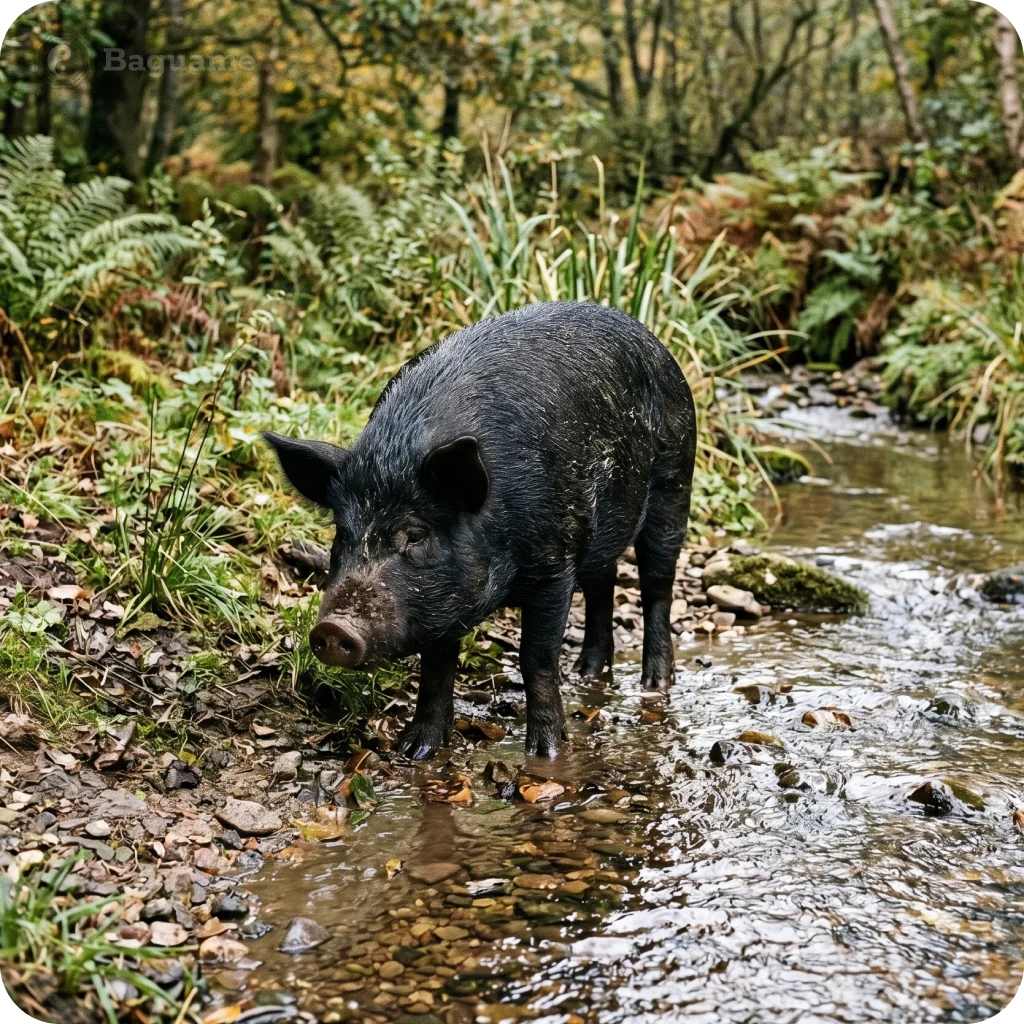
亥 Hai is the twelfth and final of the 12 Earthly Branches — and the first branch of Winter. It closes the annual cycle and simultaneously carries the seed of the next. Where 戌 Xu (Dog) held Autumn’s last warmth, Hai is the release into cold and darkness — pure Yin Water descending, the world contracting inward before the cycle begins again. Its element is Water, its polarity is Yin, and its zodiac animal is the Pig.
In BaZi (Four Pillars of Destiny), Hai is one of the four “Traveling Horse” branches — alongside 寅 Yin (Tiger), 巳 Si (Snake), and 申 Shen (Monkey). It contains two hidden Heavenly Stems and is the only Yin-polarity Traveling Horse in the system — an important distinction that shapes its expression of the Traveling Horse energy.
| Attribute | Value |
| Chinese Character | 亥 |
| Romanization | Hai |
| Position in Cycle | 12th of 12 |
| Polarity | Yin |
| Element | Water |
| Zodiac Animal | Pig |
| Season | Early Winter |
| Solar Month | 10th month (approx. November) |
| Hours | 21:00 – 23:00 |
| Direction | NNW (330°) |
| Principal Hidden Stem | 壬 Ren (Yang Water) — 60% |
| Residual Hidden Stem | 甲 Jia (Yang Wood) — 40% |
Hidden Stems: Two Layers Inside Hai
Hai contains two hidden Heavenly Stems — both Yang, despite Hai being a Yin branch. Like 午 Wu (Horse), which is a Yang branch with only Yin hidden stems, Hai presents the inverse: a Yin branch whose interior is entirely Yang. This polarity inversion gives Hai its distinctive character — a quiet, receptive exterior concealing enormous generative force within.
壬 Ren — Yang Water (60%)
The Principal Qi of Hai. 壬 Ren is the Yang Water of vast oceans and great rivers — powerful, deep, and in constant motion despite appearing still on the surface. Where 癸 Gui (the Water inside Zi) is the water of rain and dew — gentle, descending — Ren is the water of the ocean: vast, dark, and possessing an undertow that moves everything eventually. This makes Hai’s Water fundamentally different in character from Zi’s, even though both are Water branches.
甲 Jia — Yang Wood (40%)
The Residual Qi of Hai. 甲 Jia — the same Yang Wood that dominates Yin (Tiger) — sits inside Hai as the seed of the next cycle’s Spring. Water generates Wood in the Five Element cycle, and this hidden Jia is the first expression of that generative relationship: the new growth that has not yet emerged but is already forming in the dark. At 40%, Jia carries significant weight within Hai — more than a typical residual stem — making Hai one of the most Wood-generative branches in Winter.
Elemental Nature and Symbolic Meaning
Hai marks the start of Winter — the beginning of the inward journey. The last warmth of Autumn has been released, darkness is lengthening, and Yin energy is ascending toward its peak at the Winter Solstice in the following Zi (Rat) month. And yet, paradoxically, Winter begins with Yang Water (壬 Ren) and Yang Wood (甲 Jia) hidden within — the seeds of Spring already present in the first days of cold. Hai is the end that contains the beginning.
In the cycle of the Five Elements, Water at early Winter is vast and deep rather than frozen. The ocean does not ice over in November — it deepens. Hai is this quality of depth: the Water that holds more than is visible, that moves more powerfully than its surface suggests, and that carries within it the invisible beginning of the next cycle. The Pig embodies this beautifully — an animal of remarkable intelligence and sensory acuity beneath an unhurried, generous exterior.
In classical Feng Shui, the NNW direction at 330° sits within the territory of the Qian Trigram (☰ Heaven) transitioning toward Kan (☵ Water). On the 24 Mountains Luo Pan, the NNW zone contains: 乾 Qian, 亥 Hai, and 壬 Ren — with Hai occupying the central 15° of NNW (322.5°–337.5°).
Branch Interactions
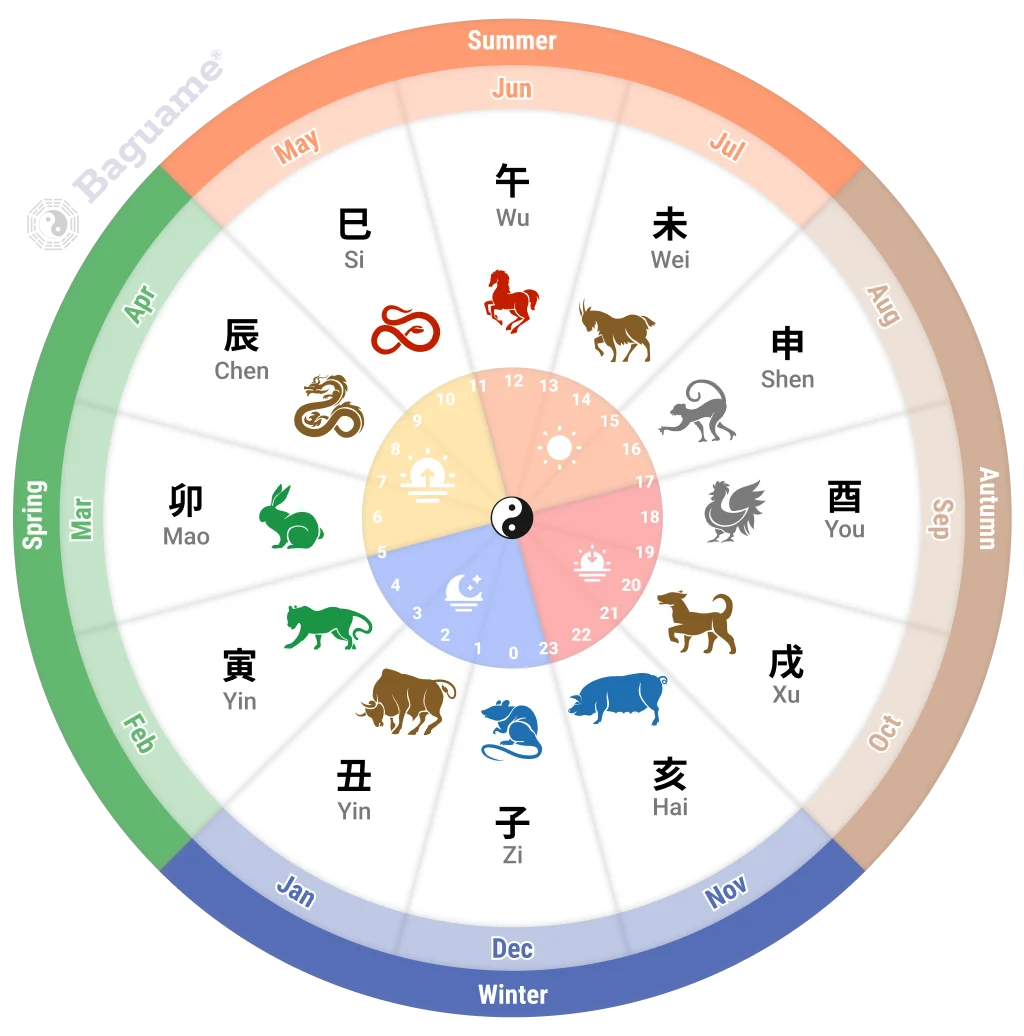
Hai participates in a rich and layered set of interactions. It opens the Wood Three Combination through its hidden Jia Wood, combines with Tiger for Wood in the Six Combination, clashes with its direct opposite Snake, and participates in the Winter Seasonal Frame. As the final Traveling Horse branch, its clash carries the same quality of sudden movement and major life transition as Yin, Si, and Shen. In BaZi analysis, Hai’s dual Yang hidden stems make it one of the more forward-looking branches despite sitting at Winter’s opening.
Six Combination (六合): Hai + Yin → Wood
亥 Hai combines with 寅 Yin (Tiger) to produce Wood energy. This is one of the most naturally productive Six Combinations in the system — Water generates Wood in the Five Element cycle, and Hai’s hidden 甲 Jia Wood combines with Yin’s principal 甲 Jia Wood to anchor the interaction. In a chart where Wood is needed, Hai–Yin combination is one of the most reliable Wood-producing interactions available.
Three Combination (三合): Hai + Mao + Wei → Wood Frame
亥 Hai, 卯 Mao (Rabbit), and 未 Wei (Goat) form the Wood Three Combination (三合木局). Hai acts as the opening node, anchored by its hidden 甲 Jia Wood. This combination spans three seasons — Winter, Spring, Summer — and its activation means Winter’s Water energy is channeled directly into Wood production. When all three branches appear in a chart, Wood energy is powerfully amplified.
Seasonal Combination (三會): Hai + Zi + Chou → Water Season
亥 Hai, 子 Zi (Rat), and 丑 Chou (Ox) form the Seasonal Water Frame — the three branches of Winter. Hai acts as the opening node through its principal stem 壬 Ren Water. When all three are present, Water energy dominates the chart with maximum seasonal force — the strongest Water combination in the system, and one of the most difficult elemental dominances to moderate once established.
Six Clash (六沖): Hai ↔ Si
亥 Hai clashes directly with 巳 Si (Snake) — both Traveling Horse branches, a Water–Fire opposition along the NNW–SSE axis. Water controls Fire in the Five Element cycle, so the clash is structurally weighted against Si when Hai is stronger. Both branches are destabilized, their hidden stems scattered. In time-based forecasting, a Hai–Si clash frequently triggers the same qualities as other Traveling Horse clashes: sudden travel, career pivots, relocation, and significant directional change.
Punishment (刑): Hai ↔ Hai — Self-Punishment
Hai is one of four branches capable of self-punishment (自刑). When two Hai branches appear in the same chart, they punish each other. The self-punishment of Hai manifests as self-sabotage through over-generosity and diffuseness — the vast Yang Water that holds everything eventually becomes unable to hold itself together. In practice this can surface as overcommitment, spreading resources too widely, or a pattern of giving to others while neglecting one’s own foundation.
Harm (害): Hai ↔ Shen
亥 Hai and 申 Shen (Monkey) form a Harm relationship (六害). Despite Metal generating Water in the Five Element cycle — a relationship that should be productive — in this Harm configuration the dynamic turns draining. Shen’s Metal feeds Hai’s Water, but receives nothing in return, creating a one-directional drain. In a chart where both appear, the areas governed by Shen tend to be depleted in service of Hai’s Water, without reciprocal benefit.
Hai in the BaZi Chart: Four Pillar Positions
The meaning of Hai shifts depending on which pillar it occupies in a BaZi chart. Use the Baguame BaZi calculator to identify where Hai appears across your Year, Month, Day, and Hour pillars.
Year Pillar
Relates to ancestry and early life. Hai in the Year Branch suggests an upbringing characterized by depth, imagination, and emotional richness. The family environment may have been intellectually stimulating, fluid in its structure, and marked by a sense of abundance — material, emotional, or both.
Month Pillar
Reflects career context. Hai in the Month Branch places the deep, generative Water energy in the professional sphere. Natural domains include research, philosophy, creative industries, healing arts, international work, and any field that benefits from breadth of knowledge, imaginative depth, and the capacity to work across boundaries.
Day Pillar
Describes the self and closest relationships. Hai as a Day Branch indicates a person with 壬 Ren Water as their core energy — generous, perceptive, and capable of containing enormous complexity without being overwhelmed. In relationships they give abundantly, sometimes to their own detriment, and may need to actively cultivate the capacity to receive as well as give.
Hour Pillar
Governs later life and private desires. Hai in the Hour Branch places Water’s vast, generative energy in the realm of inner aspiration — a person whose private world is rich with vision, whose later life carries a quality of depth and meaning that grows rather than diminishes, and whose hidden Jia Wood ensures the next creative cycle is already forming even in life’s final chapters.
Hai as a Time Marker: Month, Hour, and Direction
Hai Month
Hai governs the 10th lunar month — beginning with 立冬 Li Dong (Start of Winter, approximately November 7). This is the official start of Winter in the Chinese metaphysical calendar. Yin energy is now dominant and ascending toward its peak at the Winter Solstice. Hai month energy is deep, inward, and generative beneath the surface — a time for reflection, preparation, and allowing the seeds of the next cycle to form in the dark before they are ready to emerge.
Hai Hour
Hai governs 21:00–23:00 — the late evening hours before midnight. The household has settled, the day’s activity has ended, and the world is preparing for the deepest darkness of the Zi (Rat) hour that follows. In classical Chinese timekeeping this was the hour of the Pig’s rest — unhurried, complete, and fully at ease. Births during this window are recorded as the Hai Hour in a BaZi chart, associated with depth, generosity, and imaginative richness.
Hai Direction: NNW
Hai corresponds to NNW at 330° on the compass, between the Qian Trigram (☰ Heaven) and the Kan Trigram (☵ Water) in classical Feng Shui. On the 24 Mountains Luo Pan, Hai occupies the central 15° of NNW (322.5°–337.5°), flanked by 乾 Qian and 壬 Ren. In Flying Stars natal chart analysis, the NNW sector marks the transition from Heaven’s authority to Water’s depth — a powerful compass position associated with wisdom, strategic vision, and the preparation for new cycles.
Pig Years in the 60-Year Cycle: Wood, Fire, Earth, Metal, Water Pig
In the BaZi calendar, every Pig year pairs 亥 Hai with a different Heavenly Stem. Because Hai is a Yin Branch, it always pairs with Yin Stems — completing its full cycle of 5 variations every 60 years.
| Stem + Branch | Name | Stem Element | Recent Years |
| 乙亥 | Wood Pig | 乙 Yi — Yin Wood | 1935, 1995, 2055 |
| 丁亥 | Fire Pig | 丁 Ding — Yin Fire | 1947, 2007, 2067 |
| 己亥 | Earth Pig | 己 Ji — Yin Earth | 1959, 2019, 2079 |
| 辛亥 | Metal Pig | 辛 Xin — Yin Metal | 1911, 1971, 2031 |
| 癸亥 | Water Pig | 癸 Gui — Yin Water | 1923, 1983, 2043 |
| Note: Hai always pairs with Yin Stems only (乙, 丁, 己, 辛, 癸) — Yin Branch pairs with Yin Stem. There is no Yang Stem Pig year. | |||
Pig Symbolism and Character in Chinese Culture
The Pig holds one of the most purely auspicious positions in the Chinese zodiac. It is associated with wealth, abundance, and honest good fortune — the kind that comes not from cunning or force but from a genuinely generous nature that attracts what it needs. In classical Chinese culture, the Pig was the animal of the final harvest feast: the creature that had absorbed the abundance of the entire year and now offered it back to the household that had nurtured it. This cycle of giving and returning is Hai’s deepest character.
The Pig’s connection to Water and to the hidden 甲 Jia Wood within it gives the Pig its characteristic combination of depth and generativity. It does not merely receive and store — it transforms what it receives into the beginning of the next cycle. This is what separates Hai from the other Water branch, Zi (Rat): Zi holds Water at its purest; Hai holds Water already in the process of becoming Wood.
Core Pig Traits in BaZi
Hai’s two Yang hidden stems — Ren Water and Jia Wood — produce a distinctive character profile when Hai appears prominently in a chart:
- Genuine generosity — gives without calculation; the most naturally abundant of the twelve branches
- Deep intelligence — the vast Ren Water holds enormous amounts of information and perception without effort
- Creative vision — the hidden Jia Wood ensures Hai is always generating, always beginning something new
- Traveling Horse energy — beneath the unhurried surface, a persistent drive toward movement and new territory
- Difficulty with boundaries — the ocean does not naturally maintain edges; self-protection requires conscious effort
- Sensory richness — deeply attuned to pleasure, comfort, and the quality of lived experience
What the Pig Symbolizes
- Abundance and honest fortune — wealth that comes from genuine generosity rather than strategy
- The end that begins — the 12th branch already carrying the seed of the 1st; the cycle’s completion and renewal
- Deep Water, hidden Wood — vast intelligence carrying the next season’s growth already within it
- The Traveling Horse — movement and major life transitions, expressed through depth rather than speed
- Early Winter descent — the world turning inward, darkness lengthening, the ocean deepening
- The harvest feast — the abundance of the entire year transformed into nourishment and shared
Frequently Asked Questions
Hai is Yin Water. Its principal hidden stem is 壬 Ren (Yang Water) at approximately 60%, with 甲 Jia (Yang Wood) contributing around 40%. Both hidden stems are Yang — making Hai a Yin branch with an entirely Yang interior, a polarity inversion shared only with 午 Wu (Horse) in the opposite direction. Hai is the only Water branch in the system that contains significant Wood energy.
Hai clashes with 巳 Si (Snake). Both are Traveling Horse branches — a Water–Fire clash along the NNW–SSE axis. Water controls Fire in the Five Element cycle, so the clash is structurally weighted against Si when Hai is the stronger branch. As with all Traveling Horse clashes, the Hai–Si clash is associated with sudden movement, career pivots, relocation, and major life transitions in time-based forecasting.
Because Hai contains 甲 Jia (Yang Wood) as a significant residual hidden stem at approximately 40%. In the Wood Three Combination (Hai–Mao–Wei) and the Six Combination with Yin (Tiger), it is this hidden Jia that enables Hai to open the combination. This is the same principle that allows Si (Snake) to open the Metal combination despite being a Fire branch: Three Combinations operate through hidden stems, not surface elements.
Yes — both are Water branches in Winter, but they are fundamentally different. Zi (Rat) contains only 癸 Gui (Yin Water) — still, pure, and at maximum Yin. Hai contains 壬 Ren (Yang Water) and 甲 Jia (Yang Wood) — vast, moving, and already generating the next season. In a BaZi chart, Zi strengthens Water through purity and containment; Hai strengthens Water through depth and forward generation. A chart with both Hai and Zi has very different Water dynamics than one with just one of them.
Both simultaneously — and this is one of the most profound aspects of the Earthly Branch cycle. Hai closes the year as the 12th branch, but it already carries 甲 Jia Wood within it — the same Yang Wood that will emerge as the dominant force in the next Spring’s Yin (Tiger) month. In Chinese cosmological thinking, endings always contain beginnings: the cycle does not stop at 12 and restart at 1 — it flows continuously, with each ending already pregnant with what comes next. Hai embodies this principle structurally. It is the closing note that resolves into the opening note of the next octave — and in its hidden Jia Wood, the next Spring is already alive.