
Rooster (酉 You): The Tenth Earthly Branch, Element & Interactions
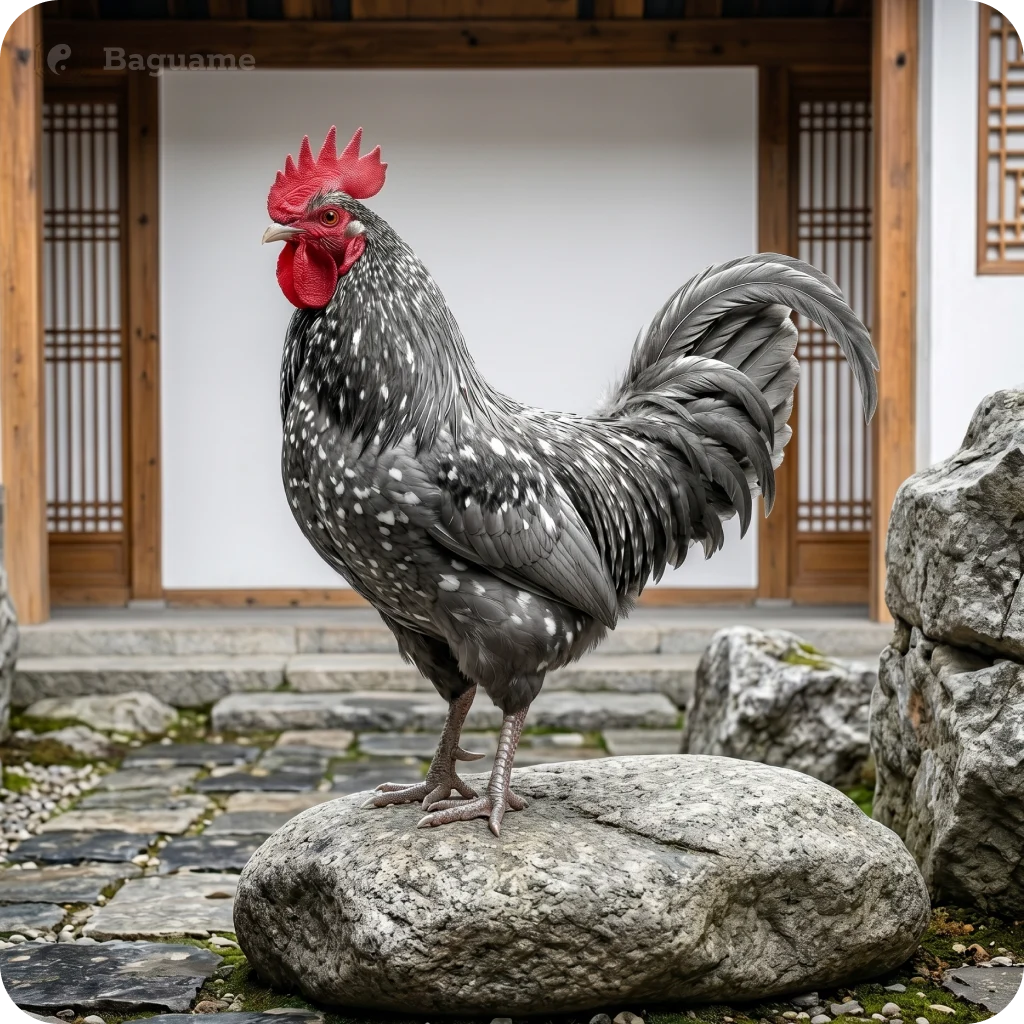
酉 You is the tenth of the 12 Earthly Branches and the central branch of Autumn. Where 申 Shen (Monkey) marked the start of Autumn’s sharp clarity, You is its peak — Metal energy at full strength, fully in its season, expressed without dilution. Its element is Metal, its polarity is Yin, and its zodiac animal is the Rooster.
In BaZi (Four Pillars of Destiny), You is one of the purest branches in the system — like 子 Zi (Rat) for Water and 卯 Mao (Rabbit) for Wood, You contains only a single hidden Heavenly Stem. This makes it entirely predictable, entirely consistent, and among the most powerful expressions of its element in the entire branch cycle.
| Attribute | Value |
| Chinese Character | 酉 |
| Romanization | You |
| Position in Cycle | 10th of 12 |
| Polarity | Yin |
| Element | Metal |
| Zodiac Animal | Rooster |
| Season | Mid-Autumn |
| Solar Month | 8th month (approx. September) |
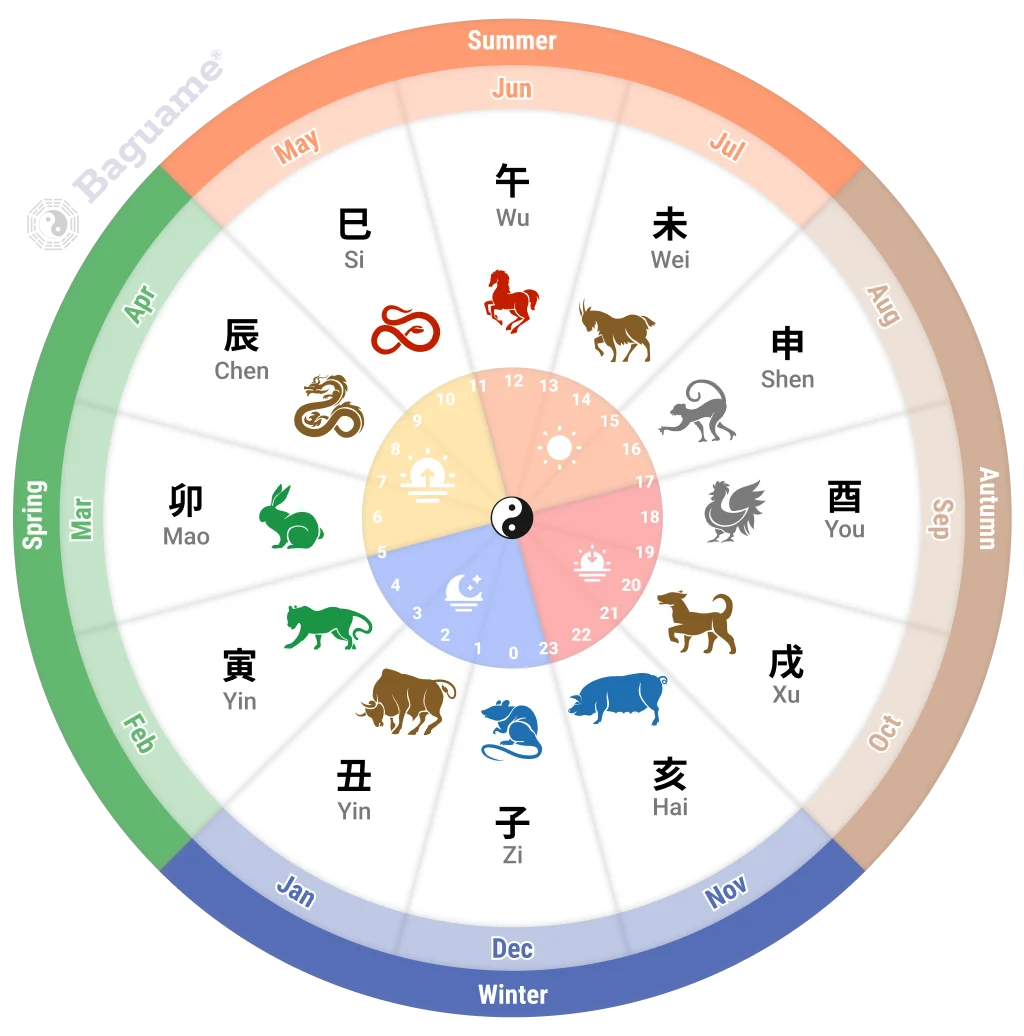
| Hours | 17:00 – 19:00 |
| Direction | West (270°) |
| Hidden Stem | 辛 Xin (Yin Metal) — 100% |
Hidden Stem: 辛 Xin — Yin Metal
Like Zi (Rat) with its single Gui Water and Mao (Rabbit) with its single Yi Wood, You contains only one hidden stem: 辛 Xin (Yin Metal), occupying 100% of the branch’s energy. There is no secondary stem, no hidden complexity, no buried element waiting to surface. You is pure Yin Metal — and nothing else.
辛 Xin is the Yin Metal of jewelry, gemstones, surgical instruments, and refined blades — where 庚 Geng (Yang Metal) is the raw axe, Xin is the finished jewel. It is Metal after refinement: precise, beautiful, and capable of cutting with minimal force. This quality gives You its distinctive character — elegant, exacting, and sensitive to imperfection in a way that raw Yang Metal is not.
Elemental Nature and Symbolic Meaning
You represents the peak of Autumn — the Autumn Equinox falls within You month, the point where day and night are equal and Yin begins to dominate. The harvest is in. The air is crisp and clear. Everything that has grown through Spring and Summer has now been gathered, assessed, and sorted. What is kept will carry through Winter; what is discarded is released. This quality of precise evaluation and selective retention is You’s defining character.
In the cycle of the Five Elements, Metal at its Yin peak is refined and concentrated. It is no longer the raw ore of early Autumn but the finished instrument — sharpened, polished, and ready for its purpose. The Rooster embodies this perfectly: precise in its timekeeping, exacting in its standards, and completely uninterested in approximation. The Rooster does not crow almost on time.
In classical Feng Shui, due West is governed by the Dui Trigram (☱ Lake) — the trigram of joy, harvest, and the youngest daughter. Dui’s energy of completion and satisfied abundance aligns with You’s position at the peak of Autumn harvest. On the 24 Mountains Luo Pan, the West zone contains: 庚 Geng, 酉 You, and 辛 Xin — with You occupying the central 15° of West (262.5°–277.5°).
Branch Interactions
You participates in the Metal Three Combination as its central node, forms one of the cleanest clashes in the system with 卯 Mao (Rabbit), and carries a self-punishment when doubled. In BaZi analysis, You’s single hidden stem makes its interactions unusually pure — there is no hidden complexity to buffer or redirect its elemental expression.
Six Combination (六合): You + Chen → Metal
酉 You combines with 辰 Chen (Dragon) to produce Metal energy. Earth generates Metal in the Five Element cycle, and You’s pure 辛 Xin Metal completes the interaction with Chen’s 戊 Wu Earth. In a chart, You–Chen combination significantly boosts Metal — and simultaneously neutralizes Chen’s hidden Water, preventing it from participating in the Water Three Combination while the combination holds.
Three Combination (三合): Si + You + Chou → Metal Frame
巳 Si (Snake), 酉 You (Rooster), and 丑 Chou (Ox) form the Metal Three Combination (三合金局). You acts as the central node at the peak of Metal energy, anchored by its pure 辛 Xin Metal. When all three branches appear in a chart, Metal energy is powerfully amplified. Even partial combinations (Si–You or You–Chou) produce significant Metal strengthening.
Seasonal Combination (三會): Shen + You + Xu → Metal Season
申 Shen (Monkey), 酉 You (Rooster), and 戌 Xu (Dog) form the Seasonal Metal Frame — the three branches of Autumn. You sits at the center as the peak Metal branch, giving the frame its greatest concentration of Metal energy. The Seasonal Frame is considered the strongest Metal combination in the system when all three branches are present together.
Six Clash (六沖): You ↔ Mao
酉 You (Yin Metal) clashes directly with 卯 Mao (Rabbit) — also a single-stem branch, pure 乙 Yi (Yin Wood). This is a clean, direct Metal–Wood clash along the West–East axis. Because both branches contain only one stem each, this is the purest clash in the entire system — two concentrated elemental forces with no hidden complexity on either side. Metal controls Wood in the Five Element cycle, making this clash structurally weighted against Mao when You is the stronger branch.
Self-Punishment (自刑): You ↔ You
You is one of four branches capable of self-punishment (自刑). When two You branches appear in the same chart, they punish each other. The self-punishment of You manifests as excessive self-criticism and perfectionism — the Yin Metal quality of refinement turned inward with no external outlet. In practice this can surface as paralysis through over-analysis, unrealistically high standards that prevent completion, or a harsh internal critic that undermines what has already been achieved.
Harm (害): You ↔ Xu
酉 You and 戌 Xu (Dog) form a Harm relationship (六害). This is notable because You and Xu are adjacent branches that also appear together in the Autumn Seasonal Frame (Shen–You–Xu). Like the Mao–Chen Harm within the Spring Seasonal Frame, the You–Xu Harm creates internal friction within the Autumn combination — a tension that classical practitioners assess when all three Autumn branches appear together in a chart.
You in the BaZi Chart: Four Pillar Positions
The meaning of You shifts depending on which pillar it occupies in a BaZi chart. Use the Baguame BaZi calculator to identify where You appears across your Year, Month, Day, and Hour pillars.
Year Pillar
Relates to ancestry and early life. You in the Year Branch suggests an upbringing that placed high value on precision, presentation, and standards. The family environment may have been refined, disciplined, or marked by high expectations — an atmosphere where quality was noticed and mediocrity was not tolerated.
Month Pillar
Reflects career context. You in the Month Branch places Yin Metal’s refined precision in the professional sphere. Natural domains include medicine, jewelry, music, editing, quality control, auditing, and any field where the difference between good and excellent is the entire point — and where that difference is immediately visible.
Day Pillar
Describes the self and closest relationships. You as a Day Branch indicates a person with 辛 Xin Metal as their core energy — elegant, exacting, and sensitive to the quality of their environment and relationships. In relationships they hold high standards; they notice everything, forgive little that is genuinely sloppy, and offer a level of attention and care that few others match.
Hour Pillar
Governs later life and private desires. You in the Hour Branch places Yin Metal’s refining energy in the realm of inner aspiration — a person whose private goals are defined by quality over quantity, and whose later years are characterized by a continued drive toward perfection and the satisfaction of work that meets their own exacting standards.
You as a Time Marker: Month, Hour, and Direction
You Month
You governs the 8th lunar month — containing the Autumn Equinox (秋分 Qiu Fen, approximately September 8 – October 7 in the solar calendar). Day and night are equal at the Equinox, and from this point Yin begins to dominate. You month energy is crisp, clear, and harvest-oriented — a time for completing what was begun, evaluating results with honesty, and making precise decisions about what to carry forward and what to release.
You Hour
You governs 17:00–19:00 — sunset and early evening, when the day’s work is assessed and the transition to night begins. In classical Chinese timekeeping this was the hour of the Rooster’s call — announcing the end of the working day and the beginning of rest. Births during this window are recorded as the You Hour in a BaZi chart, associated with precision, completion, and a natural orientation toward evaluation and closure.
You Direction: West
You corresponds to due West (270°) — the direction of sunset, governed by the Dui Trigram (☱ Lake) in classical Feng Shui. On the 24 Mountains Luo Pan, You occupies the central 15° of West (262.5°–277.5°), flanked by 庚 Geng and 辛 Xin. In Flying Stars natal chart analysis, the West sector at You carries the purest expression of Metal energy on the compass — relevant for children, joy, and completion in a property.
Rooster Years in the 60-Year Cycle: Wood, Fire, Earth, Metal, Water Rooster
In the BaZi calendar, every Rooster year pairs 酉 You with a different Heavenly Stem. Because You is a Yin Branch, it always pairs with Yin Stems — completing its full cycle of 5 variations every 60 years.
| Stem + Branch | Name | Stem Element | Recent Years |
| 乙酉 | Wood Rooster | 乙 Yi — Yin Wood | 1945, 2005, 2065 |
| 丁酉 | Fire Rooster | 丁 Ding — Yin Fire | 1957, 2017, 2077 |
| 己酉 | Earth Rooster | 己 Ji — Yin Earth | 1909, 1969, 2029 |
| 辛酉 | Metal Rooster | 辛 Xin — Yin Metal | 1921, 1981, 2041 |
| 癸酉 | Water Rooster | 癸 Gui — Yin Water | 1933, 1993, 2053 |
| Note: You always pairs with Yin Stems only (乙, 丁, 己, 辛, 癸) — Yin Branch pairs with Yin Stem. There is no Yang Stem Rooster year. | |||
Rooster Symbolism and Character in Chinese Culture
The Rooster holds a unique practical significance in Chinese culture — it is the creature whose call orders time itself. Before clocks, the Rooster’s crow at dawn signaled the start of the day for entire communities. This timekeeping function made the Rooster a symbol of reliability, order, and the precise marking of boundaries between states: night and day, rest and work, chaos and structure. In Chinese mythology, the Rooster’s crow was also believed to drive away evil spirits — its voice cutting through darkness the way Xin Metal cuts through impurity.
The Rooster is associated with the five virtues in classical Chinese culture: civil virtue (文), martial virtue (武), courage (勇), benevolence (仁), and trustworthiness (信) — each attributed to different physical features of the bird. This multi-virtue symbolism reflects You’s character precisely: a branch that operates at the intersection of precision, principle, and aesthetic excellence.
Core Rooster Traits in BaZi
You’s single hidden stem — pure 辛 Xin Metal — produces a distinctive and consistent character profile when You appears prominently in a chart:
- Precision and perfectionism — notices what others miss; cannot ignore the flaw in the otherwise perfect object
- Aesthetic intelligence — naturally attuned to form, beauty, and the difference between refined and merely adequate
- Punctuality and structure — the timekeeping Rooster; operates best within clear boundaries and expectations
- Sharp communication — says exactly what is meant; diplomatic packaging is not instinctive
- Self-punishment tendency — the most common shadow of Xin Metal; turns the refining blade inward
- Deep reliability — when committed, delivers without exception
What the Rooster Symbolizes
- The timekeeper — the creature whose call divides darkness from light, chaos from order
- Autumn at its peak — the Autumn Equinox, Metal fully expressed, harvest complete
- Sunset and evaluation — governs 17:00–19:00, the hour of completion and honest assessment
- The five virtues — civil, martial, courage, benevolence, trustworthiness — all embodied in a single creature
- Pure Yin Metal — the finished jewel; refinement as both method and goal
- Protection through clarity — drives away darkness not through force but through the precision of its voice
Frequently Asked Questions
You is Yin Metal. Its only hidden stem is 辛 Xin (Yin Metal), making it 100% Metal in elemental composition. You is one of only four single-stem branches in the system — alongside Zi (Rat), Mao (Rabbit), and Wu (Horse, two stems) — making it entirely predictable in its elemental behavior. What You projects on the surface is exactly what is inside.
You clashes with 卯 Mao (Rabbit). Both are single-stem branches — You holds only 辛 Xin Metal and Mao holds only 乙 Yi Wood — making this the purest clash in the entire system. No hidden stems on either side to buffer or redirect the impact. Metal controls Wood in the Five Element cycle, so the clash tends to be weighted against Mao when You is dominant in the chart context.
You participates in the Metal Three Combination (三合金局): 巳 Si (Snake) + 酉 You (Rooster) + 丑 Chou (Ox). You acts as the central node at the peak of Metal energy. Its pure 辛 Xin Metal anchors the combination at its strongest point. When all three branches appear in a BaZi chart, Metal energy is powerfully amplified.
The Six Combination between You and 辰 Chen (Dragon) produces Metal through the Earth-generates-Metal relationship in the Five Element cycle. Chen’s dominant 戊 Wu Earth generates You’s 辛 Xin Metal. This is a productive, stabilizing interaction — Earth provides the foundation, Metal refines it. The practical consequence is significant: when You and Chen combine, Chen’s hidden Water stem (癸 Gui) is typically suppressed, preventing Chen from participating in the Water Three Combination (Shen–Zi–Chen) while the combination holds.
You is one of four branches that self-punish (自刑) when doubled in a chart — alongside Mao (Rabbit), Chen (Dragon), and Wu (Horse). When two You appear in the same chart, the Yin Metal energy turns against itself — the refining blade with no external material to work on begins to refine itself. This most commonly manifests as perfectionism that becomes self-destructive: hypercriticism, inability to complete projects because nothing meets the internal standard, or a harsh inner voice that undermines genuine achievement. In a BaZi chart, identifying a You self-punishment is important for understanding the person’s relationship with self-evaluation and standards.