
Monkey (申 Shen): The Ninth Earthly Branch, Element & Interactions
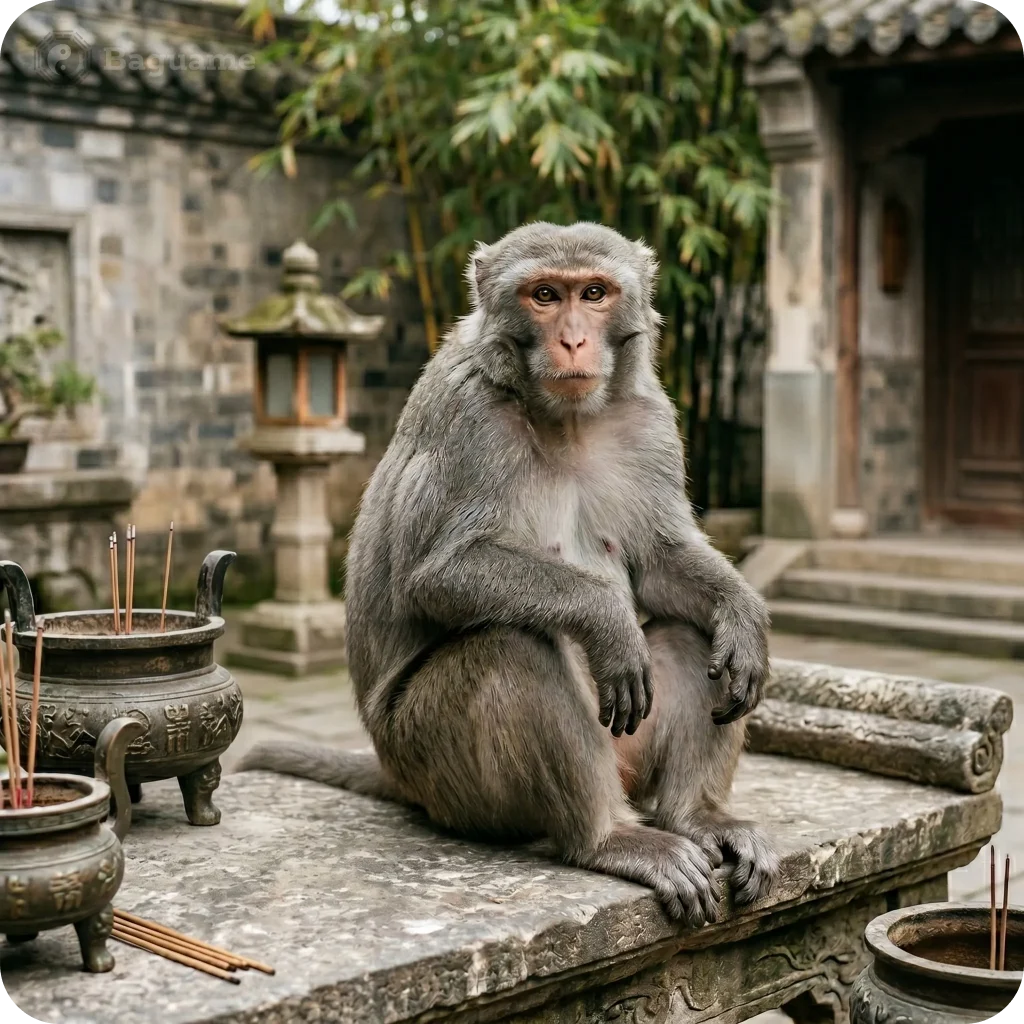
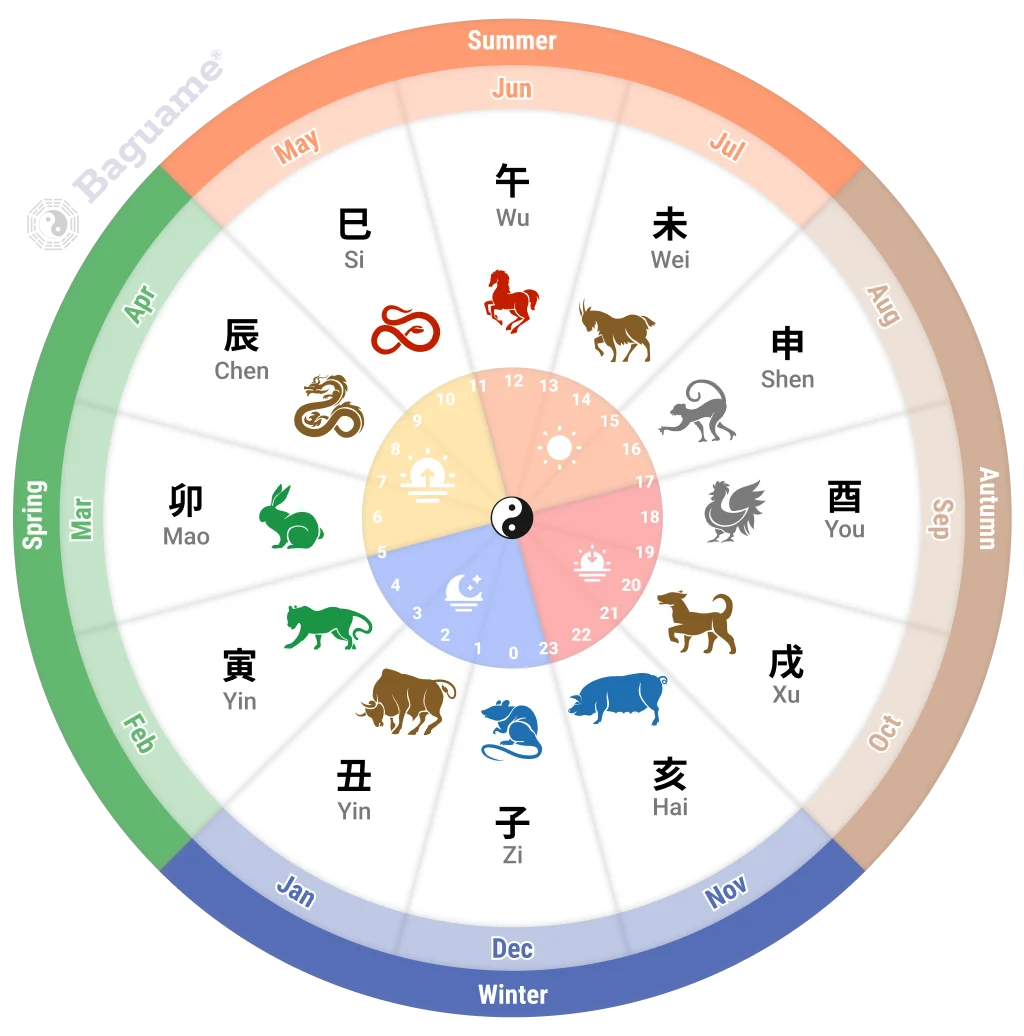
申 Shen is the ninth of the 12 Earthly Branches and the first branch of Autumn. Where 未 Wei (Goat) held Summer’s warmth in its final fullness, Shen is the break — the moment Yin energy emerges from hiding and begins its ascent toward Winter. Its element is Metal, its polarity is Yang, and its zodiac animal is the Monkey.
In BaZi (Four Pillars of Destiny), Shen is one of the four “Traveling Horse” branches — like 寅 Yin (Tiger), 巳 Si (Snake), and 亥 Hai (Pig). It carries three hidden Heavenly Stems and is directly opposite Yin (Tiger) on the Branch wheel — a clash between the two most forceful single-season openers in the system.
| Attribute | Value |
| Chinese Character | 申 |
| Romanization | Shen |
| Position in Cycle | 9th of 12 |
| Polarity | Yang |
| Element | Metal |
| Zodiac Animal | Monkey |
| Season | Early Autumn |
| Solar Month | 7th month (approx. August) |
| Hours | 15:00 – 17:00 |
| Direction | WSW (240°) |
| Principal Hidden Stem | 庚 Geng (Yang Metal) — 60% |
| Middle Hidden Stem | 壬 Ren (Yang Water) — 20% |
| Residual Hidden Stem | 戊 Wu (Yang Earth) — 20% |
Hidden Stems: Three Layers Inside Shen
Like 寅 Yin (Tiger), Shen contains three hidden Heavenly Stems — all Yang. This makes Shen one of four all-Yang hidden stem branches (alongside Yin, Si, and Hai), creating a branch of concentrated, forceful energy with no internal Yin moderation. What distinguishes Shen is the generative chain inside it: Metal produces Water, and Earth produces Metal — a forward-producing sequence that makes Shen one of the most productive branches in the system.
庚 Geng — Yang Metal (60%)
The Principal Qi of Shen. 庚 Geng is the Yang Metal of raw ore, axes, and forged blades — hard, decisive, and cutting. It is the most forceful of the ten stems, possessing the quality of harvesting and restructuring: it removes what is unnecessary without hesitation. As Shen’s dominant stem, Geng defines the branch’s character — sharp, efficient, results-oriented, and capable of decisive action where others hesitate. In Autumn, Metal is in its own season and at full strength.
壬 Ren — Yang Water (20%)
The Middle Qi of Shen. 壬 Ren is the Yang Water of vast oceans and great rivers — powerful, deep, and inexorable. Its presence inside Shen is the natural product of Metal generating Water in the Five Element cycle. This hidden Ren Water is what allows Shen to anchor the opening node of the Water Three Combination (Shen–Zi–Chen), and it gives the Monkey its characteristic depth and strategic intelligence beneath the active exterior.
戊 Wu — Yang Earth (20%)
The Residual Qi of Shen. 戊 Wu — the Yang Earth of mountains — provides the structural foundation beneath Shen’s Metal and Water energy. Earth generates Metal in the Five Element cycle, so Wu here is both the source of Geng’s strength and a stabilizing anchor for the branch as a whole. In chart analysis, this hidden Earth can serve as a resource for Earth Day Masters and moderates what would otherwise be an entirely Metal-Water dominant branch.
Elemental Nature and Symbolic Meaning
Shen marks the start of Autumn — the moment the season shifts and Yin energy begins its long return. The heat of Summer is still present, but there is something different in the air: a sharpness, a clarity, a sense that something is about to change. Leaves have not yet turned, but the angle of the sun has shifted and the nights are growing cooler. This transitional quality — powerful and in motion — is Shen’s defining character.
In the cycle of the Five Elements, Metal at early Autumn is at the beginning of its seasonal strength. It is not yet at full power — that belongs to 酉 You (Rooster) — but it is energized and directional. Metal’s nature is to cut, clarify, and separate what is useful from what is not. The Monkey embodies this with its characteristic energy: brilliant, quick, versatile, and always evaluating its environment with sharp-eyed intelligence.
In classical Feng Shui, the WSW direction at 240° sits within the territory of the Kun Trigram (☷ Earth) transitioning toward Dui (☱ Lake). On the 24 Mountains Luo Pan, the WSW zone contains: 坤 Kun, 申 Shen, and 庚 Geng — with Shen occupying the central 15° of WSW (232.5°–247.5°).
Branch Interactions
Shen is one of the most interaction-dense branches in the entire system. It participates in the Water Three Combination, clashes with its direct opposite Yin (Tiger), forms three simultaneous interactions with Si (Snake), and appears in the Ungoverned Punishment. In BaZi analysis, Shen demands careful multi-layer reading.
Six Combination (六合): Shen + Si → Water
申 Shen combines with 巳 Si (Snake) to produce Water energy. Metal (Shen) generates Water in the Five Element cycle, and the interaction with Si’s hidden Metal (Geng) creates the bridge for this transformation. The result is counterintuitive — two branches from different seasons and elements combining to produce Water — but it is enabled by the hidden stems of both branches. In a chart, this combination neutralizes both Metal and Fire, converting them into Water.
Three Combination (三合): Shen + Zi + Chen → Water Frame
申 Shen, 子 Zi (Rat), and 辰 Chen (Dragon) form the Water Three Combination (三合水局). Shen acts as the opening node, anchored by its hidden 壬 Ren Water. When all three branches appear in a chart, Water energy is dramatically amplified. Even partial combinations (Shen–Zi or Shen–Chen) produce significant Water strengthening.
Seasonal Combination (三會): Shen + You + Xu → Metal Season
申 Shen, 酉 You (Rooster), and 戌 Xu (Dog) form the Seasonal Metal Frame — the three branches of Autumn. Shen acts as the opening node through its principal stem 庚 Geng Metal. When all three are present, Metal energy dominates the chart with maximum seasonal force — the strongest Metal combination in the system.
Six Clash (六沖): Shen ↔ Yin
申 Shen clashes directly with 寅 Yin (Tiger) — both Traveling Horse branches, both season openers, both all-Yang hidden stem branches. This is a Metal–Wood clash along the WSW–ENE axis. Metal controls Wood in the Five Element cycle, so Shen’s Metal attacks Yin’s Wood. Both branches are destabilized, their hidden stems scattered. In time-based forecasting a Shen–Yin clash frequently triggers sudden travel, career upheaval, relocation, or major confrontations with authority.
Punishment (刑): Yin → Si → Shen — Ungoverned Punishment
申 Shen participates in the three-branch Ungoverned Punishment (無制之刑) together with 寅 Yin (Tiger) and 巳 Si (Snake). Shen both receives punishment from Si and delivers it to Yin — while Yin is simultaneously its clash partner. The coexistence of clash and punishment between Shen and Yin in a single chart creates one of the most volatile interaction pairs in BaZi: the clash operates on the elemental level, the punishment on the behavioral and relational level.
Destruction (破) + Harm (害): Shen ↔ Si
申 Shen and 巳 Si (Snake) share three simultaneous interactions: Six Combination (Water), Ungoverned Punishment, and Destruction (破). Additionally, Shen and 亥 Hai (Pig) form a Harm relationship (六害) — a quiet structural incompatibility between the opening Metal branch of Autumn and the closing Water branch of the year. With Hai also being Shen’s eventual combination partner in other contexts, the Shen–Hai Harm adds a layer of tension to what might otherwise appear to be a supportive Metal–Water relationship.
Shen in the BaZi Chart: Four Pillar Positions
The meaning of Shen shifts depending on which pillar it occupies in a BaZi chart. Use the Baguame BaZi calculator to identify where Shen appears across your Year, Month, Day, and Hour pillars.
Year Pillar
Relates to ancestry and early life. Shen in the Year Branch suggests an upbringing marked by high stimulation, rapid change, and an environment that rewarded quick thinking and adaptability. Early life may have involved frequent disruption or an atmosphere of competitive intelligence.
Month Pillar
Reflects career context. Shen in the Month Branch places Metal’s decisive, analytical energy in the professional sphere. Natural domains include technology, engineering, finance, law, surgery, military, and any field requiring precision, speed, and the capacity to cut through complexity to the essential point.
Day Pillar
Describes the self and closest relationships. Shen as a Day Branch indicates a person with 庚 Geng Metal as their core energy — sharp, direct, and results-focused. In relationships, they are straightforward to the point of bluntness, deeply loyal once committed, and uncomfortable with ambiguity or indirect communication.
Hour Pillar
Governs later life and private desires. Shen in the Hour Branch places Metal’s clarifying, goal-directed energy in the realm of inner aspiration — a person whose private goals are specific, efficiently organized, and pursued with the same decisive intelligence they bring to their outer life.
Shen as a Time Marker: Month, Hour, and Direction
Shen Month
Shen governs the 7th lunar month — beginning with 立秋 Li Qiu (Start of Autumn, approximately August 7). This is the official start of Autumn in the Chinese metaphysical calendar, even though the summer heat often persists for weeks afterward. Shen month energy is active, change-oriented, and marked by a sharpening of perception — a time when clarity about what needs to be released begins to emerge, even if the release itself has not yet begun.
Shen Hour
Shen governs 15:00–17:00 — the mid-to-late afternoon, when the day’s peak energy has passed and a productive second wind arrives. In classical Chinese timekeeping this was considered an excellent hour for focused work: the distractions of morning have resolved, the heat of midday has eased, and the mind is clear. Births during this window are recorded as the Shen Hour in a BaZi chart.
Shen Direction: WSW
Shen corresponds to WSW at 240° on the compass, at the boundary between the Kun Trigram (☷ Earth) and the Dui Trigram (☱ Lake) in classical Feng Shui. On the 24 Mountains Luo Pan, Shen occupies the central 15° of WSW (232.5°–247.5°). In Flying Stars natal chart analysis, the WSW sector carries early Autumn Metal energy — relevant for clarity, precision, and the harvesting of what has been built.
Monkey Years in the 60-Year Cycle: Wood, Fire, Earth, Metal, Water Monkey
In the BaZi calendar, every Monkey year pairs 申 Shen with a different Heavenly Stem. Because Shen is a Yang Branch, it always pairs with Yang Stems — completing its full cycle of 5 variations every 60 years.
| Stem + Branch | Name | Stem Element | Recent Years |
| 甲申 | Wood Monkey | 甲 Jia — Yang Wood | 1944, 2004, 2064 |
| 丙申 | Fire Monkey | 丙 Bing — Yang Fire | 1956, 2016, 2076 |
| 戊申 | Earth Monkey | 戊 Wu — Yang Earth | 1908, 1968, 2028 |
| 庚申 | Metal Monkey | 庚 Geng — Yang Metal | 1920, 1980, 2040 |
| 壬申 | Water Monkey | 壬 Ren — Yang Water | 1932, 1992, 2052 |
| Note: Shen always pairs with Yang Stems only (甲, 丙, 戊, 庚, 壬) — Yang Branch pairs with Yang Stem. There is no Yin Stem Monkey year. | |||
Monkey Symbolism and Character in Chinese Culture
The Monkey holds a uniquely celebrated position in Chinese culture — most famously through Sun Wukong (孫悟空), the Monkey King of Journey to the West, one of the most beloved and enduring figures in Chinese literature. Sun Wukong possesses 72 transformations, infinite cunning, irrepressible energy, and a refusal to be bound by any authority — divine or earthly. He is both the trickster and the hero, the chaos agent and the devoted protector. This mythological figure captures Shen’s essential nature perfectly: brilliance that cannot be contained, speed that outpaces opposition, and intelligence that finds its way through every obstacle.
In Chinese culture more broadly, the Monkey is associated with success in examinations, official advancement, and clever problem-solving. The word for Monkey (猴, hóu) sounds like the word for “marquis” (侯, hóu) — a nobleman or high official — making it a symbol of social ascent and achieved ambition.
Core Monkey Traits in BaZi
Shen’s all-Yang hidden stems — Geng Metal, Ren Water, Wu Earth — produce a distinctive character profile when Shen appears prominently in a chart:
- Exceptional intelligence — processes information rapidly and finds solutions others miss
- Versatility — can operate effectively across multiple domains simultaneously
- Restlessness — the Traveling Horse quality; needs movement, change, and new challenges
- Directness — Geng Metal’s cutting quality; says what needs to be said without softening
- Strategic depth — the hidden Ren Water gives Shen its capacity for long-range thinking beneath the active surface
- Impatience with mediocrity — high standards for self and others; low tolerance for inefficiency
What the Monkey Symbolizes
- Sun Wukong — the Monkey King — China’s most beloved trickster-hero; transformation and indomitable spirit
- Official advancement — 猴 (hóu) sounds like 侯 (marquis); associated with career success
- Early Autumn clarity — the sharpening of perception as Summer’s heat gives way
- The Traveling Horse — movement, relocation, and sudden pivots in direction
- The generative chain — Earth feeds Metal feeds Water; internal productivity and forward momentum
- Brilliance under constraint — the harder the challenge, the sharper the response
Frequently Asked Questions
Shen is Yang Metal. Its principal hidden stem is 庚 Geng (Yang Metal) at approximately 60%, with 壬 Ren (Yang Water) and 戊 Wu (Yang Earth) each contributing around 20%. All three hidden stems are Yang, and they form a consecutive generative chain: Earth produces Metal, Metal produces Water — making Shen internally one of the most productive branches in the system.
Shen clashes with 寅 Yin (Tiger). Both are Traveling Horse branches and all-Yang hidden stem branches — making this one of the most forceful clashes in the system. Metal controls Wood in the Five Element cycle, so Shen’s Metal attacks Yin’s Wood. Notably, Shen and Yin also appear together in the Ungoverned Punishment (Yin–Si–Shen), layering punishment on top of clash between the same two branches.
Because Shen contains 壬 Ren (Yang Water) as a middle hidden stem. In the Water Three Combination (Shen–Zi–Chen), it is this hidden Ren that enables Shen to open the combination. The Three Combination operates through hidden stems, not the branch’s surface element — the same principle that allows Si (Snake) to open the Metal combination despite being a Fire branch. Understanding hidden stems is essential to reading combination interactions accurately in BaZi.
Shen and 巳 Si (Snake) have three simultaneous interactions: a Six Combination (producing Water), participation in the Ungoverned Punishment (Yin–Si–Shen), and a Destruction relationship (破). This makes Shen–Si one of the most complex pairs in the system — they can combine productively, punish each other, and destroy each other, depending on the full chart context. Classical practitioners assess which interaction dominates based on the other branches present, the Heavenly Stems above, and the overall elemental balance.
The four Traveling Horse branches (驛馬) are 寅 Yin (Tiger), 巳 Si (Snake), 申 Shen (Monkey), and 亥 Hai (Pig) — the four branches that open each seasonal quarter. They are associated with movement, travel, relocation, and major life transitions. A chart with multiple Traveling Horse branches tends to produce significant mobility across a lifetime. When a Traveling Horse is clashed — as Shen is by Yin — its movement energy activates, often triggering sudden and significant change. Use the Baguame BaZi calculator to identify Traveling Horse branches in your chart.