
Goat (未 Wei): The Eighth Earthly Branch, Element & Interactions
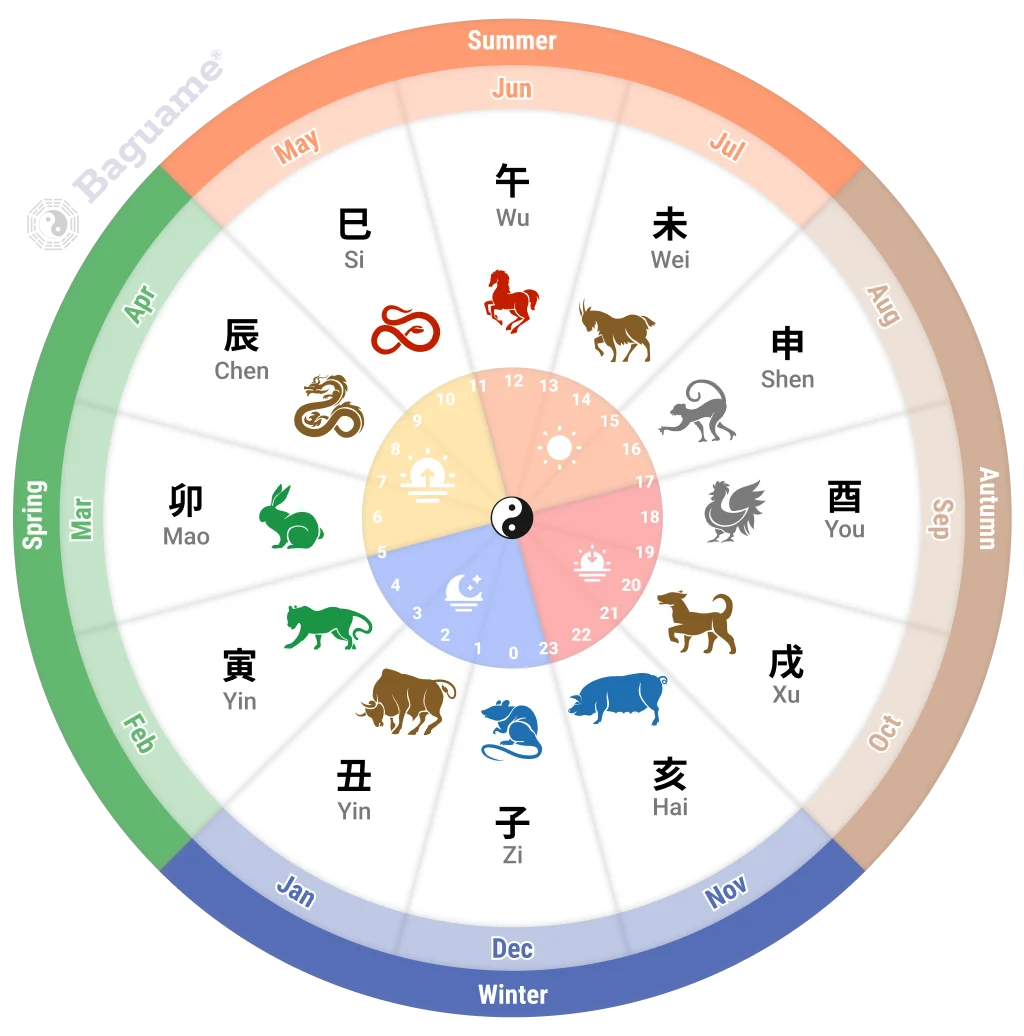
未 Wei is the eighth of the 12 Earthly Branches and the closing branch of Summer. Where 午 Wu (Horse) expressed Fire energy at its absolute Yang peak, Wei is the long, warm exhale that follows — Summer’s final fullness before Autumn begins its descent. Its element is Earth, its polarity is Yin, and its zodiac animal is the Goat.
In BaZi (Four Pillars of Destiny), Wei is one of the four “Earth Reservoir” or Storage branches (土庫) — specifically, the Wood Reservoir (木庫). Like 辰 Chen (Dragon), Wei contains hidden elemental energy from a previous season that it stores and holds in transition. Its three hidden stems tell the story of Summer’s heat, its Earth foundation, and the Wood energy carried over from Spring.
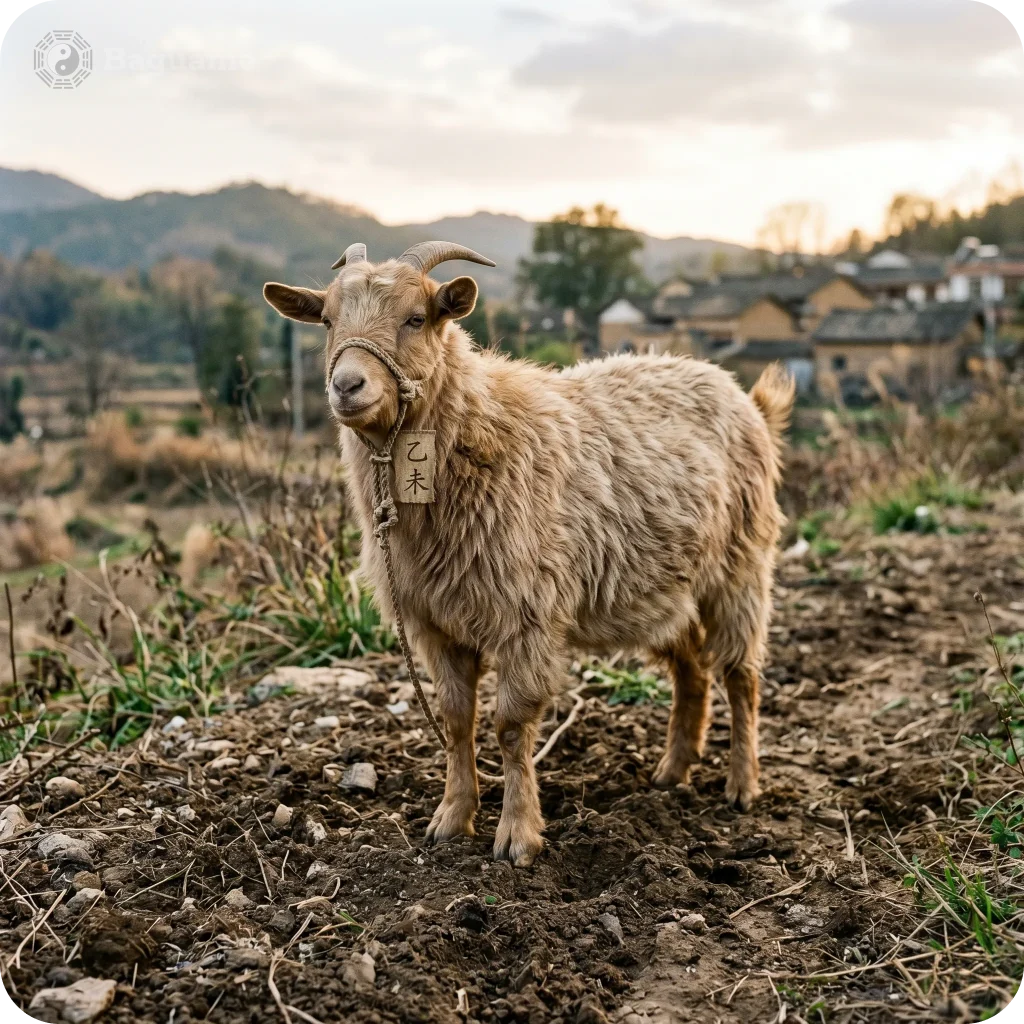
| Attribute | Value |
| Chinese Character | 未 |
| Romanization | Wei |
| Position in Cycle | 8th of 12 |
| Polarity | Yin |
| Element | Earth |
| Zodiac Animal | Goat |
| Season | Late Summer |
| Solar Month | 6th month (approx. July) |
| Hours | 13:00 – 15:00 |
| Direction | SSW (210°) |
| Principal Hidden Stem | 己 Ji (Yin Earth) — 60% |
| Middle Hidden Stem | 丁 Ding (Yin Fire) — 20% |
| Residual Hidden Stem | 乙 Yi (Yin Wood) — 20% |
Hidden Stems: Three Layers Inside Wei
Wei contains three hidden Heavenly Stems — all Yin, like 丑 Chou (Ox). This makes Wei one of two all-Yin hidden stem branches in the system. The combination of Yin Earth, Yin Fire, and Yin Wood inside a single branch creates a uniquely gentle, warm, and nurturing elemental profile — and also makes Wei the Wood Reservoir, storing Spring’s residual Wood energy deep in Summer’s heat.
己 Ji — Yin Earth (60%)
The Principal Qi of Wei. 己 Ji — the same Yin Earth that dominates Chou (Ox) — appears here warmed by Summer’s heat rather than frozen by Winter’s cold. Ji Earth in Wei is at its most fertile and productive: moist, yielding, and capable of nurturing whatever is planted in it. This is farmland in July — fully alive, holding everything Summer has given it, ready to give back. In chart analysis, Wei’s Ji Earth is a strong resource for Earth Day Masters.
丁 Ding — Yin Fire (20%)
The Middle Qi of Wei. 丁 Ding — the same Yin Fire that is the principal stem of Wu (Horse) — lingers inside Wei as Summer’s residual warmth. The season has peaked but not yet ended; the heat is still present, still generating, but beginning its slow transition. This hidden Ding means Wei can participate in the Summer Seasonal Frame (Si–Wu–Wei) and the Fire Three Combination, and makes Wei a support for Fire Day Masters.
乙 Yi — Yin Wood (20%)
The Residual Qi of Wei. 乙 Yi — the same Yin Wood that fills Mao (Rabbit) entirely — sits deep inside Wei as the stored remnant of Spring. This is what makes Wei the Wood Reservoir (木庫): Spring’s Wood energy, absorbed into Summer’s Earth, held in reserve. In chart analysis, this hidden Yi enables Wei to anchor the Wood Three Combination (Hai–Mao–Wei) despite being an Earth branch — mirroring exactly how Chen (Dragon) anchors the Water combination through its hidden Water.
Elemental Nature and Symbolic Meaning
Wei is the transitional Earth of late Summer — the long, warm afternoons of July when the heat is still full but the angle of the sun has begun its subtle southward shift. Crops are heavy on the branch. The land is giving its maximum yield. This is not the explosive energy of early Summer but its ripe completion — abundance that has had time to deepen and settle.
In the cycle of the Five Elements, transitional Earth bridges Summer and Autumn. Wei specifically carries the warmth of Fire and the lingering memory of Wood — three elements present in one branch, all at their Yin expression, creating an unusually soft and receptive elemental profile. The Goat embodies this quality: a gentle, community-oriented creature that thrives through cooperation rather than competition, and whose greatest strength is the capacity to nourish those around it.
In classical Feng Shui, the SSW direction at 210° sits at the boundary of the Kun Trigram (☷ Earth) — the trigram of receptivity, nourishment, and the mother. Kun’s energy of yielding strength and nurturing abundance aligns perfectly with Wei’s character. On the 24 Mountains Luo Pan, the SSW zone contains: 丁 Ding, 未 Wei, and 坤 Kun — with Wei occupying the central 15° of SSW (202.5°–217.5°).
Branch Interactions
Wei participates in an unusually wide range of interactions. As a Storage branch it carries the same clash-release dynamic as Chen, Xu, and Chou. Its three hidden stems enable it to participate in both Wood and Fire combinations, making it one of the most versatile branches in the system. In BaZi analysis, always assess which hidden stem is being activated by a given interaction.
Six Combination (六合): Wei + Wu → Fire
未 Wei combines with 午 Wu (Horse) to produce Fire energy — a natural combination as both are Summer branches. Wei’s hidden 丁 Ding Fire completes this interaction, reinforcing the shared Summer Fire character. In a chart, Wu–Wei combination amplifies Fire and concentrates Summer energy — one of the warmer and more sustained combinations in the system.
Three Combination (三合): Hai + Mao + Wei → Wood Frame
亥 Hai (Pig), 卯 Mao (Rabbit), and 未 Wei form the Wood Three Combination (三合木局). Wei acts as the closing node, anchored by its hidden 乙 Yi Wood. Despite being a Summer Earth branch, Wei stores enough Wood to anchor this combination — mirroring how Chen anchors the Water combination through its hidden Water. When all three branches appear, Wood energy is powerfully amplified.
Seasonal Combination (三會): Si + Wu + Wei → Fire Season
巳 Si (Snake), 午 Wu (Horse), and 未 Wei form the Seasonal Fire Frame — the three branches of Summer. Wei acts as the closing node through its hidden 丁 Ding Fire. The Seasonal Frame is considered the strongest Fire combination when all three branches are present together — and Wei’s participation despite being an Earth branch is enabled entirely by this hidden stem.
Six Clash (六沖): Wei ↔ Chou
未 Wei (Yin Earth, Summer) clashes directly with 丑 Chou (Ox) — also Yin Earth, but from Winter. This is the same Earth–Earth clash between opposing seasons we saw with Chen–Xu, but between the two Yin Earth Storage branches. When Wei and Chou clash, both release their stored elements: Wei releases its hidden 乙 Yi Wood; Chou releases its hidden 辛 Xin Metal and 癸 Gui Water. The resulting elemental disruption can significantly reshape a chart’s balance.
Punishment (刑): Chou → Xu → Wei — Bullying Punishment
未 Wei participates in the three-branch Bullying Punishment (恃勢之刑) together with 丑 Chou (Ox) and 戌 Xu (Dog) — the three Yin Earth branches in a mutual punishment cycle. Each punishes the next: Chou punishes Xu, Xu punishes Wei, Wei punishes Chou. This creates a pattern of stubborn, grinding friction between branches sharing the same element — no resolution, no release, just persistent erosion. Even two of the three branches can produce partial punishment effects.
Harm (害): Wei ↔ Zi
未 Wei and 子 Zi (Rat) form a Harm relationship (六害). The warm, yielding Yin Earth of midsummer and the pure Yang Water of midnight are at maximum elemental and seasonal distance. Their Harm manifests as quiet, structural incompatibility — a slow erosion of each other’s effectiveness rather than an open confrontation. In a chart where both appear, areas of life governed by Wei and Zi tend to work at cross purposes in ways that are difficult to identify and correct.
Wei in the BaZi Chart: Four Pillar Positions
The meaning of Wei shifts depending on which pillar it occupies in a BaZi chart. Use the Baguame BaZi calculator to identify where Wei appears across your Year, Month, Day, and Hour pillars.
Year Pillar
Relates to ancestry and early life. Wei in the Year Branch suggests an upbringing characterized by warmth, creativity, and a nurturing environment. The family context may have emphasized emotional connection, artistic expression, or communal harmony over competition and individual achievement.
Month Pillar
Reflects career context. Wei in the Month Branch places the Goat’s nurturing, creative energy in the professional sphere. Natural domains include the arts, design, education, counseling, healthcare, and any field requiring patience, sustained attention, and genuine care for the people involved.
Day Pillar
Describes the self and closest relationships. Wei as a Day Branch indicates a person with 己 Ji Earth as their core energy — gentle, empathetic, and deeply oriented toward connection. In relationships they are giving and loyal, but may struggle with boundaries — absorbing others’ difficulties as their own, and finding it hard to disengage from those who drain them.
Hour Pillar
Governs later life and private desires. Wei in the Hour Branch places Earth’s nurturing, accumulating energy in the realm of inner aspiration — a person whose later life is characterized by the quiet enjoyment of what has been built over a lifetime, and whose private world is rich with warmth, creativity, and meaningful connection.
Wei as a Time Marker: Month, Hour, and Direction
Wei Month
Wei governs the 6th lunar month — containing the Major Heat (大暑 Da Shu) solar term (approximately July 7 – August 6 in the solar calendar). This is statistically the hottest period of the year in most of East Asia, even though Yang energy has already begun its decline from the Summer Solstice. Wei month energy is lush, warm, and deeply fertile — a time of maximum abundance before Autumn begins its transformation.
Wei Hour
Wei governs 13:00–15:00 — the early afternoon, when the sun has passed its zenith and the day’s heat is at its most intense even as the light begins its slow decline. This is the hour of warmth without urgency — a natural pause in the day’s activity. Births during this window are recorded as the Wei Hour in a BaZi chart, associated with warmth, creativity, and a deeply relational inner world.
Wei Direction: SSW
Wei corresponds to SSW at 210° on the compass, within the territory of the Kun Trigram (☷ Earth) in classical Feng Shui. On the 24 Mountains Luo Pan, Wei occupies the central 15° of SSW (202.5°–217.5°), flanked by 丁 Ding and 坤 Kun. In Flying Stars natal chart analysis, the SSW sector carries the energy of late Summer Earth — relevant for relationships, nourishment, and receptive accumulation in a property.
Goat Years in the 60-Year Cycle: Wood, Fire, Earth, Metal, Water Goat
In the BaZi calendar, every Goat year pairs 未 Wei with a different Heavenly Stem. Because Wei is a Yin Branch, it always pairs with Yin Stems — completing its full cycle of 5 variations every 60 years.
| Stem + Branch | Name | Stem Element | Recent Years |
| 乙未 | Wood Goat | 乙 Yi — Yin Wood | 1955, 2015, 2075 |
| 丁未 | Fire Goat | 丁 Ding — Yin Fire | 1907, 1967, 2027 |
| 己未 | Earth Goat | 己 Ji — Yin Earth | 1919, 1979, 2039 |
| 辛未 | Metal Goat | 辛 Xin — Yin Metal | 1931, 1991, 2051 |
| 癸未 | Water Goat | 癸 Gui — Yin Water | 1943, 2003, 2063 |
| Note: Wei always pairs with Yin Stems only (乙, 丁, 己, 辛, 癸) — Yin Branch pairs with Yin Stem. There is no Yang Stem Goat year. | |||
Goat Symbolism and Character in Chinese Culture
The Goat (also rendered as Sheep or Ram in some traditions) holds one of the most consistently positive symbolic positions in the Chinese zodiac. It is associated with gentleness, artistic talent, and the grace of things that are beautiful without effort. In Chinese culture, three Goats together (三羊開泰, Sān Yáng Kāi Tài) is one of the most auspicious symbols of the new year — traditionally depicted at the start of the first lunar month to invoke blessings, prosperity, and smooth beginnings.
The Goat’s connection to Earth and to the Kun Trigram deepens its nurturing character. Kun is the mother, the receptive, the one who sustains. The Goat in a herd feeds, protects, and moves together — its strength is collective, its nature communal. It does not lead through force but through connection.
Core Goat Traits in BaZi
Wei’s all-Yin hidden stems — Ji Earth, Ding Fire, Yi Wood — produce a distinctive character profile when Wei appears prominently in a chart:
- Empathy and sensitivity — absorbs the emotional atmosphere of any environment
- Artistic and aesthetic intelligence — naturally attuned to beauty, form, and creative expression
- Gentle persistence — does not force; finds the path of least resistance and follows it consistently
- Deep loyalty — forms strong bonds and holds them across time and difficulty
- Boundary difficulty — the receptive Earth quality can absorb too much from others
- Hidden resilience — the Wood Reservoir beneath the soft surface holds more strength than is visible
What the Goat Symbolizes
- 三羊開泰 — Three Goats Open Prosperity — one of the most auspicious symbols in Chinese culture
- Late Summer abundance — the land at maximum yield, warm and giving
- The Wood Reservoir — Spring’s energy stored deep in Summer’s Earth
- Kun — the Mother — receptivity, nourishment, and the strength that sustains without asserting
- Artistic grace — beauty that arises naturally, without effort or announcement
- Community over competition — the herd animal; strength in connection, not isolation
Frequently Asked Questions
Wei is Yin Earth. Its principal hidden stem is 己 Ji (Yin Earth) at approximately 60%, with 丁 Ding (Yin Fire) and 乙 Yi (Yin Wood) each contributing around 20%. All three hidden stems are Yin — making Wei one of two all-Yin hidden stem branches alongside 丑 Chou (Ox). Wei is designated the Wood Reservoir because of its hidden Yi Wood.
Wei stores Wood energy through its hidden 乙 Yi Wood stem — the residual Wood energy of Spring absorbed into Summer’s Earth. This is what allows Wei, an Earth branch, to anchor the closing node of the Wood Three Combination (Hai–Mao–Wei). The four Storage branches are: 辰 Chen (Water), 未 Wei (Wood), 戌 Xu (Fire), and 丑 Chou (Metal). When Wei is clashed — by Chou — the stored Wood is released into the chart.
Wei clashes with 丑 Chou (Ox). Both are Yin Earth Storage branches from opposite seasons — Wei holds Summer’s Wood, Chou holds Winter’s Metal and Water. When they clash, both release their stored elemental energies simultaneously, creating a significant multi-element disruption. Wei and Chou are also part of the same Bullying Punishment triangle (with Xu), adding another layer of interaction between these two branches.
Because Wei contains two relevant hidden stems: 乙 Yi Wood and 丁 Ding Fire. In the Wood Three Combination (Hai–Mao–Wei), the Yi Wood activates. In the Summer Seasonal Frame (Si–Wu–Wei) and the Six Combination with Wu, the Ding Fire activates. This dual participation — in Wood and Fire combinations — is what makes Wei one of the most versatile closing nodes in the system, directly paralleling how Chen participates in both Water and Wood combinations.
Yes — 未 Wei is variously translated as Goat, Sheep, or Ram depending on the source and tradition. In classical Chinese, 羊 (yáng) refers broadly to the family of ovine animals without distinguishing between goat, sheep, or ram. Most modern English-language BaZi and Chinese astrology resources use “Goat” as the standard translation, though “Sheep” remains common in older texts and some regional traditions. In BaZi analysis, the translation used does not affect the branch’s elemental properties, interactions, or meaning — all three terms refer to the same branch, 未 Wei.