
Rat (子 Zi): The First Earthly Branch, Element & Interactions
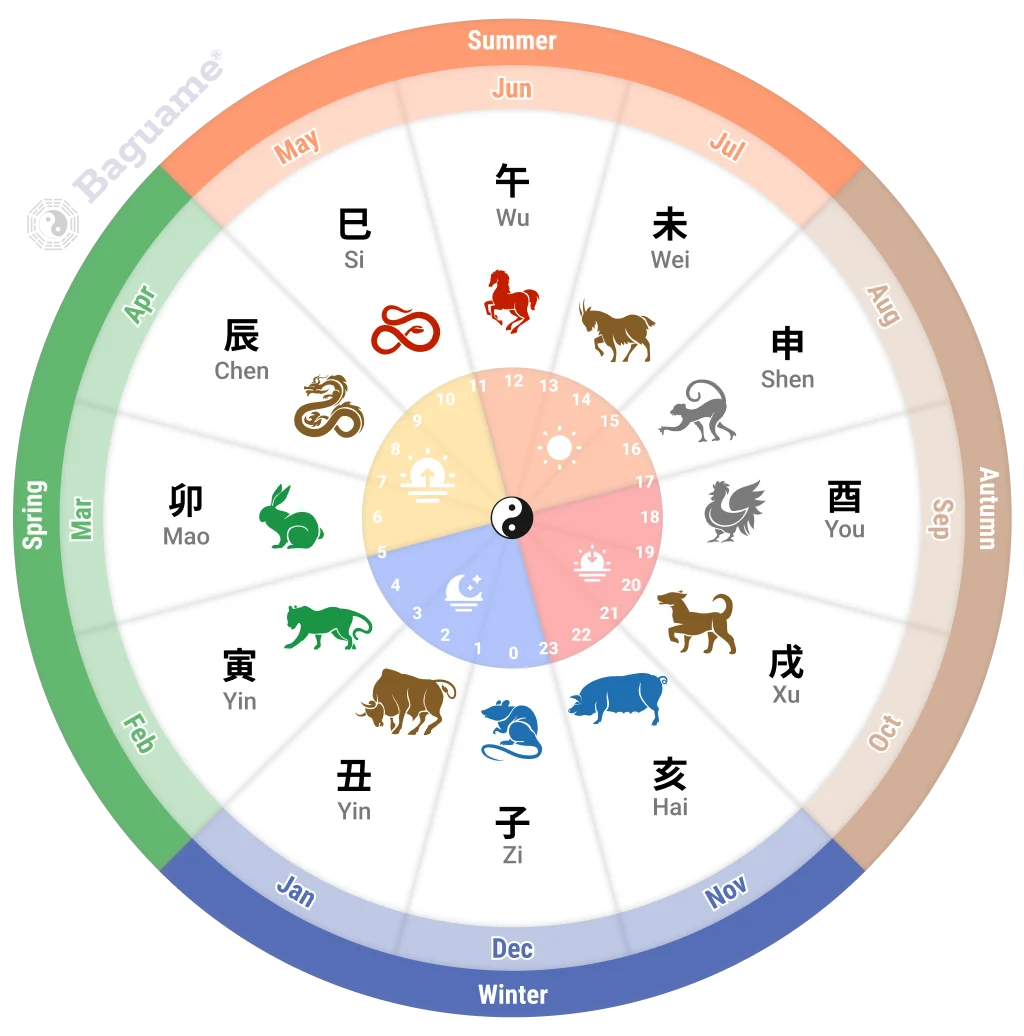
子 Zi is the first of the 12 Earthly Branches and the starting point of the entire Branch cycle. It marks the peak of Winter, the moment of maximum Yin — and paradoxically, the hidden birth of Yang. In the Chinese calendar, Zi governs the 11th solar month (roughly December), the hours of 23:00–01:00, and the compass direction of due North. Its zodiac animal is the Rat. Its element is Water — specifically, pure Yang Water.
In BaZi (Four Pillars of Destiny), the Earthly Branches form the bottom row of every pillar. Understanding Zi in depth is essential to reading any chart where it appears — as a Year, Month, Day, or Hour Branch.

| Attribute | Value |
| Chinese Character | 子 |
| Romanization | Zi |
| Position in Cycle | 1st of 12 |
| Polarity | Yang |
| Element | Water |
| Zodiac Animal | Rat |
| Season | Mid-Winter |
| Solar Month | 11th month (approx. December) |
| Hours | 23:00 – 01:00 |
| Direction | North (0° / 360°) |
| Hidden Stem | 癸 Gui (Yin Water) — 100% |
Hidden Stem: 癸 Gui — Yin Water
Unlike most Earthly Branches, which contain two or three hidden Heavenly Stems, Zi contains only one: 癸 Gui (Yin Water). It is the Principal Qi and occupies 100% of the branch’s energy. There is no secondary or residual stem.
癸 Gui Water is the water of rain, mist, dew, and underground streams. It is soft, penetrating, and persistent. It does not overpower — it seeps. This purity makes Zi one of the most “clean” branches in the system: what you see on the surface is exactly what is inside. There is no hidden complexity, no buried fire or earth waiting to surface under the right conditions.
Elemental Nature and Symbolic Meaning
Zi sits at the northernmost point of the compass and the deepest point of Winter. In the cycle of the Five Elements, it represents the peak of Water energy — the moment when Yin is at its absolute maximum and Yang has not yet emerged into the visible world. This is the Winter Solstice in elemental terms.
The symbolic image is of still, deep water under ice: everything seems frozen and dormant, but beneath the surface, movement never stops. Seeds are gestating. Plans are forming in silence. The Rat — a creature that moves at midnight, navigating by instinct in total darkness — captures this quality perfectly.
In Feng Shui, the North sector is governed by the Kan Trigram (☵), also associated with Water, depth, and hidden intelligence. Zi and Kan share this underlying quality: the power that moves beneath the surface rather than on it. To explore how Water energy manifests across your home’s compass sectors, see the Flying Stars and 24 Mountains tools.
Branch Interactions
In BaZi analysis, Earthly Branches interact with each other in five fundamental ways: Six Combinations (六合), Three Combinations (三合), Seasonal Combinations (三會), Clashes (沖), Punishments (刑), and Harms (害). Each type either strengthens, redirects, or disrupts the elemental energy in the chart. Here is how Zi participates in each.
Six Combination (六合): Zi + Chou → Earth
子 Zi combines with 丑 Chou (Ox) to produce Earth energy. This is a productive, harmonizing interaction. The cold Water of Zi is absorbed and stabilized by Chou’s dense Earth, yielding groundedness and practical reliability. In a chart, this combination can transform what might otherwise be excessive Water into something more structured and usable.
Three Combination (三合): Shen + Zi + Chen → Water Frame
申 Shen (Monkey), 子 Zi (Rat), and 辰 Chen (Dragon) form the Water Three Combination. This is one of the most powerful Water-producing interactions in the system. When all three branches appear in a chart — or even two of the three — Water elemental energy is dramatically amplified.
Seasonal Combination (三會): Hai + Zi + Chou → Water Season
亥 Hai (Pig), 子 Zi (Rat), and 丑 Chou (Ox) form the Seasonal Water Frame — the three branches of Winter. This is considered stronger than the Three Combination, as it reflects a natural seasonal concentration of energy. When all three appear together, Water dominance is at its most intense and difficult to moderate.
Six Clash (六沖): Zi ↔ Wu
子 Zi clashes directly with 午 Wu (Horse). This is a Water–Fire opposition — two mutually destructive forces positioned exactly opposite each other on the Branch wheel (North vs. South, 0° vs. 180°). The clash destabilizes both branches, weakening their energy and potentially triggering sudden changes or instability in the areas of life they govern. In a chart or in annual forecasting, a Zi–Wu clash is one of the most activating and disruptive interactions to watch for.
Punishment (刑): Zi ↔ Mao — Ungrateful Punishment
子 Zi and 卯 Mao (Rabbit) form the “Ungrateful Punishment” (無恩之刑). Unlike a clash, a punishment is a subtler friction-based interaction. It does not destroy energy as visibly, but creates ongoing tension and a sense that effort goes unrecognized or unreciprocated. In a natal chart, Zi–Mao punishment often surfaces in relationship dynamics or situations where loyalty is tested.
Harm (害): Zi ↔ Wei
子 Zi and 未 Wei (Goat) form a Harm relationship (六害). Harms represent a quiet incompatibility — a structural tension that drains rather than ignites. The Zi–Wei harm involves Water meeting Earth in a configuration where neither dominates, creating an environment of subtle obstruction and slow erosion rather than acute conflict.
Zi in the BaZi Chart: Four Pillar Positions
The meaning and influence of Zi shifts depending on which pillar it occupies in a BaZi chart. Use the Baguame BaZi calculator to see where Zi appears across your Year, Month, Day, and Hour pillars.
Year Pillar
Relates to ancestry, social environment, and early life conditions. Zi in the Year Branch suggests a background associated with Water qualities — adaptability, mobility, and intelligence. It may also indicate the person was born in a year of concentrated Water energy.
Month Pillar
Reflects career context, parents, and the adult working environment. Zi in the Month Branch places peak Water energy in the professional sphere — often indicating careers involving intelligence, research, strategy, or fields where adaptability is a key asset.
Day Pillar
The Day Branch describes the self and closest relationships. Zi as a Day Branch indicates a person with strong Gui Water as their foundational nature — perceptive, emotionally intelligent, strategic, and capable of working patiently toward long-term goals.
Hour Pillar
Governs later life, children, and the inner world of thoughts. Zi in the Hour Branch places pure Water energy in the realm of imagination and private thinking — a person whose plans form in silence long before they are acted upon.
Zi as a Time Marker: Month, Hour, and Direction
Zi Month
Zi governs the 11th lunar month — the month containing the Winter Solstice (approximately December 7 – January 5 in the solar calendar). In Chinese metaphysics, this is not a time of endings but of concealed beginnings: Yang Qi is born at the solstice, but too weak to be felt yet. Zi month energy favors internal work, planning, rest, and quiet preparation for the cycle ahead.
Zi Hour
Zi governs 23:00–01:00 — the stroke of midnight. This is the hour when one day officially ends and another begins in the Chinese calendar. An important note: births between 23:00 and 23:59 belong to the next calendar day in classical BaZi calculation — a detail worth confirming when using a BaZi calculator.
Zi Direction: North
Zi corresponds to due North (0° / 360°) — the direction governed by the Kan Trigram (☵) in classical Feng Shui. On the 24 Mountains Luo Pan, the North sector divides into three 15° segments: 壬 Ren (Yang Water), 子 Zi, and 癸 Gui (Yin Water). Zi occupies the central 15° of North (352.5°–7.5°), making it the purest expression of North-Water energy on the compass.
Rat Years in the 60-Year Cycle: Wood, Fire, Earth, Metal, Water Rat
In the BaZi calendar, every year is defined by a pair of a Heavenly Stem and an Earthly Branch. Because there are 10 Stems and 12 Branches, Zi (Rat) pairs with a different Stem every 12 years — completing its full cycle of 6 variations every 60 years. Each combination carries a distinct elemental character on top of Zi’s base Yang Water energy.
| Stem + Branch | Name | Stem Element | Recent Years |
| 甲子 | Wood Rat | 甲 Jia — Yang Wood | 1924, 1984, 2044 |
| 丙子 | Fire Rat | 丙 Bing — Yang Fire | 1936, 1996, 2056 |
| 戊子 | Earth Rat | 戊 Wu — Yang Earth | 1948, 2008, 2068 |
| 庚子 | Metal Rat | 庚 Geng — Yang Metal | 1960, 2020, 2080 |
| 壬子 | Water Rat | 壬 Ren — Yang Water | 1972, 2032, 2092 |
| 庚子 → 甲子 | Note: Zi always pairs with Yang Stems only (甲, 丙, 戊, 庚, 壬) — Yang Branch pairs with Yang Stem. There is no Yin Stem Rat year. | ||
Rat Symbolism and Character in Chinese Culture
The Rat is the first animal of the Chinese zodiac — not because it was the strongest or the most powerful, but because it was the most resourceful. In the traditional legend of the Jade Emperor’s race, the Rat arrived first by riding on the Ox’s back and jumping ahead at the last moment. This story perfectly captures the Rat’s essential nature: intelligence over brute force, strategy over confrontation.
In classical Chinese culture, the Rat is associated with wealth, abundance, and fertility — partly because rats were observed thriving wherever grain was stored. A rat in the house was traditionally seen as a sign of prosperity, not misfortune. Its connection to Water reinforces this: Water governs wisdom, adaptability, and the capacity to find a way through any obstacle.
Core Rat Traits in BaZi
Zi’s pure Gui Water energy translates into specific character tendencies when Zi appears prominently in a chart — especially as the Day Branch or with multiple Zi across pillars:
- Sharp perception — reads situations and people quickly
- Strategic patience — plans in depth before acting
- Adaptability — changes course fluidly when conditions shift
- Restlessness — difficulty staying still; thrives on movement and novelty
- Accumulation tendency — natural affinity for gathering resources, information, and connections
What the Rat Symbolizes
Across Chinese metaphysics and culture, the Rat carries consistent symbolic associations:
- Midnight and new beginnings — governs the hour when one day ends and another begins
- Hidden intelligence — moves in darkness, acts on instinct
- Wealth and fertility — historically associated with abundance and stored resources
- The origin point — first branch, first hour, the seed before the cycle unfolds
- Winter solstice energy — maximum Yin containing the hidden seed of Yang
Frequently Asked Questions
Zi is Yang Water. Its only hidden stem is 癸 Gui (Yin Water), making it 100% Water in elemental composition. Despite Zi itself being Yang polarity, the energy stored inside it is Yin Water — this distinction matters in advanced BaZi analysis when calculating the strength of the Day Master or assessing elemental balance.
Zi clashes with 午 Wu (Horse). This is the direct Water–Fire opposition, one of the six cardinal clashes in the Earthly Branch system. A Zi–Wu clash is activated when both branches appear in the same chart, or when the annual/monthly branch brings Wu into contact with natal Zi (or vice versa). The effects depend heavily on which branch is stronger in the overall chart context.
Zi participates in the Water Three Combination (三合水局): 申 Shen (Monkey) + 子 Zi (Rat) + 辰 Chen (Dragon). When all three branches appear in a chart, they form a powerful Water frame that significantly boosts Water elemental energy. Even when only two of the three are present, partial combination effects are generally recognized by classical practitioners.
Zi combines with 丑 Chou (Ox) in the Six Combination (六合), producing Earth energy. The pure Water of Zi is moderated and grounded by Chou’s Yin Earth. In a chart, this combination can transform excess Water into a more contained, productive force — though it also partially neutralizes Zi’s Water contribution when Chou is present.
Zi governs 23:00–01:00 — the double-hour centered on midnight. In classical Chinese timekeeping, the day was divided into 12 double-hours, each governed by an Earthly Branch. Births between 23:00 and 23:59 fall on the next calendar day in traditional BaZi calculation — your Hour Pillar is Zi, but the Heavenly Stem of the Hour must be calculated from the following day’s Day Stem. Confirm this when using the Baguame BaZi calculator.