Ask anyone in a traditional Chinese household when to move house, sign a contract or schedule a wedding, and one book appears: the Tong Shu (通書) — the Chinese almanac. After years of working with classical Feng Shui, I have come to think of it as the most used and least understood tool in the whole tradition. Some people follow it as an absolute rulebook, others ignore it completely, and both groups lose something. Here is how the Tong Shu actually works, and how I use it for ordinary, everyday decisions.
What the Tong Shu Actually Is
The Tong Shu is published every year — one page per day, in calendar order. Families across China, Hong Kong and Taiwan traditionally keep a copy in the kitchen, and in Cantonese it is known as 通勝 (Tung Shing), “sure to win”.
It is not a horoscope. It is a date-selection reference (擇日, ze ri): a compact digest of what the classical texts say about each day. It does two jobs:
The general layer — the day’s own character: its pillar, its officer, and its lists of suitable (宜, yi) and unsuitable (忌, ji) activities.
The data layer — the raw material you need to judge that day for a specific person and place: day stem and branch, hourly pillars, clash and sha direction.
Think of it as a tide table rather than a prophecy. It tells you when the water rises. Whether you sail is still your call.
The Anatomy of a Day Page
Every page carries the same handful of elements. These are the ones I actually read:
Day Pillar (日柱) — the Heavenly Stem and Earthly Branch that rule the day, and the fundamental unit of any almanac page. See the ten Heavenly Stems and the twelve Earthly Branches.
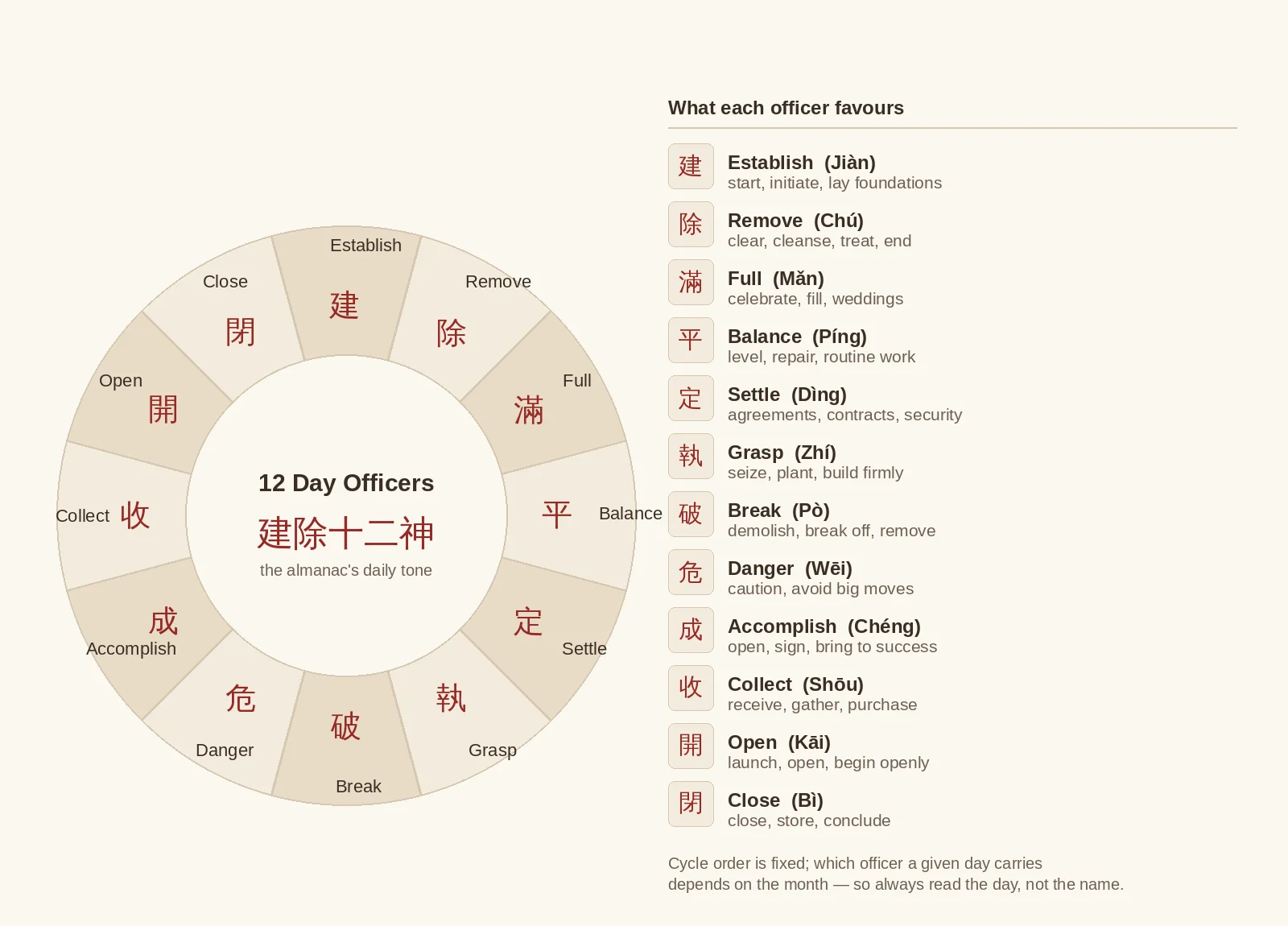
12 Day Officers (建除十二神) — the day’s officer, which sets its overall tone.
Yi (宜) and Ji (忌) — the activities traditionally supported or avoided that day.
Clash (冲) and sha direction (煞) — the branch the day conflicts with, plus the compass direction to treat carefully.
Auspicious hours (時) — which of the twelve double-hours inside the day are favourable.
Day-level markers — the Fetal God (胎神) position, Peng Zu taboos (彭祖百忌) and the star deities on duty.
You do not need all six for everyday use. But knowing what the page is telling you stops you reading a rule where there is only a hint.
The 12 Day Officers: Your Fastest Daily Filter
If you only ever check one thing, check the officer. The twelve repeat in a fixed cycle, and each names a category of action rather than a verdict.
The twelve Day Officers (建除十二神) in cycle order — the first thing I check on any almanac page.
Officer
Chinese
Best suited to
Hold back on
Establish
建 Jiàn
Starting, initiating, laying foundations, official matters
Demolition, breaking things off
Remove
除 Chú
Clearing, cleansing, medical treatment, ending what is finished
Grand ceremonies and celebrations
Full
滿 Mǎn
Weddings, celebrations, offerings, stocking and filling
Agreements, contracts, moving in, stabilising what exists
Litigation, long journeys
Grasp
執 Zhí
Planting, construction, seizing an opening
Moving house, travel
Break
破 Pò
Demolition, breaking ground, removing an obstacle
Weddings, openings, first launches
Danger
危 Wēi
Caution: keep to ordinary, low-stakes tasks
Anything risky, travel, big commitments
Accomplish
成 Chéng
Openings, signing, weddings, bringing work to completion
Disputes and litigation
Collect
收 Shōu
Receiving, collecting what is due, buying, consolidating
Starting something new
Open
開 Kāi
Grand openings, launches, weddings, moving in
Funerals, closing matters down
Close
閉 Bì
Closing, storing, concluding, resting
Openings, launches, first steps
Two cautions. The officer rotates on a month-based cycle, so the same calendar date can carry different officers in different years. And schools differ slightly on the traditional lists — which is exactly why the day’s own 宜 and 忌 columns remain the finer authority.
How to Choose a Day: A Five-Step Method
Name the intent. Sort what you are doing into one of four families: begin something, remove or cleanse something, receive or accumulate something, or close something down. Almost every real task belongs to one.
Shortlist the days. Match the intent against the officers and the 宜/忌 lists over the window you actually have. Three to five candidates are plenty.
Filter with your own chart. Strike out any day that clashes with your Day Branch, and check whether the day’s elements support your Day Master. This is the step most people skip.
Add the space layer. If the plan touches a direction — moving, renovating, digging, placing something — check the year’s afflictions and the current month’s stars for that sector.
Refine to the hour. Within the chosen day, pick a favourable double-hour and avoid the hour that clashes with your chart.
Everyday Situations: What to Look For
Moving house — Settle, Open and Accomplish days; avoid Break, Danger and Close, and any day clashing with your own branch.
Signing a contract or lease — Settle and Accomplish. Avoid Break days and any clash with your Year or Day Branch: a contract signed on a clashing day is the classic case people regret.
Launching a business, product or campaign — Open, Accomplish or Establish, ideally in a favourable hour. Fire-year momentum rewards a visible launch.
Renovation, demolition and earth works — Break governs removal, but no good day excuses disturbing the Tai Sui, Sui Po or San Sha direction, or activating a 5 Yellow sector.
Medical treatment and surgery — traditionally Remove days, chosen to support the patient’s own chart. Treat this as a complement to medical advice, never a substitute.
Interviews, negotiations, important meetings — Accomplish, Establish or Settle, and never on your own clash day.
Weddings and engagements — Full, Open, Accomplish or Settle. Avoid Break, Danger and Close, and check both partners’ branches, not just one.
Travel, exams and study — Open and Establish for departures; use the hourly pillars when the departure time is yours to choose.
The Personal Layer: Why the Generic Almanac Is Not Enough
An almanac is written for everyone, which means it is written for no one in particular. A day can be rated excellent in general and still be a poor fit for you.
Clash. Every branch clashes with the branch opposite it. When the day clashes with your Day Branch — or, for a major commitment, your Year Branch — tradition says postpone rather than push. This is the single most useful personal filter in daily use.
Elemental support. The day’s stem and branch carry elements. When they feed your Day Master and your favourable elements, the day works with you instead of against you. Our BaZi calculator shows your Day Master, your branches and your favourable elements; the theory behind it is in the Four Pillars guide and the Ten Gods reference.
Hours. The day is only the first division. The twelve double-hours refine it further, and they are the level at which most people can actually still choose.
That is the whole difference between superstition and method: the almanac supplies the pattern, your chart supplies the fit.
Where the Almanac Meets Feng Shui
Date and space are two halves of one method. The almanac answers “when”, Feng Shui answers “where” — and a date is only as good as the space it is applied in.
The year’s afflictions.Tai Sui, Sui Po and San Sha mark directions that should stay quiet. No favourable day justifies disturbing them.
The 5 Yellow. In 2026 the annual 5 Yellow sits in the South (Li palace). Whatever a day page says, keep the South calm this year — the full picture is in our Annual Afflictions guide.
The monthly layer. The stars move every month: a sector that was harmless in July can be the one to avoid in August. See August 2026 monthly Flying Stars for how a month is read combination by combination.
The exact degree. “South” is 45 degrees wide, and afflictions occupy far narrower slices — the 24 Mountains split each direction into three, which is often the difference between renovating safely and not.
A Two-Minute Daily Routine
This is the version I recommend to clients who want the almanac to be part of ordinary life rather than an occasional ritual:
Note the day’s officer and take it as the day’s tone, not a command.
Scan 宜 and 忌 for the one task that actually matters to you today.
Check the clash branch. If it is yours, keep the day for routine work and postpone signatures.
If timing matters, pick a favourable double-hour. Otherwise get on with your day.
Three Common Mistakes
Treating 宜 and 忌 as commands. They are general-purpose defaults compiled for everyone; your chart decides how much they apply to you.
Skipping the personal filter. Choosing an “excellent” day that clashes with you personally is worse than choosing an average day that does not.
Letting date-hunting replace preparation. A well-prepared action on a middling day beats a rushed one on a perfect day. The almanac sequences effort; it does not remove the need for it.
Make It Personal in a Few Minutes
Reading a day page is quick; doing the personal filter by hand is not. That is exactly why I built the calculators on this site — so the arithmetic stops being a barrier to using the almanac properly.
The BaZi Calculator gives you your Day Master and branches, the raw material for every personal filter above.
Affliction Zones shows where this year’s Tai Sui, Sui Po and San Sha fall in your home — and you can see how that works on our affliction map.
The Flying Stars Calculator reveals the monthly and annual stars per sector, so the space layer is checked in seconds.
If you want the direction layer exact, the 24 Mountains tool shows the 15-degree slices behind each compass direction.
Start with your own chart, add the almanac, then check the space. In that order, the Tong Shu stops being a book of omens and becomes what it was always meant to be: a scheduling tool with three thousand years of practice behind it.