
The Five Yellow Star (Wu Wang 五黄): Mechanics, Combinations and Cures
In the nine-star system of Classical Feng Shui, the Five Yellow Star (五黄) is the most discussed — and most feared — of the flying stars. It is pure, dense Earth, the central emperor of the Lo Shu grid, and in its flying form it carries the heaviest reputation in the whole system. Traditional guides call it the "Star of Misfortune", the "Five Yellow Calamity", or simply Wu Wang, and when it flies into a sector, that sector is treated with the greatest caution. But the Five Yellow is also the most misunderstood star. In its home palace — the center of the chart — it is dormant, safe and even neutral. It only becomes dangerous when it moves: when the annual or monthly rotation carries it out of the center and into a living sector, and when human activity (people, noise, renovation, a door or bed in that corner) wakes it up. Because the Flying Stars system is, above all, a system of movement and position, understanding where the Five Yellow flies each year and month is the practical core of handling it. This guide covers the Five Yellow specifically as a flying star: its role and element within the chart, its annual and monthly positions, how it interacts with the other eight stars, and how to read it in your own home's charts. The guide covers the star itself — what it is, where it flies, how it combines with the other eight, and how it is cured. For the overview of the whole rotation system, see the complete Flying Stars guide.
1. The Five Yellow in the Flying Stars System: Center and Emperor

Every year nine stars move through the Later Heaven Bagua grid. The Five Yellow (五黄) is the fifth, and it is unique: it is the only star whose home is the central palace, the pivot around which the other eight rotate. It belongs to the element of Earth at its most concentrated.
| Attribute | Five Yellow (五黄) |
|---|---|
| Star number | 5 |
| Element | Earth (concentrated, "dense malevolent earth") |
| Home palace | The Center of the Lo Shu grid |
| Innate nature | The "Emperor" or "Wuling" — greatest power, greatest risk |
| Classic nickname | "The Star of Misfortune" / "Five Yellow Calamity" / Wu Wang (五黄煞) |
In Xuan Kong tradition, the Five Yellow is Earth of extreme density. Unlike the softer Earth of the Two Black or the productive Earth of the Eight White, the Five Yellow is the still, heavy heart of the grid — the emperor who, when he leaves his throne and enters a household sector, brings the weight of calamity with him. Three facts frame the whole art of handling the Five Yellow in Flying Stars:
- It is strongest at the center and when it moves. In the central palace it is dormant and largely safe; the danger begins when annual, monthly or period rotation carries it into a living sector.
- Human activity activates it. A Five Yellow that enters a door, bed, desk or noisy corner is "woken"; a Five Yellow in a rarely-used, quiet void is far less of a threat.
- It amplifies whatever it touches. As the strongest Earth, it magnifies the misfortune and illness of the stars it meets — most dangerously the Two Black.
The greatest misunderstanding about the Five Yellow is that it is an "always-on" disaster. It is not. As the central palace star it is neutral and often left alone; it becomes a working misfortune star only when it flies into a lived-in sector and is stirred by activity. The whole skill of Flying Stars is tracking where it has flown this year — and reasoning calmly about that position, not fearing the number itself.
2. The Timeless (Non-Temporal) Meaning of 5 Yellow
Every star has two layers: a fixed nature that never changes, and a temporal behaviour (where it flies each year and month). The timeless layer comes first.
2.1 The fixed nature of the Emperor Earth
The Five Yellow is always the star of number 5 and dense Earth, in every period and every chart. Timeless nature:
- The pivot and "throne" of the chart — authority, magnitude, the center that holds the system together
- Extreme, concentrated power — in an auspicious set-up it can be the strongest force in the chart
- Earth of severity — illness, misfortune, accidents, losses and delays when it turns malignant
Timeless conditions for good or bad:
- Safe while still. Untouched, in a quiet void or the center, it causes little trouble.
- Malignant when stirred. Disturbed by activity, construction, noise or movement, its weight falls on the sector.
- Amplified by companions. It magnifies the misfortune and illness of whatever star it meets.
Key principle: the Five Yellow's timeless rule is about stillness versus activity, not about the number being "bad". Keep it quiet and unstimulated and it stays dormant; this is the origin of the classic "great silence" instruction.
2.2 Elemental interplay (timeless)
Because the Five Yellow is dense Earth, its elemental relationships are fixed regardless of the year:
| Element | Relationship to 5 Yellow (Earth) | Practical role in the Flying Stars chart |
|---|---|---|
| Metal (6 White, 7 Red) | Earth generates Metal | The standard "drain" — Metal spends the Earth's excess; the classic calming outlet in a malignant sector |
| Earth (2, 8) | Same element | Reinforces the density; more Earth makes the Five Yellow heavier, not lighter |
| Fire (9 Purple) | Fire generates Earth | Feeds and strengthens the Five Yellow — generally to be avoided near it |
| Water (1 White) | Earth controls Water | The Earth dominates Water; water features near the Five Yellow are usually discouraged |
| Wood (3, 4 Green) | Wood controls Earth | The theoretical controller, but hard to apply cleanly; Wood that digs at dense Earth can also stir it |
In the flying chart, the working relationship to remember is Earth → Metal. When the Five Yellow sits in an active sector, the classic response is to let it express its Earth as Metal — a calm metal presence that "drains" the excess — and to avoid Fire, which would feed it. This is the eternal, year-independent rule; the temporal part, below, tells you where to apply it this year.
3. The Temporal Behaviour: Where the 5 Yellow Flies
The timeless nature becomes actionable when the Five Yellow moves. Flying Stars is a movement system: every year and month the stars rotate around the nine palaces. The Five Yellow's position is the single most important thing to know about it.
3.1 The annual rotation
The Five Yellow follows the annual flying pattern. Its palace changes every year: one star takes the center of the Lo Shu square as the ruling star of the year, and the other eight take their places around it — a nine-year cycle that then repeats.
The flight order never changes: Center → North-West → West → North-East → South → North → South-West → East → South-East. To locate the annual Five Yellow for any year, find that year's ruling star in the center and count on through the order until you reach the Five Yellow; the palace you land on is where it sits. The current chart, plotted onto your own floor plan, is what the Baguame Flying Stars calculator gives you, and the year's reading follows in the Baguame blog when the solar year turns in February.
For a worked example, take 2026: its ruling star is 1, so the Five Yellow sits in the South (Li Palace).
The Five Yellow is always somewhere, and its position defines the year's "danger direction". The classic practice is to read the sector holding this year's Five Yellow: if it is a rarely-used storage space or a quiet void, many practitioners choose to leave it undisturbed; if it is a door, bed, desk or kitchen — an active, lived-in space — it needs calm handling (a metal drain, enforced stillness) for the year. Detailed remedies for an active sector are set out in section 7 below.
3.2 Monthly and period (natal) layers
The Five Yellow also appears in monthly charts, moving through the palaces about every thirty days. Rule of thumb:
- Anchor to the annual. The yearly Five Yellow is the stable target; do not reorganise a room monthly.
- Use monthly for short care — if a monthly Five Yellow briefly lands on a bedroom or main desk, expect that corner to feel heavier for that month and avoid starting important or disruptive work there.
Every home also has a natal (period) chart cast from its construction or current-use year. In some configurations the Five Yellow appears as a fixed star in a palace; reading it there is part of the full home analysis. See how to determine your home's natal chart parameters.
4. How the 5 Yellow Interacts With the Other Eight Stars
The Five Yellow never flies alone — in any chart it meets other stars, and because it amplifies whatever it touches, its combinations matter more than most.
| 5 Yellow meets | Star's element | Result in the chart |
|---|---|---|
| 1 White | Water | Water struggles against the dense Earth; a heavy, mixed sector that needs calm |
| 2 Black | Earth | The classic double-Earth misfortune: the Two Black illness star meeting the Five Yellow — the most feared pairing for illness and loss |
| 3 Jade | Wood | Wood trying to dig into dense Earth — agitation and friction; a restless, quarrelsome sector |
| 4 Green | Wood | Subtle friction; frustration more than open conflict, with a shadow of gossip |
| 6 White | Metal | Earth generates Metal — the best-natured neighbour: it lets the Five Yellow drain productively |
| 7 Red | Metal | Metal drain with a sharper edge — effective relief, but with loss or injury overtones if stirred |
| 8 White | Earth | Earth alongside Earth — wealth star dampened; manageable but heavy, keep it still |
| 9 Purple | Fire | Fire feeds Earth — the Five Yellow is strengthened; the trickiest neighbour to calm |
The pairing that matters most
5 Yellow + 2 Black (double Earth). This is the combination the classics warn about most. Two dense Earth stars together amplify illness, loss and misfortune far beyond either alone. If this pair occupies a lived-in sector in your chart, treat it with the greatest care — keep it quiet, avoid construction and heavy activity, and apply a calm Metal drain rather than Fire, which would feed both.
5 Yellow + 6 White or 7 Red (Earth to Metal). The more constructive side. Because the Five Yellow's natural outlet is Metal, meeting a Metal star gives its dense Earth somewhere productive to go. This is the pairing that responds best to a calmer, more settled reading — and it is why Metal is the recurring theme in Five Yellow handling.
5. How the Five Yellow Manifests in Different Areas of Life
As the star of dense Earth, the Five Yellow most often shows itself in four areas. (The remedies themselves are set out in section 7; here the focus is on how to read its flying position.)
5.1 Health and illness
The clearest manifestation. A stirred Five Yellow in a bedroom, kitchen or bathroom heightens the risk of stubborn illness, injury and recovery setbacks, and it magnifies the Two Black sickness star when the two meet. Flying-stars reading: note the sector holding this year's Five Yellow, and if it is a sleeping or cooking space, treat it with stillness and a metal drain.
5.2 Misfortune, accidents and loss
Its classic "calamity" face: accidents, sudden losses, breakages, and life events that seem to come out of nowhere. Directionally, misfortune tends to surface in and around the sector the Five Yellow currently occupies. Flying-stars reading: avoid renovation, drilling or big changes in that corner this year, and keep its activity low.
5.3 Career and money
Less direct, but real: a stirred Five Yellow over a desk or front door can bring stalled progress, losses, disputes over money and unexpected expenses. Flying-stars reading: if your desk or entrance falls in the yearly Five Yellow sector, consider a calm rebalance rather than aggressive pursuit of growth there.
5.4 Relationships and the atmosphere of the home
Because it is heavy and amplifying, a Five Yellow sector can press down on the mood of the whole house if it is highly used, adding weight, worry and arguments. Flying-stars reading: the key question is always activity — a quiet Five Yellow corner is far less of a factor than one crossed daily by the family.
6. The Mechanics of Activation: Stillness, Activity and Cures
6.1 What the flying position decides
- Read motion, not the number. The Five Yellow's danger is a function of where it flies and who uses that place — not of the star existing.
- Keep it still. The timeless rule ("great silence") applies most: avoid renovation, drilling, heavy movement and loud activity in the yearly Five Yellow sector.
- Drain it with Metal. Because Earth produces Metal, a calm metal presence (a metal object, coins, a quiet bell) gives the density an outlet — the standard, year-independent response.
- Avoid Fire. Fire feeds Earth and strengthens the star; do not add fire energy or bright, hot activity to the sector.
- Respect low-use spaces. If the Five Yellow sits in a rarely-used void, many practitioners prefer to leave it alone rather than touch it at all.
6.2 Common mistakes in handling it
- Panicking at the number wherever it appears — the Five Yellow in its center or a quiet void is not actively harmful.
- Adding water or fire "for balance" — water is dominated by the Earth, and fire feeds it; neither helps.
- Doing renovations or heavy work in its yearly sector — activity is what turns a dormant Five Yellow into an active one.
- Ignoring the combining star — a Five Yellow alone is read differently from a 5+2 or 5+9 double-Earth or Fire-fed pairing.
6.3 The four strict taboos of the sector

The classical prohibitions are all versions of one rule: do not stir what is dense. They are worth learning as a list, because in practice the harm is almost always done by accident.
- No ground breaking. Digging, excavating or disturbing the foundation in the sector is the most serious of the taboos.
- No structural vibration. Knocking down walls, drilling into floors or long stretches of work with power tools belong to the same class.
- No fire or bright light. The star is Earth and Fire feeds Earth: a stove, an open fireplace, candles and hot colours all strengthen it.
- No excessive noise or movement. Loud music, doors that slam and constant foot traffic are what turn a dormant star into a working one.
7. Remedies: How to Drain the Five Yellow
The Five Yellow is Earth at its densest, so the remedy is not to fight it but to give it an outlet. In the five-element cycle Earth produces Metal, so a calm metal presence in the sector spends the star's excess and settles it. Fire runs the other way and feeds the Earth, and Earth remedies — stones, crystals, ceramics, earthenware — only add to the weight. Everything below follows from that one rule; the Five Elements article has the cycle in full.
7.1 The three classical metal cures
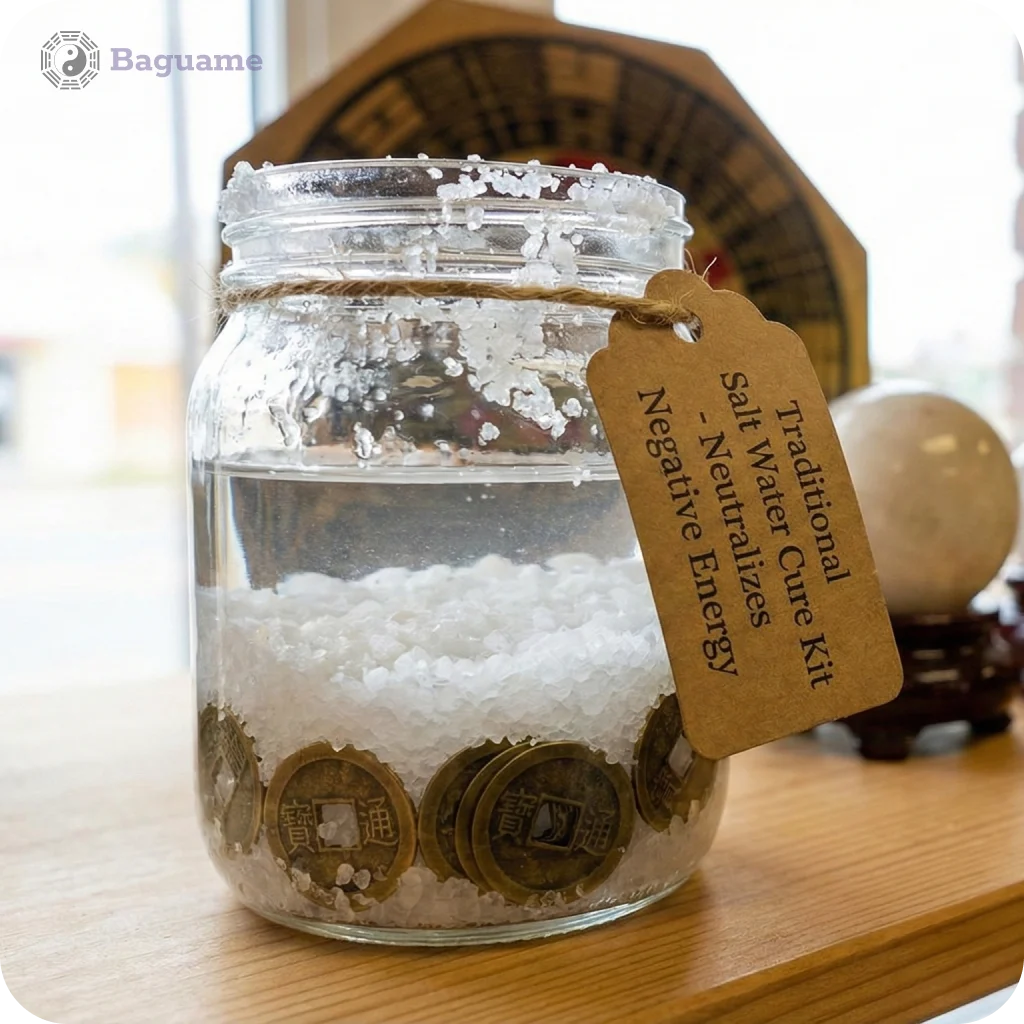
The salt water cure
A glass jar filled with salt and water, with six copper or brass coins inside. It is the most widely used cure for the star: the six coins supply the Metal, and the salt water is held to absorb and drain its density. Renew it at the end of every solar year and throw the whole jar away outside the home rather than washing it out.
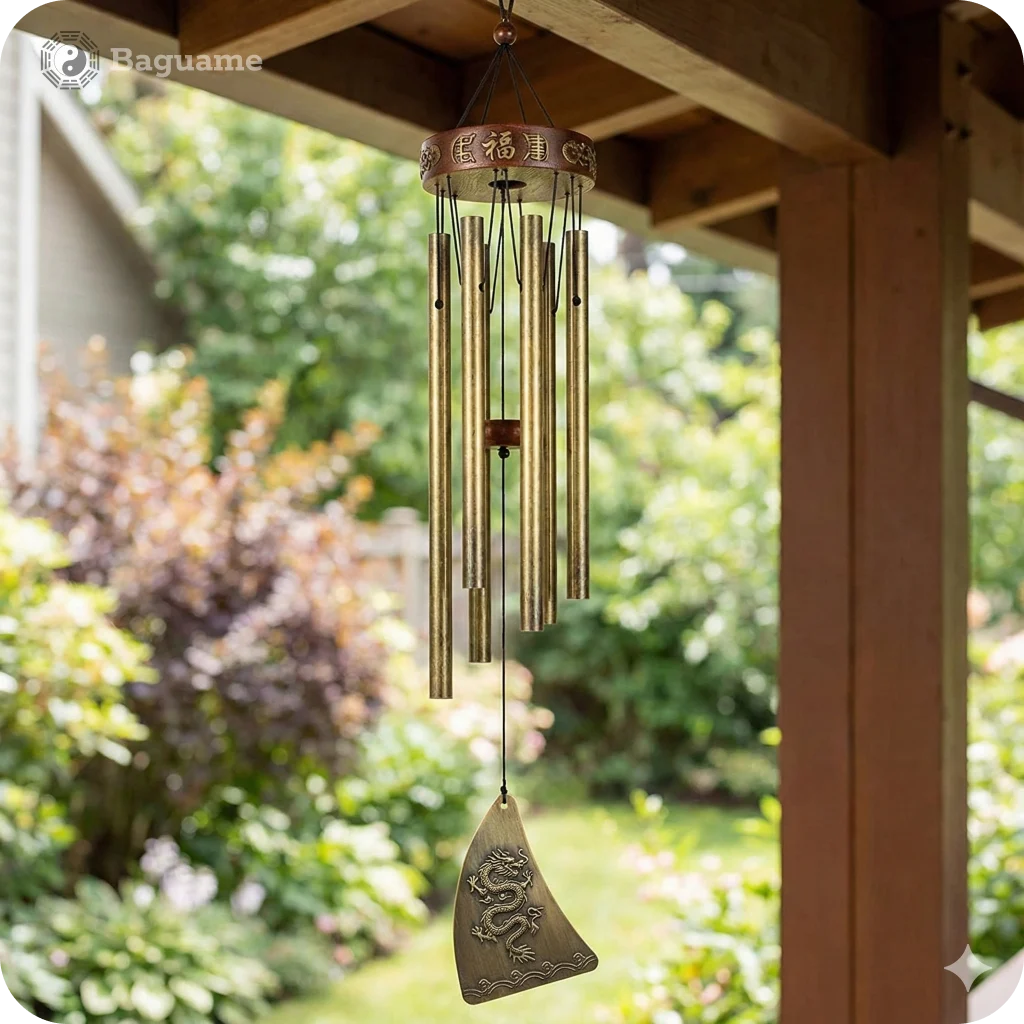
A six-rod metal wind chime
Six hollow metal rods, hung so that they can ring. Six is the number of Qian and of Metal, and the hollow rods give the vibration a voice: the sound of metal is understood to disperse stagnant Earth. It is the standard remedy when the affected sector is also a door that has to be used.
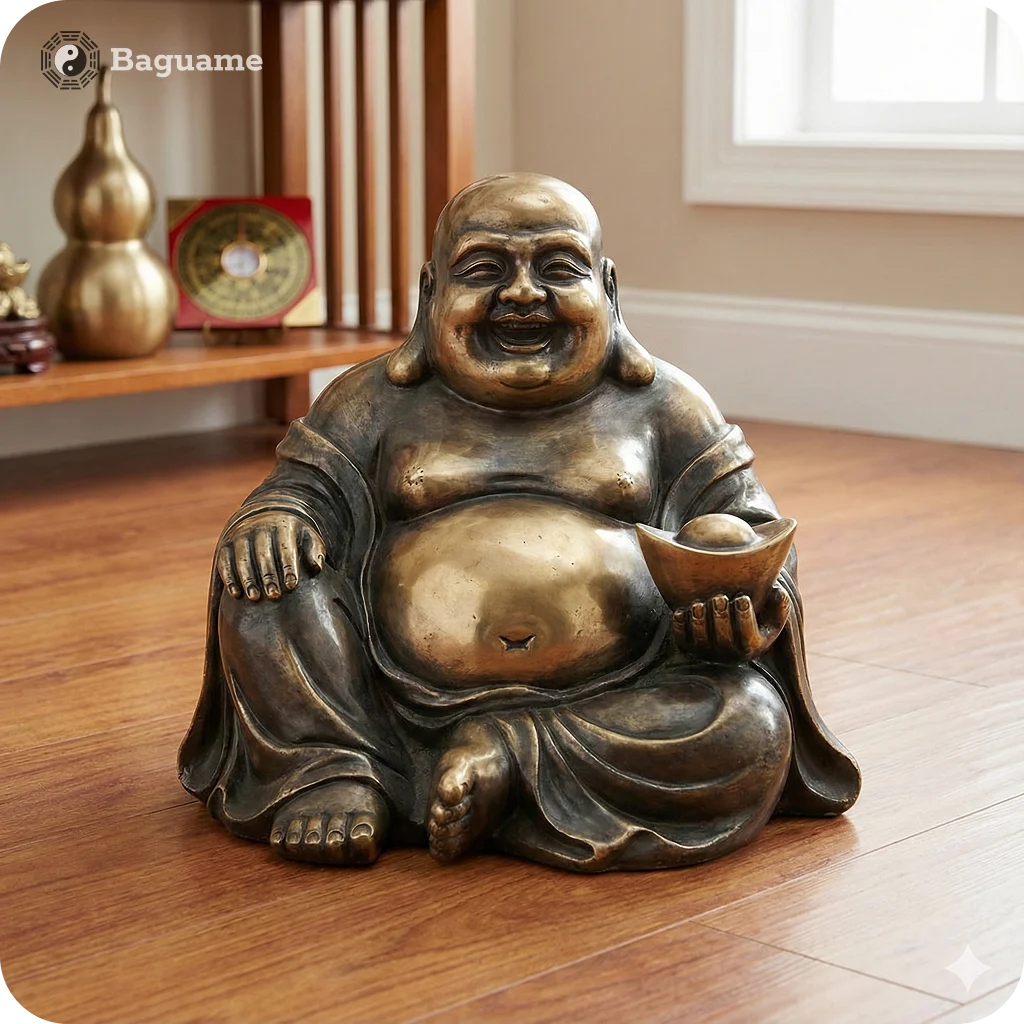
Heavy metal objects
Weight matters with this star. A brass basin, a bronze statue, an iron weight or a metal luopan presses down on the density and gives the Earth somewhere to go. Use one where a wind chime would be impractical or where the sector needs a permanent, quiet presence.
Crystals, geodes, quartz points, salt lamps and fired ceramics are Earth, not Metal. Placing them in a Five Yellow sector feeds the element that needs draining — the most common and most expensive mistake in handling this star.
7.2 When the sector cannot be avoided
| Area carrying the Five Yellow | How to manage it |
|---|---|
| Main entrance | Keep the door quiet: oil the hinges, avoid slamming, and place a metal wind chime or a heavy metal object near it. |
| Kitchen | The awkward case, because a stove is Fire and feeds the star. Put a heavy metal remedy or the salt water cure in the sector, and do not site the stove there if the layout allows otherwise. |
| Bedroom | If the bed cannot move, set the salt water cure under the bed or on the nightstand, and choose white, silver or grey bedding — Metal colours — over red and bright yellow. |
| Living room | Keep it calm: lower the volume, no candles and no open fire, and avoid turning that corner into a thoroughfare. |
| Storage room or void | Often best left alone. An undisturbed Five Yellow in a room nobody uses is a far smaller matter than a cure that draws attention to it. |
7.3 If the sector has already been disturbed
Stop the work — do not finish the job in the hope of balancing it. Put the strongest metal remedy you have at the point of disturbance, then keep the whole area quiet for some weeks: no drilling, no loud activity, no heavy traffic. The classical view is that the agitation settles once the movement stops, and that adding further cures in a hurry only adds movement.
8. The Five Yellow in Your Home: Reading the Position
- Find the sector. Identify the direction carrying this year's annual Five Yellow (see the rule in section 3.1, or the calculator for the current chart). This is your Five Yellow space for the year.
- Assess its use. Is it a lived-in sector (door, bed, desk, kitchen) or a quiet void? This single question determines how much care it needs.
- Read the combination. Which star meets the Five Yellow this year? Section 4's table tells you whether it is a heavy pairing (5+2), a drainable one (5+6, 5+7) or a Fire-fed one (5+9).
- Choose a calm response. For a lived-in sector, stillness plus a metal drain; for a quiet void, often the best choice is to leave it untouched.
- Check monthly and natal layers. A monthly Five Yellow is a short care window; a fixed natal one is a standing condition in the home.
9. Applying the Five Yellow with the Baguame Flying Stars Calculator
Locating the Five Yellow across nine palaces, through annual, monthly and natal layers, is exactly the kind of work that invites hand-errors — and, with the most feared star, precision matters. The Baguame Flying Stars calculator overlays the current chart onto your floor plan, so you can see exactly where the 5 Yellow (and every other star) sits in each room, switch between annual and monthly layers, spot a dangerous 5+2 or 5+9 pairing, and check the natal chart — without manual scoring. The Flying Stars calculator is part of the broader Baguame Feng Shui tools.
If you would rather start from a map than from a compass reading, register with Baguame and upload your floor plan: the overlay places the annual chart on the rooms and marks the sector to keep quiet.
Frequently Asked Questions
Is the Five Yellow always bad in Flying Stars?
No. The Five Yellow is only a working misfortune star when it flies into a lived-in, active sector and is stirred by activity. In its home palace (the center) or in a quiet void it is dormant and largely harmless. The danger is a function of position and activity, not of the number itself.
Where is the 5 Yellow this year?
The 5 Yellow moves annually. Section 3.1 gives the method: find the year's ruling star in the center and count through the fixed flight order to the 5 Yellow. To see where it falls in your own home, let the Baguame Flying Stars calculator plot the current chart onto your floor plan; the year's reading, sector by sector, is published in the Baguame blog.
How do I cure the 5 Yellow when it is active?
The standard approach is stillness plus a calm Metal drain: avoid renovation and heavy activity in the sector, and add a metal presence that lets the dense Earth express itself as Metal. Fire feeds it and water is dominated by it, so neither is the right response. The full set of remedies is in section 7.
What is the worst 5 Yellow combination?
The 5 Yellow with the Two Black (5+2) is the most feared pairing: two dense Earth stars together amplify illness, loss and misfortune. A 5 Yellow with 9 Purple (fire-fed Earth) is also tricky because the Fire strengthens it. A 5 Yellow meeting a Metal star (6 or 7) is the most constructive, because the Earth can drain productively.
Should I renovate the 5 Yellow sector this year?
Generally no. Renovation, drilling and heavy activity are exactly what turn a dormant Five Yellow into an active one. If the yearly Five Yellow falls in a sector you need to work on, prefer calm handling and a metal drain, and avoid disruptive construction there if you can.
Can I use crystals, geodes or a salt lamp to cure the Five Yellow?
No — and this is the most common mistake. Crystals, geodes, quartz, salt lamps and fired ceramics all belong to the Earth element, so they feed the star instead of draining it. Only metal works in this sector: brass, bronze, copper, steel, or iron.
Do I have to replace the salt water cure every year?
Yes. The jar is renewed at the end of the solar year, around early February, when the annual star moves on. By then the salt usually shows crystallisation and corrosion, which is read as the cure having done its work. Throw the whole jar away outside the home and set up a fresh one in the star's new sector.
What should I do if I have already drilled or renovated in that sector?
Stop the work rather than finishing it. Put your strongest metal remedy at the point of disturbance and keep the area quiet and low-traffic for some weeks afterwards. The agitation is the problem, so ending the activity matters more than adding objects.
Which colours should I avoid in a Five Yellow sector?
Avoid the colours of Fire — bright reds, oranges and hot pinks — because Fire produces Earth. Use the colours of Metal instead: white, silver and grey. Large fields of yellow, beige or terracotta work the same wrong way, since they are Earth colours.

