
BaZi — Four Pillars of Destiny: A Deep Theoretical Guide
BaZi (四柱八字, Four Pillars of Destiny) is the classical Chinese system of natal chart analysis — a complete framework for understanding the elemental composition of a person's life, timing windows, and the interplay of forces that shape their path. This guide covers the full theoretical architecture of BaZi: from the structure of the chart and the meaning of each pillar, through the Five Elements, Ten Gods, hidden stems, and branch interactions, to the Luck Pillar timing system and BaZi's relationship to classical Feng Shui.
To generate your own BaZi chart and explore these concepts in practice, use the Baguame BaZi calculator.
1. What BaZi Is — and What It Is Not
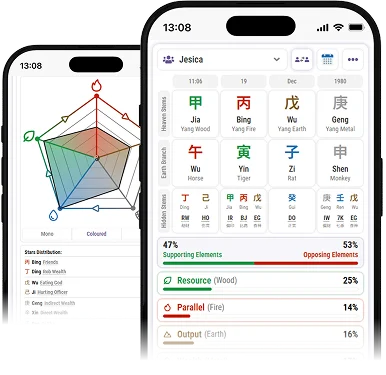
BaZi (八字), literally "Eight Characters," is the classical Chinese system of destiny analysis based on the precise moment of a person's birth. The full name Si Zhu Ba Zi (四柱八字) means "Four Pillars, Eight Characters" — four pillars because the birth chart is built from four time units (Year, Month, Day, Hour), and eight characters because each pillar contributes exactly two Chinese characters: one Heavenly Stem above and one Earthly Branch below. BaZi is a system of temporal energetics. It maps the quality and distribution of the Five Elemental Qi (Wood, Fire, Earth, Metal, Water) that was present in the cosmos at the exact moment a person entered the world. The premise is Daoist: an individual is not separate from the universe but a continuation of it, shaped by the same rhythmic cycles that govern nature, seasons, and time itself.
"Heaven, Earth, and Human are the Three Powers. BaZi reveals how the heavenly moment of birth shapes the human experience on earth." — Classical Chinese Metaphysics principle
It is important to state clearly what BaZi is not. It is not fatalism. Classical masters understood the chart as revealing potential patterns — tendencies, strengths, vulnerabilities, timing windows — not fixed, immutable outcomes. The chart shows the weather; the person chooses whether to carry an umbrella.
Key Distinction: BaZi differs fundamentally from Western astrology in that it does not use planetary positions or the zodiac. Its entire vocabulary is built from the binary logic of Yin/Yang, the Five Elements, and the sixty-year Stem-Branch cycle — a closed, internally consistent cosmological grammar.
BaZi is also distinct from Feng Shui, though the two disciplines are deeply complementary. Feng Shui concerns the energetic quality of space; BaZi concerns the energetic quality of time as it relates to an individual. A skilled practitioner uses both: the chart to understand the person, the environment to support or mitigate what the chart reveals.
2. The Four Pillars: Structure of a Chart
The BaZi chart is constructed by converting a birth date and time into the Chinese lunisolar calendar system, then expressing each of four time units as a Stem-Branch pair. Each pillar consists of a Heavenly Stem on top and an Earthly Branch below — two characters per pillar, eight characters total.
Month Pillar
Yue Zhu
Governs: Career trajectory, early adult life, parents' influence, siblings, workplace.
The Day Stem — the upper character of the Day Pillar — is called the Day Master (Ri Zhu, 日主). It is the single most important character in the entire chart: it represents the self, and every other character is interpreted in relation to it.
Structural Note: The Month Branch is considered the most powerful single branch in the chart. It represents the season of birth, which determines which elemental Qi is in full force. A Day Master that is in harmony with the Month Branch is said to be "rooted" and has additional strength.
3. The Ten Heavenly Stems (Tian Gan 天干)
The Heavenly Stems are ten symbolic characters representing the expression of the Five Elements in both Yin and Yang polarity. They appear in the upper row of the four pillars. The Stems represent what is visible, manifest, and active — the expressed surface energy of a pillar.
| # | Stem | Polarity | Element | Nature / Imagery |
|---|---|---|---|---|
| 1 | 甲 Jia | Yang Wood | Wood | A tall, upright tree; ambition, leadership, direct growth |
| 2 | 乙 Yi | Yin Wood | Wood | A vine or grass; adaptability, flexibility, subtle persistence |
| 3 | 丙 Bing | Yang Fire | Fire | The sun; radiance, visibility, generosity, external warmth |
| 4 | 丁 Ding | Yin Fire | Fire | Candlelight; focused illumination, precision, inner warmth |
| 5 | 戊 Wu | Yang Earth | Earth | A mountain or dam; stability, containment, reliability |
| 6 | 己 Ji | Yin Earth | Earth | Cultivated soil; nourishing, receptive, careful |
| 7 | 庚 Geng | Yang Metal | Metal | An axe or raw ore; forcefulness, decisiveness, transformation |
| 8 | 辛 Xin | Yin Metal | Metal | A jewel or needle; refinement, precision, sensitivity, aesthetics |
| 9 | 壬 Ren | Yang Water | Water | The ocean; vast intelligence, resourcefulness, ambition |
| 10 | 癸 Gui | Yin Water | Water | Rain or morning dew; intuition, subtlety, nourishing wisdom |
Stems as Personality Indicators
In chart interpretation, the Day Master's Stem is treated as the person's core elemental identity. A Jia Wood Day Master tends toward directness, vision, and competitive drive — the growing tree seeking light. A Gui Water Day Master tends toward introspection, emotional depth, and intuitive perception. These are archetypal tendencies, always modified by the context of the entire chart.
4. The Twelve Earthly Branches (Di Zhi 地支)
The Earthly Branches are twelve characters that form the lower row of the four pillars. They correspond to the twelve months of the year, twelve two-hour periods of the day, and the twelve animals of the Chinese zodiac — though in classical BaZi practice, the zodiac associations are secondary to their elemental and seasonal properties.
| Branch | Zodiac | Season / Period | Primary Element | Hidden Stems |
|---|---|---|---|---|
| 子 Zi | Rat | Mid-Winter (Dec) | Yang Water | Gui Water |
| 丑 Chou | Ox | Late Winter (Jan) | Yin Earth | Ji Earth, Gui Water, Xin Metal |
| 寅 Yin | Tiger | Early Spring (Feb) | Yang Wood | Jia Wood, Bing Fire, Wu Earth |
| 卯 Mao | Rabbit | Mid-Spring (Mar) | Yin Wood | Yi Wood |
| 辰 Chen | Dragon | Late Spring (Apr) | Yang Earth | Wu Earth, Yi Wood, Gui Water |
| 巳 Si | Snake | Early Summer (May) | Yin Fire | Bing Fire, Wu Earth, Geng Metal |
| 午 Wu | Horse | Mid-Summer (Jun) | Yang Fire | Ding Fire, Ji Earth |
| 未 Wei | Goat | Late Summer (Jul) | Yin Earth | Ji Earth, Ding Fire, Yi Wood |
| 申 Shen | Monkey | Early Autumn (Aug) | Yang Metal | Geng Metal, Ren Water, Wu Earth |
| 酉 You | Rooster | Mid-Autumn (Sep) | Yin Metal | Xin Metal |
| 戌 Xu | Dog | Late Autumn (Oct) | Yang Earth | Wu Earth, Xin Metal, Ding Fire |
| 亥 Hai | Pig | Early Winter (Nov) | Yin Water | Ren Water, Jia Wood |
5. Hidden Stems: The Qi Inside the Branches
Each Earthly Branch is not a single energetic unit — it is a container of multiple Heavenly Stems in varying concentrations. These are called Zang Gan (藏干), "Hidden Stems" or "Buried Stems." Understanding hidden stems is essential for accurate interpretation because they reveal resources and energies that are present but not immediately visible.
The Three Levels of Hidden Qi
Within each branch, the hidden stems are distributed across three levels of influence:
- Main Qi (Zheng Qi 正氣) — the dominant stem, most influential, representing the core energy of the branch. It occupies roughly 60–70% of the branch's energetic weight.
- Middle Qi (Zhong Qi 中氣) — present in transitional branches, representing residual energy from the previous season. Moderately influential.
- Residual Qi (Yu Qi 餘氣) — the faintest trace, representing elemental energies that are fading or just beginning to emerge.
Key Principle — Tong Gen (通根): The hidden stems inside branches can serve as roots for corresponding Heavenly Stems elsewhere in the chart. A Day Master whose element appears among the hidden stems of the Month Branch has its Qi "rooted" — this substantially increases its strength and stability.
Consider the Branch 寅 Yin (Tiger): it contains Jia Wood as its main Qi, Bing Fire as middle Qi, and Wu Earth as residual Qi. A Jia Wood Day Master encountering Yin in the chart has a strong root. The four "pure" branches — 子 Zi (Rat), 卯 Mao (Rabbit), 午 Wu (Horse), 酉 You (Rooster) — contain only a single hidden stem each. These are called cardinal branches and represent the peak expression of their respective elemental seasons. Their energy is undiluted and powerful, but also less flexible.
6. The Five Elements: Generating and Controlling Cycles
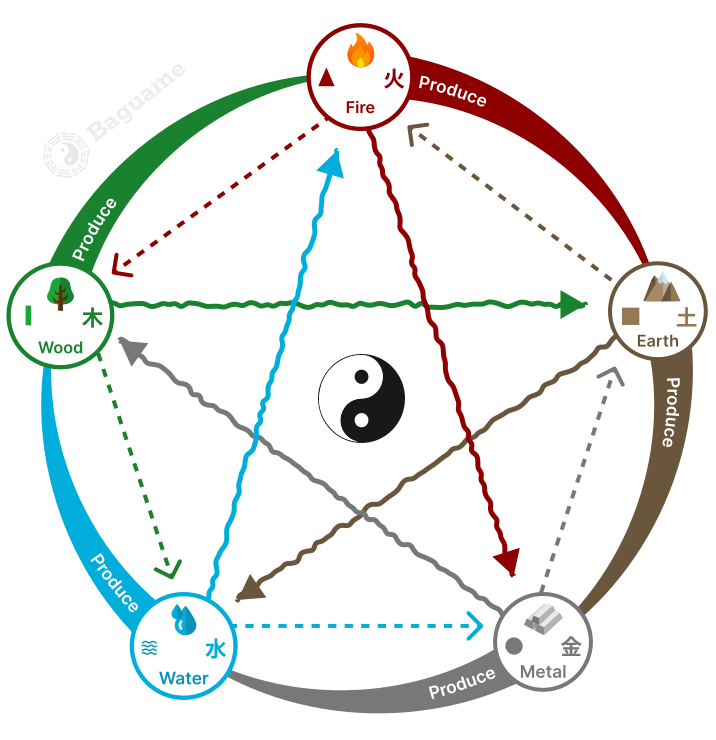
All BaZi analysis is built on the Five Elements (Wu Xing 五行): Wood (木), Fire (火), Earth (土), Metal (金), Water (水). These are not literal materials but metaphors for qualities of Qi — patterns of movement, transformation, and relationship.
Generating Cycle (Sheng Cycle 相生)
Each element produces and nourishes the next: Wood feeds Fire → Fire creates ash (Earth) → Earth contains Metal → Metal holds Water → Water nourishes Wood. This is a nurturing, supportive relationship.
Controlling Cycle (Ke Cycle 相剋)
The controlling cycle operates across: Wood controls Earth → Earth controls Water → Water controls Fire → Fire controls Metal → Metal controls Wood. Control is not inherently negative — without it, elements would grow unchecked.
Exhausting Cycle (Xie Cycle 相洩)
This is the reverse of generation: the element being generated drains the generating element. Wood producing Fire exhausts Wood. This cycle is critical in BaZi because an Output element — one that the Day Master generates — can weaken the Day Master if present in excess.
Important: The intensity of a generating or controlling relationship depends heavily on the strength of both elements involved. A weak Water element attempting to control a powerful Fire is like rain falling into a furnace — it evaporates before it can contain. Context always governs outcome.
7. Yin and Yang in BaZi
Every Stem and Branch carries a Yin (陰) or Yang (陽) polarity. This polarity fundamentally shapes how elements interact — it represents a qualitative difference in the mode of expression of elemental energy. Yang elements are expansive, outward, direct, and forceful. Yang Wood (Jia) grows upward without deviation. Yang Fire (Bing) radiates in all directions. Yin elements are receptive, inward, subtle, and adaptive. Yin Wood (Yi) bends around obstacles. Yin Fire (Ding) illuminates selectively.
| Polarity | Expression Mode | Strengths | Vulnerabilities |
|---|---|---|---|
| Yang | Direct, visible, expansive, action-oriented | Leadership, decisiveness, presence | Inflexibility, aggression, overextension |
| Yin | Subtle, receptive, adaptive, internalized | Sensitivity, strategy, endurance | Indirectness, withdrawal, over-reliance on others |
Polarity also affects the direction of a Luck Pillar sequence. A male born in a Yang year runs his Luck Pillars forward through time; a female born in a Yang year runs them backward. The logic is rooted in the movement of Qi — Yang moves forward in the generative direction, Yin moves backward in the receptive direction.
8. Branch Interactions: Combinations, Clashes, Punishments, and Harms
The Earthly Branches do not exist in isolation. When two or more branches appear together — in the natal chart, in Luck Pillars, or in annual pillars — they generate specific interactions that alter the elemental balance of the chart dramatically. For a complete reference of all interactions, see the 12 Earthly Branches guide.
Six Harmonies (Liu He 六合)
Six pairs of branches that combine to transform into a new element: Rat+Ox → Earth; Tiger+Pig → Wood; Rabbit+Dog → Fire; Dragon+Rooster → Metal; Snake+Monkey → Water; Horse+Goat → Fire. The transformation only fully activates under specific conditions of elemental strength.
Triple Combination (San Hui 三會)
Three consecutive seasonal branches combining: Tiger-Rabbit-Dragon → Wood (Spring); Snake-Horse-Goat → Fire (Summer); Monkey-Rooster-Dog → Metal (Autumn); Pig-Rat-Ox → Water (Winter). Considered stronger than San He because it follows the natural seasonal sequence.
Six Clashes (Liu Chong 六沖)
Six pairs of branches in direct opposition: Rat vs. Horse; Ox vs. Goat; Tiger vs. Monkey; Rabbit vs. Rooster; Dragon vs. Dog; Snake vs. Pig. Clashes represent disruption, movement, and separation. They are not inherently negative — a clash can dislodge stagnant Qi and create needed change.
Punishments (Xing 刑)
Three categories of mutual punishment: Unkindness Punishment (Tiger-Snake-Monkey); Ingratitude Punishment (Rat-Rabbit); Bullying Punishment (Ox-Dog-Goat); Self-Punishment (Horse, Rooster, Pig, Dragon with themselves). Punishments often manifest as legal issues, health problems, or interpersonal betrayals.
Harms and Destructions (Hai & Po 害破)
Six Harms (Liu Hai) create friction and obstacles without the explosive energy of clashes. Six Destructions (Liu Po) break apart the structure of combinations. Both are secondary interactions but meaningful in timing analysis when activated by annual or Luck Pillar branches.
Key Principle: The distance between branches in the chart matters. Adjacent branches interact more strongly than branches separated by two pillars. An interaction triggered by an external pillar (annual or Luck) has immediate but temporary effects; interactions within the natal chart are persistent structural features.
9. Stem Interactions: Combinations and Clashes
Heavenly Stems also interact when they appear adjacent to each other in the chart. Stem interactions are visible and immediate — they affect the surface expression of energy rather than the hidden structural roots.
Five Stem Combinations (Tian Gan Wu He 天干五合)
Five pairs of opposite-polarity Stems combine to potentially transform into a new element:
| Combination | Transforms Into | Condition for Full Transformation |
|---|---|---|
| Jia (Yang Wood) + Ji (Yin Earth) | Earth | Earth dominant in chart/season |
| Yi (Yin Wood) + Geng (Yang Metal) | Metal | Metal dominant in chart/season |
| Bing (Yang Fire) + Xin (Yin Metal) | Water | Water dominant in chart/season |
| Ding (Yin Fire) + Ren (Yang Water) | Wood | Wood dominant in chart/season |
| Wu (Yang Earth) + Gui (Yin Water) | Fire | Fire dominant in chart/season |
A critical concept: when two Stems combine, they become "occupied" with each other. A Day Master Jia Wood that has combined with Ji Earth is no longer fully available to express itself — it is bound. This can represent a person whose energy is consumed by a relationship, obligation, or external demand.
Stem Clashes (Tian Gan Ke 天干剋)
When Stems of the same polarity but with a controlling relationship appear adjacent, they clash. Yang Wood Jia directly suppresses Yang Earth Wu; Yang Metal Geng directly chops Yang Wood Jia. These clashes reveal internal tensions and areas where the person experiences friction between different life domains.
Distinction: Stem interactions are like weather on the surface — immediate, visible, and changeable. Branch interactions are like geology beneath the ground — structural, persistent, and more consequential in shaping the long-term landscape of life.
10. The Day Master: Identity, Strength, and the Core Question
Before any BaZi interpretation can proceed meaningfully, the practitioner must answer the most fundamental question: Is the Day Master strong or weak? This single determination governs the entire logic of the reading.
Factors Determining Day Master Strength
- Season (Month Branch) — most important factor. A Wood Day Master born in Spring (Tiger or Rabbit month) is in season and receives full seasonal support. Born in Autumn (Metal months), it is out of season and weakened.
- Root (Tong Gen 通根) — whether the Day Master's element appears as a hidden stem in any Branch. Rooted Day Masters have a foundation of support.
- Support from other Stems — whether Stems in other pillars generate the Day Master.
- Overall elemental balance — the distribution of all eight characters taken together.
Strong vs. Weak: What It Means
A strong Day Master has abundant energy and needs elements that channel, control, or exhaust it — Output, Wealth, and Officer elements are beneficial. A weak Day Master needs nourishment and reinforcement — Resource and Companion elements are beneficial. Applying the wrong remedies produces the opposite of the intended effect.
Special Charts: The Follow Structures (Cong Ge 従格)
When a Day Master is extremely weak — so weak that it has almost no support at all — a different interpretive framework applies. In this case, the Day Master "surrenders" to the dominant element in the chart and actually benefits from it rather than being harmed. These are rarer but powerful configurations.
The Central Principle: BaZi interpretation is always relative, never absolute. No element is inherently good or bad. Every character in the chart is evaluated through its relationship to the Day Master and the prevailing elemental balance. A Fire element can be a lifeline or a hazard depending entirely on context.
11. The Ten Gods (Shi Shen 十神): The Language of Relationships
The Ten Gods are the interpretive vocabulary of BaZi. Rather than describing elements in isolation, they describe each character in the chart relative to the Day Master. Every Stem in the chart receives a Ten God designation that determines its meaning and influence.
| Ten God | Chinese | Relationship to Day Master | Life Domain |
|---|---|---|---|
| Friend / Rob Wealth Bi Jian / Jie Cai | 比肩 / 劫財 | Same element, same / opposite polarity | Peers, competitors, siblings; self-reliance, rivalry |
| Eating God Shi Shen | 食神 | Element DM generates, same polarity | Self-expression, creativity, food, lifestyle, talent |
| Hurting Officer Shang Guan | 傷官 | Element DM generates, opposite polarity | Rebellion, brilliance, art, conflict with authority |
| Indirect Wealth Pian Cai | 偏財 | Element DM controls, same polarity | Windfall, speculation, father |
| Direct Wealth Zheng Cai | 正財 | Element DM controls, opposite polarity | Stable income, responsibility, spouse (for men) |
| Seven Killings Qi Sha | 七殺 | Element that controls DM, same polarity | Pressure, power, stress, authority over DM |
| Direct Officer Zheng Guan | 正官 | Element that controls DM, opposite polarity | Career, reputation, law, spouse (for women) |
| Indirect Resource Pian Yin | 偏印 | Element that generates DM, same polarity | Unconventional learning, spirituality, isolation |
| Direct Resource Zheng Yin | 正印 | Element that generates DM, opposite polarity | Education, mother, mentors, support, credentials |
Principle of Usefulness (Yong Shen 用神): In classical BaZi, the "Useful God" is the single most important Ten God in a chart — the one element that, if strengthened, most effectively balances the Day Master. Identifying the Useful God is considered the master skill of BaZi analysis.
12. Luck Pillars (Da Yun 大運) and Annual Pillars (Sui Yun 歲運)
The natal chart is the foundation, but the Luck Pillar system is what makes BaZi a dynamic tool for timing. The natal chart reveals the permanent structure of a person's Qi; the Luck Pillars reveal how that Qi unfolds and is activated across time.
Luck Pillars (Da Yun 大運) Decade-Scale Timing
Each Luck Pillar is a Stem-Branch pair that governs a ten-year period of life. The sequence is derived from the Month Pillar of the natal chart, moving forward or backward through the Stem-Branch 60-cycle depending on the person's gender and birth year polarity. Within each 10-year Luck Pillar, the Stem is considered active in the first five years and the Branch in the second five years — though both are present throughout.
Annual Pillars (Sui Yun 歲運) Year-Scale Precision
Every calendar year carries its own Stem-Branch pair which overlays on both the natal chart and the current Luck Pillar simultaneously. The combination of natal chart + Luck Pillar + Annual Pillar creates a three-layer dynamic field for identifying specific years of significant change, opportunity, or challenge. Some practitioners extend analysis to monthly and daily pillars for event-specific timing precision.
Timing Logic: A Luck Pillar that introduces the Useful God element to a chart is generally considered a prosperous decade. A Luck Pillar that brings the most detrimental element signals a challenging period requiring proactive management. Neither is permanent — both are phases in a larger cycle.
13. Seasonal Qi and Month Branch Dominance
The concept of seasonal Qi explains why the Month Branch carries such disproportionate weight in BaZi. Nature cycles through concentrated phases, each dominated by a specific element reaching its peak expression.
| Season | Dominant Element | Branches | Qi State |
|---|---|---|---|
| Spring | Wood | Tiger (寅), Rabbit (卯), Dragon (辰) | Growing, ascending, expansive |
| Summer | Fire | Snake (巳), Horse (午), Goat (未) | Radiating, peaking, transformative |
| Autumn | Metal | Monkey (申), Rooster (酉), Dog (戌) | Condensing, harvesting, inward |
| Winter | Water | Pig (亥), Rat (子), Ox (丑) | Storing, descending, consolidating |
| Transitional | Earth | Dragon, Goat, Dog, Ox (last month of each season) | Stabilizing, bridging, grounding |
An element is considered "in season" (得令, De Ling) when it matches the Month Branch's dominant element. An element born in its home season receives a massive strength bonus — enough to transform an otherwise weak configuration into a strong one.
14. BaZi Within the Broader Feng Shui Framework
In classical Chinese metaphysical practice, BaZi and Feng Shui are inseparable disciplines applied to complementary domains. The Chinese tradition distinguishes three primary sources of destiny: Tian Ming (天命, Heaven Mandate — the BaZi chart), Di Li (地理, Earth Principles — Feng Shui), and Ren He (人和, Human Harmony — personal effort and virtue). This triad is expressed in the classical aphorism: "First destiny, second luck, third Feng Shui, fourth virtue, fifth education."
How BaZi Informs Feng Shui Practice
- Favorable vs. unfavorable directions — a person's Gua number and their BaZi Useful God element together determine which sectors most powerfully support them. See Ba Zhai (Eight Mansions) for the directional framework.
- Elemental activation — if a person's chart needs Water to balance a Fire-dominant configuration, introducing Water features in the appropriate Feng Shui sectors reinforces the chart's needs at the environmental level.
- Timing of moves and renovations — a person's Luck Pillar phase determines whether a given period is auspicious for major environmental changes. Consult the Annual Afflictions guide for yearly timing factors.
Integrated Perspective: The most sophisticated classical practitioners do not treat BaZi and Feng Shui as separate services. They read the chart to understand the person, then design the space to support the chart's needs and mitigate its vulnerabilities. Time and space become a unified field of analysis.
Understanding BaZi also deepens a practitioner's grasp of Flying Stars Feng Shui — particularly in the use of annual and monthly stars, which are governed by the same Stem-Branch calendar system underlying BaZi. The year's Annual Star chart and a person's Annual Pillar are part of the same temporal fabric.
Closing Thoughts: The Map and the Territory
BaZi is an extraordinarily sophisticated system — not despite its reliance on a fixed vocabulary of sixty Stem-Branch pairs, but because of how that vocabulary generates infinite combinations and contexts. Two people can share the same Day Master Stem and still have radically different charts because the season, the hidden stems, the interaction patterns, and the Luck Pillar sequences create entirely distinct elemental environments.
"The chart does not command; it advises. The stars do not compel; they indicate. Wisdom lies in knowing which wind is blowing, and in setting your sails accordingly."
The system described in this article represents the foundational theoretical architecture of BaZi as practiced in the classical tradition. Advanced study extends into specialized structures (格局, Ge Ju), the analysis of specific life themes such as health, marriage, and wealth, and the integration of BaZi with Qi Men Dun Jia, Liu Ren, and other classical branches of Chinese metaphysics.
Frequently Asked Questions
How do I calculate my BaZi chart?
You need your exact date, time and place of birth, which are converted into the Year, Month, Day and Hour pillars (four pillars, eight characters) of Heavenly Stems and Earthly Branches. Doing this by hand takes careful calendrical work, so the Baguame BaZi calculator generates the full chart instantly and safely for you.
What information is needed for an accurate BaZi reading?
Precision matters most: the exact local time of birth (to the minute where possible), the date, and the location/time zone, because the Hour branch can change the Day Master's strength and entire reading. A birth time off by even an hour can shift the chart significantly, so use your official hospital or birth-record time when you have it.
Can BaZi predict my future?
BaZi does not deliver fixed predictions. It reveals potential patterns — natural strengths, vulnerabilities, and favorable timing windows — that you can work with or around. Classical masters describe it as revealing the weather: the chart shows the conditions, while your choices determine how you respond to them.
Does my BaZi chart change if I move or change my name?
No. The chart is fixed at the exact moment of your birth and does not change with location, name, or life events. What does change are the Luck Pillars (Da Yun) and annual pillars, which describe the shifting energies you move through over time — so the chart is static, but its activation is not.
What is the difference between BaZi and Western astrology?
BaZi does not use planetary positions or the zodiac. Its entire vocabulary rests on Yin/Yang, the Five Elements, and the sixty-year Stem-Branch cycle, derived purely from the moment of birth. Where Western astrology reads celestial geometry, BaZi reads the elemental composition of time itself.
How is BaZi different from Feng Shui?
Feng Shui concerns the energetic quality of space — the directions, rooms and layout of a home or office. BaZi concerns the energetic quality of time — the elemental makeup of a person's birth. The two are complementary: BaZi shows what a person needs, and Feng Shui provides the environment to support it (see Ba Zhai for the directional framework).
