I have walked through flats that looked identical on paper — same street, same square footage, same renovation budget — and felt completely different inside. One felt calm and generous; the other felt like it was quietly working against the people living in it. The difference is rarely the furniture. It is usually the natal chart of the house.
A house natal chart is not astrology for a building. It is a Flying Star (Xuan Kong Fei Xing) chart: the nine stars arranged in the nine sectors of the Lo Shu grid according to two fixed parameters — the construction period and the facing direction of the building. Those two inputs lock the chart at the moment the building is completed, and it stays with the property for as long as that period lasts.
This is the part buyers miss: the natal chart does not change from year to year. Annual and monthly stars are only a layer on top of it. You can move a sofa, repaint a wall, or hang a remedy, but you cannot change the baseline energy map of the building without a renovation serious enough to “re-periodise” it — and even that is a school-dependent idea, not a universal rule. That is why the chart belongs in the decision before you sign, not after you move in.
The whole procedure is shorter than most people expect.
1. Find the construction period. The chart is “born” when the building is completed and sealed — usually the year the roof goes on. Periods run in 20-year cycles:
| Period | Years |
|---|---|
| Period 7 | 1984–2003 |
| Period 8 | 2004–2023 |
| Period 9 | 2024–2043 |
A house finished in 2019 carries a Period 8 chart. One finished last year carries Period 9. If you do not know the exact year, property records or the building permit date will usually settle it.
2. Measure the facing direction. Facing is the most Yang side of the building: the formal entrance, the side with the most openness, movement and light. For a standalone house, stand outside a few steps from the front door and face away from the building — the direction your compass reads is the facing. For an apartment, the classical method uses the main lobby entrance of the whole building; the alternative uses the unit’s largest window or balcony. The two can disagree, and that disagreement matters.
3. Build the chart. Period and facing together produce the nine-sector grid, with a mountain star and a water star in every sector. From there you read where prosperity, health, authority and conflict land — and whether those sectors are the rooms you actually use.
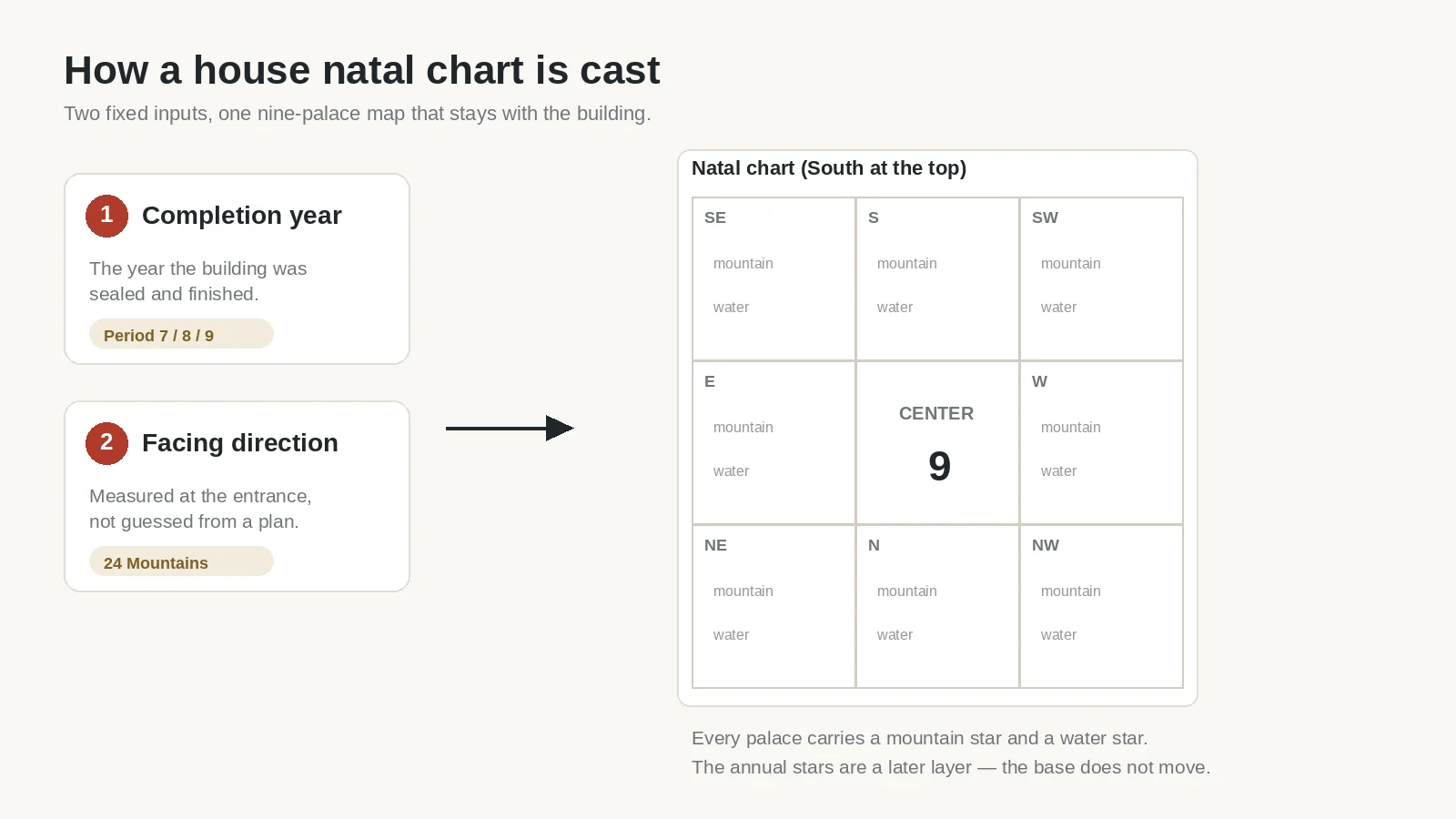
The full step-by-step, including the apartment methods and how to take the compass reading correctly, is in the knowledge base: How to Determine Your Home’s Natal Chart Parameters.
Not every chart is equal. Some produce patterns that are read as structurally supportive, regardless of the year.
A pearl string is a palace-level formation, not a line drawn across the floor plan. In one sector, the three stars that meet there — the mountain star, the water star and the period star — carry three consecutive numbers: 1-2-3, 2-3-4, 3-4-5, and so on up to 7-8-9. The sector is read as “stitched together”: the three influences act as one continuous sequence instead of three separate agendas. The related parent string follows the same logic with the triples 1-4-7, 2-5-8 and 3-6-9.
This matters most in a difficult chart. Classical practice holds that a pearl string can soften a mountain-water reversed chart — the formation that would otherwise be a clear reason to walk away. If you find a reversed chart, check for the string before you reject the property.
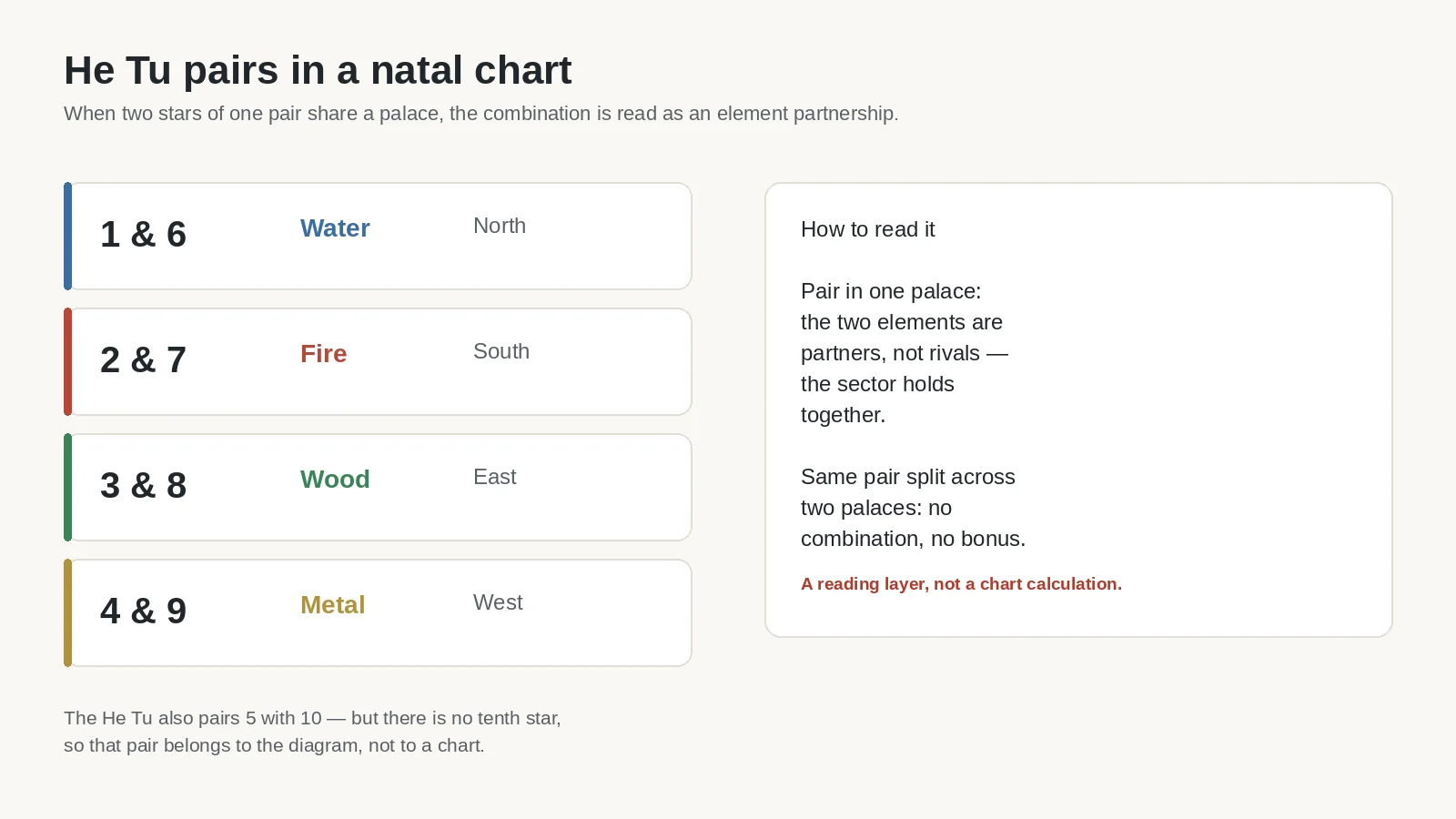
The He Tu pairs numbers into five element partnerships, but only four of them can appear in a chart as stars: 1–6, 2–7, 3–8 and 4–9. (The fifth, 5–10, belongs to the diagram itself — there is no tenth star.) When two stars forming one of these pairs meet in the same palace, the combination is read as an element partnership — supportive rather than conflicting. This is a reading convention applied to a chart, not a separate calculation: the He Tu itself does not generate Flying Star charts. If you want the underlying diagram, it is here: The He Tu: How Ten Numbers Shaped Classical Feng Shui.
A chart is only as good as its usable sectors. A timely prosperity star in a storage room is a nice fact and nothing more. What matters is whether the good stars land on the entrance, the main bedroom, the kitchen and the desk — and whether the difficult stars can be kept in bathrooms, corridors and utility spaces. Pairs summing to ten (1–9, 2–8, 3–7, 4–6) are read as balancing and are often the reason a chart with difficult stars still works in practice. One exception: 5 with 5 also adds to ten, but it is never read as a balancing couple — that is double Five Yellow, and it is covered below.
A chart is read with the land, not instead of it. Roads, water, neighbouring towers and the shape of the plot can outweigh what the grid says, and the most experienced reading treats the two together. With that caveat, these are the chart conditions that earn a second look — or a walk away.
A facing that falls on a mountain boundary. The 24 mountains divide the compass into 15° segments. If the facing sits within about 3° of the line between two mountains — the “empty line”, 空亡 — the chart becomes ambiguous: two practitioners can legitimately produce two different charts. Qi on a boundary is unstable by definition. If the reading is not clear, treat the property as unresolved rather than pick the chart you prefer.
Mountain-water reversed charts (上山下水). In some period-and-facing combinations the prosperous water star lands at the back of the building and the prosperous mountain star at the front. The house is structurally set up so that the two most important stars sit where their element cannot be used: wealth wants water and activity at the rear, health wants solid support at the front, and the form of the building usually offers the opposite. These charts exist in every period, and they are difficult to manage without compromise — unless a pearl string is present.
Houses whose period has passed. A Period 7 house standing in Period 9 still carries its Period 7 base chart; that part never changes. What has changed is the standing of its stars: the number that ruled its period is long past its prime, and the timely energy of Period 9 sits above a chart designed for another era. You can decorate around that, but you cannot promote a retired star by decorating. In the schools that allow re-periodisation, the honest fix is a renovation substantial enough to reset the period — a different budget from a cosmetic refresh.
Double Five at the entrance. A 5–5 combination at the door — two of the three stars in that palace both Five Yellow — or a 2–5 sickness combination in a bedroom, is one of the clearest reasons to walk away from an otherwise attractive flat. Five Yellow is the star that demands the most care, and at the mouth of Qi it sets the tone for the whole property.
Charts with no usable favorable sector. Sometimes every timely star falls in a bathroom, a closet or a windowless hallway. The chart may look fine on paper and still be unusable in daily life, because the sectors that carry support are the sectors nobody occupies.
An uncertain facing. Corner units, two entrances, a shop conversion, a building where the lobby and the flat face different directions — all of these produce a chart you cannot trust. Uncertainty about facing is uncertainty about everything downstream.
In practice I often recommend doing this on two or three shortlisted properties rather than on one. The comparison is what makes the chart useful: a chart in isolation tells you what a house is, and two charts side by side tell you which house to choose.
To avoid doing the grid by hand, I built a Flying Stars calculator that generates the natal chart for your period and facing and lays it over your plan. If you are still deciding between two properties, this companion piece on the water and mountain sides of a house is the natural next read.