
The He Tu: How Ten Numbers Shaped Classical Feng Shui
The He Tu (河圖, "River Map") is one of the two foundational diagrams of Chinese metaphysics, and the one that fixes the numbers of the Five Elements. This guide covers its legend, its ten numbers and their element pairs, and what separates it from the Luo Shu.
1. What Is He Tu — the Legend and Origin
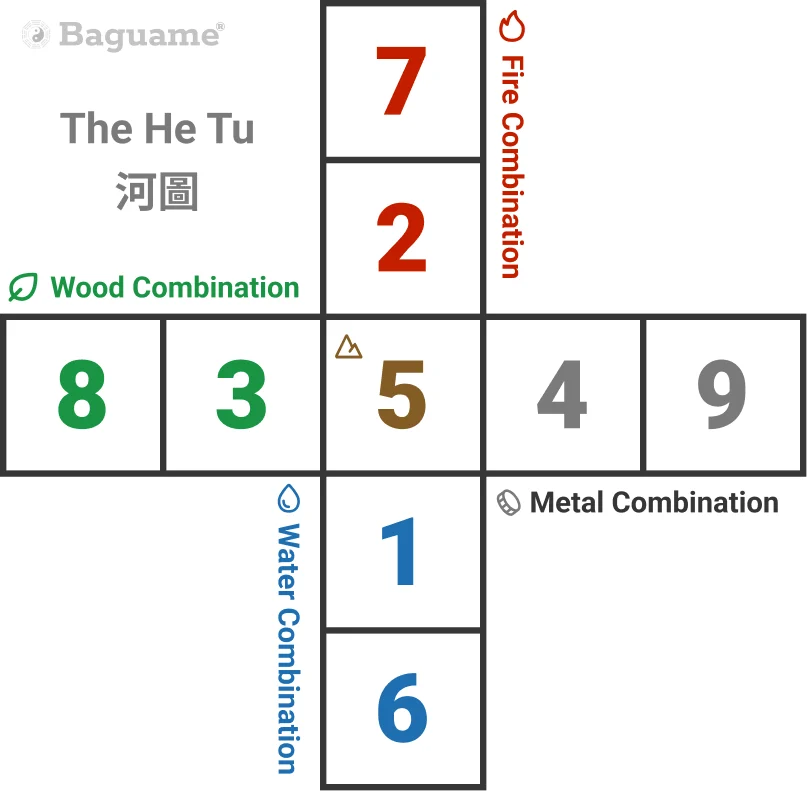
The He Tu (河圖, "River Map") is one of the two foundational numerical diagrams in Chinese metaphysics, alongside the Luo Shu. According to legend, a dragon-horse emerged from the Yellow River carrying a pattern of dots on its back, which the mythical sage Fu Xi interpreted as the He Tu. This diagram predates written Chinese numerals and is considered the original blueprint from which the Early Heaven Bagua was derived. Unlike the Luo Shu, which describes movement, change, and the flow of Qi over time, the He Tu represents a static, balanced, and idealized state — the numerical order of Heaven before manifestation into the physical world.
Key Note: The He Tu is not used for annual or monthly Flying Stars calculations. Its role is symbolic and structural — it explains why the Five Elements are numbered the way they are in classical Feng Shui.
2. The Ten Numbers and Their Element Pairs
The He Tu arranges the numbers 1 through 10 into five pairs, each pair assigned to one of the Five Elements and a cardinal direction. Every pair consists of a smaller "generation number" (生數) and a larger "completion number" (成數), separated by exactly 5.
| Numbers | Element | Direction | Nature |
|---|---|---|---|
| 1 & 6 | Water | North | 1 = Yang (generation), 6 = Yin (completion) |
| 2 & 7 | Fire | South | 2 = Yin (generation), 7 = Yang (completion) |
| 3 & 8 | Wood | East | 3 = Yang (generation), 8 = Yin (completion) |
| 4 & 9 | Metal | West | 4 = Yin (generation), 9 = Yang (completion) |
| 5 & 10 | Earth | Center | 5 = Yang (generation), 10 = Yin (completion) |
3. Generation Numbers vs. Completion Numbers
Generation Numbers (生數): 1, 2, 3, 4, 5
These represent the birth or emergence of an element — its raw, undeveloped potential. They correspond to Heaven's initial impulse to create.
Completion Numbers (成數): 6, 7, 8, 9, 10
These represent an element reaching maturity and stability on Earth. Each completion number equals its generation number plus 5 — the number of Earth itself, which "completes" every process.
This 5-unit offset is the mathematical core of the He Tu: every element exists in two phases, Heaven's intention (generation) and Earth's realization (completion). This same logic underlies why BaZi and Flying Stars calculations treat certain number relationships as inherently stable — they echo this ancient generation-completion structure.
4. He Tu vs. Luo Shu — Key Differences
Students often confuse the two diagrams, but they serve entirely different functions in classical Feng Shui theory.
| Aspect | He Tu | Luo Shu |
|---|---|---|
| Nature | Static, ideal order | Dynamic, changing order |
| Numbers | 1–10, in pairs | 1–9, in a 3x3 magic square |
| Associated Bagua | Early Heaven Bagua | Later Heaven Bagua |
| Practical use today | Theoretical / symbolic foundation | Flying Stars, Eight Mansions, sector calculations |
5. Why He Tu Still Matters in Modern Practice
Although the He Tu is not applied directly when calculating a Flying Stars chart or annual afflictions, it is the reason the Five Elements are numbered 1 through 10 in the first place. Every calculator that assigns a number to Water, Wood, Fire, Earth, or Metal — from BaZi Stems and Branches to the 24 Mountains compass — ultimately traces its numerical logic back to this diagram. Understanding the He Tu gives practitioners a deeper appreciation for why classical Feng Shui treats numbers as more than labels: each digit carries an elemental identity, a polarity, and a place in the ongoing cycle from potential to completion.
Frequently Asked Questions
What is the He Tu in Feng Shui?
The He Tu (River Map) is an ancient Chinese numerical diagram that pairs the numbers 1–10 with the Five Elements and cardinal directions. It is considered the theoretical origin of the Early Heaven Bagua and the numerical logic used throughout classical Feng Shui.
Is He Tu the same as Luo Shu?
No. The He Tu represents a static, ideal order of numbers 1–10, while the Luo Shu is a dynamic 3x3 magic square of numbers 1–9 used in practical calculations such as Flying Stars.
Is the He Tu used to calculate Flying Stars or Eight Mansions?
No, those calculations are based on the Luo Shu. The He Tu is a theoretical foundation rather than a calculation tool used in modern chart generation.
What do generation and completion numbers mean?
Generation numbers (1–5) represent an element's initial emergence, while completion numbers (6–10) represent that same element reaching maturity. Each completion number equals its generation number plus 5.

