
Yin Water (癸 Gui) — The Tenth Heavenly Stem
Yin Water, written 癸 and pronounced Gui, is the tenth and final of the Ten Heavenly Stems and the second of the two Water stems. In contrast to Yang Water (壬 Ren), which is the open ocean — vast, expansive, and always in motion — Yin Water is the rain, the morning dew, the underground spring, the mist that settles quietly over a valley. It does not announce itself. It nourishes everything it touches without being seen doing it.
Core Identity

Gui is Yin energy within the Water element — internalized, perceptive, and quietly persistent. Where Ren moves visibly across the surface, Gui moves underground. Furthermore, where Ren is the ocean that everyone can see, Gui is the water table beneath the earth — invisible, essential, and far more widespread than it appears.
In classical texts, Gui is associated with deep sensitivity, extraordinary intuition, and a capacity for inner knowing that often borders on the uncanny. Gui people sense what others feel before it is expressed, see patterns before they become visible, and carry an inner world of remarkable richness. In practice, this makes them profoundly effective in any role that requires emotional intelligence, subtle perception, or working with what is hidden.
Key Attributes at a Glance
Element
Water (Yin)
Natural Image
Rain · Morning Dew · Mist · Underground Spring
Season / Direction
Winter · North
Polarity
Yin (even)
The Five Element Relationships
Understanding Gui requires mapping it against all five elements. The interactions below form the foundation of BaZi analysis when Yin Water appears in any pillar.
Metal Produces Water (生)
Producing element. Metal (庚 Geng, 辛 Xin) generates Gui and acts as its resource. For Yin Water people, Xin Yin Metal is the most natural pairing — a small jewel condensing pure droplets of dew. In contrast to Ren, which draws from Geng’s mountain springs, Gui receives its nourishment from the refined, gentle distillation of Xin. As a result, Gui people often carry an innate sense of refinement and selectivity in where they draw their energy from.
Wood Drains Water (泄)
Output element. Wood (甲 Jia, 乙 Yi) is produced by Water and represents Gui’s creative output. However, for Yin Water, the preferred output is Yi Yin Wood — the vine, the flower, the delicate growth that morning dew sustains. Gui nourishing Yi is one of the most poetic pairings in the Ten Stems: invisible water feeding visible beauty. In practice, Gui people often express themselves through careful, refined creation rather than bold, large-scale production.
Water — Same Element (比)
Parallel / Companion. Other Water stems (Gui or Ren) share the pillar. For Yin Water, a companion Gui deepens sensitivity and inner perception — two quiet springs flowing together. That said, too much Water creates emotional overwhelm and loss of boundary. Furthermore, a Gui-Ren pairing is particularly nuanced: the ocean and the rain in the same chart, vastness alongside intimacy. Balance requires Earth or Wood to give the water somewhere to go.
Earth Controls Water (克)
Controlling element. Earth (戊 Wu, 己 Ji) restrains Gui. For Yin Water, Ji Yin Earth is the natural controller — soft, fertile earth that absorbs and holds rain. This is the Officer or Power star for Gui Day Masters. However, too much Earth turns nourishing rain into muddy stagnation. In classical analysis, a single Ji Earth in the right position provides the structure that allows Gui’s sensitivity to become purposeful rather than scattered.
Water Extinguishes Fire (克)
Dominated element. Fire (丙 Bing, 丁 Ding) is dominated by Water. In BaZi, Fire represents Wealth for Gui. Specifically, Ding Yin Fire is the preferred Wealth target — rain extinguishing a candle is precisely calibrated, one small flame meeting one small drop. As a result, Gui people tend to attract and manage refined, focused wealth rather than large visible accumulation. The relationship with Bing Yang Fire is more precarious: rain and the sun, potentially beautiful but also in direct conflict.
The Rain and the Candle
One of the most discussed pairings for Gui: 癸 Gui (Yin Water, Rain) meeting 丁 Ding (Yin Fire, Candle Flame). In this pairing, rain meets candle — the most asymmetric of all Water-Fire interactions. A single raindrop can extinguish a candle; yet under the right conditions, a candle sheltered from rain burns more beautifully for the contrast. Consequently, this dynamic in a chart speaks to the interplay between sensitivity and precision, between the emotional and the intellectual.
Personality Traits
Yin Water is not a weaker version of Yang Water. It is a fundamentally different quality — internal, nourishing, and extraordinarily perceptive. Below are the core traits observed in individuals with Gui as the Day Master or prominent in the chart.
Strengths
- Deep intuition. Gui people perceive what others do not. In particular, they read emotional undercurrents, unspoken tensions, and hidden motivations with an accuracy that can seem almost supernatural to those around them.
- Quiet persistence. Rain does not force — it falls, soaks in, and over time transforms even the hardest ground. Consequently, Gui people achieve goals through sustained, gentle persistence that outlasts direct confrontation.
- Nourishing presence. Like morning dew, Gui gives life without demanding recognition. Moreover, people in a Gui person’s circle often feel quietly sustained and supported in ways they struggle to articulate.
- Refined sensitivity. Gui carries an aesthetic sensibility and emotional precision that is rare among the Ten Stems. As a result, they are often drawn to — and exceptionally skilled in — art, music, poetry, healing, and any work that requires subtle attunement.
- Inner resilience. Underground water survives drought, cold, and pressure by going deeper. For this reason, Gui people often possess a hidden core of endurance that surprises even those who know them well.
Challenges
- Boundary dissolution. Yin Water absorbs everything it touches. In many cases, Gui people take on the emotional states of those around them without realizing it, leading to exhaustion and confusion about what they actually feel themselves.
- Indirectness. Rain does not confront — it seeps and surrounds. However, this indirectness can become evasiveness, making it difficult for Gui people to state needs, set limits, or address conflict directly.
- Overwhelm by sensitivity. The same perceptiveness that is Gui’s greatest strength can become its heaviest burden. Consequently, Gui people are often deeply affected by environments, moods, and energies that others barely register.
- Difficulty with visibility. Underground water is invisible by nature. For this reason, Gui people often underestimate their own impact and resist the public exposure that would allow their gifts to be more widely recognized.
- Emotional flooding. When Gui’s water has nowhere to go — no Wood output, no Earth structure — it pools and stagnates. Above all, without purposeful direction, Gui’s sensitivity can turn inward as anxiety, rumination, or emotional heaviness.
Gui in the Four Pillars
The position of 癸 in the BaZi chart changes its expression significantly. The same stem operates differently depending on whether it appears in the Year, Month, Day, or Hour pillar.
| Pillar | Domain | Expression of Yin Water |
| Year (年) | Ancestors, social environment, early life | Sensitive or artistic family background; early environment characterized by emotional depth, creativity, or a strong inner life cultivated from childhood |
| Month (月) | Career, parents, prime years (20–40) | Career built on perception, empathy, and refined skill; works best in roles that reward sensitivity and depth over visibility and volume |
| Day (日) | Self, spouse palace | Day Master — defines core character as described above. Spouse palace suggests a partner who provides grounding structure, warmth, or the Earth energy that gives Gui’s water a place to rest and nourish |
| Hour (时) | Children, later life, hidden thoughts | Sensitive or intuitively gifted children; late-life depth and spiritual richness; inner world of extraordinary complexity — a constant inner stream that never fully stops |
Gui as Day Master — the Rain Identity
When 癸 is the Day Master, the entire chart is read through the lens of rain and hidden water. The key questions are: does this water nourish or flood? Is it directed by Earth, expressed through Wood, or left to disperse? You can calculate your own chart using the Baguame BaZi calculator.
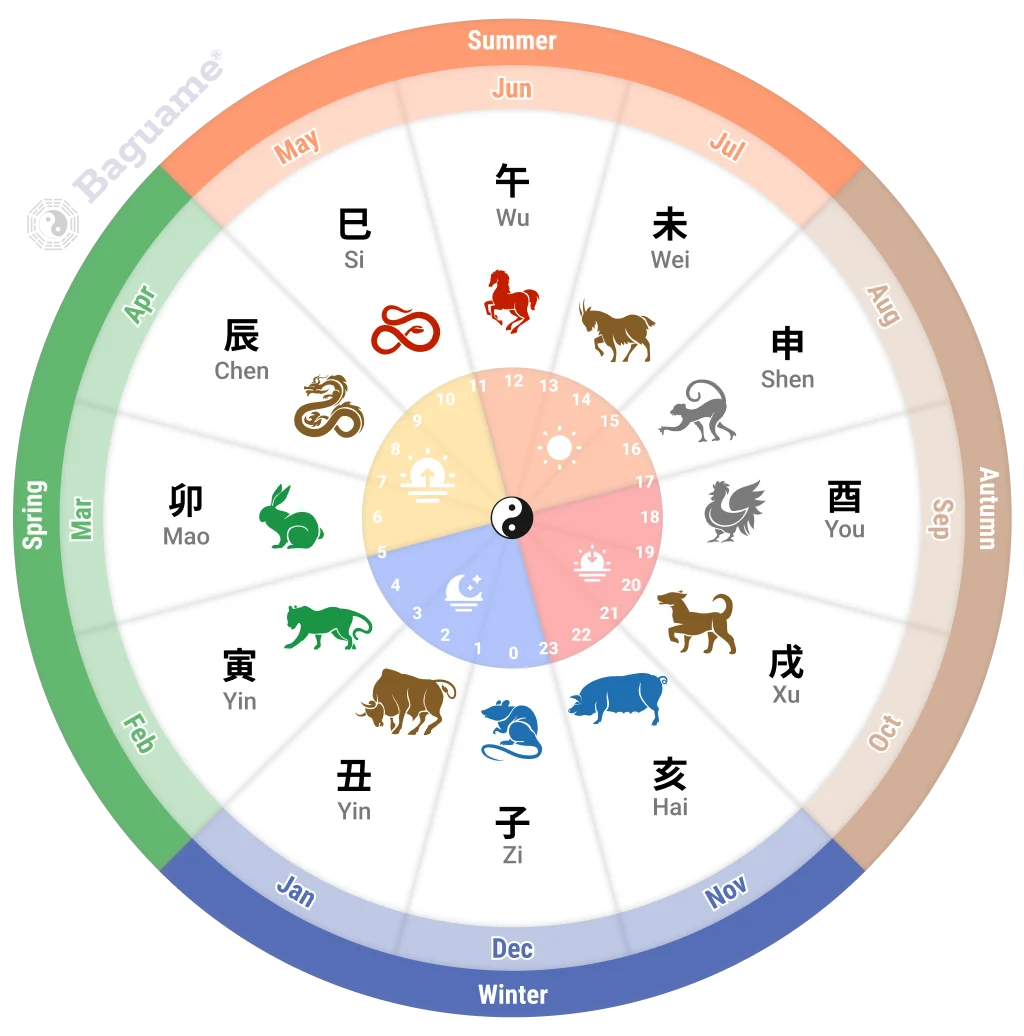
The central question for a Gui Day Master is: does this water have a purpose — and is it protected from excessive heat or excessive cold? Season shapes the answer fundamentally.
Winter (亥 Hai · 子 Zi · 丑 Chou)
Gui in winter is in its home season — but also in its most vulnerable state. Water is plentiful, yet the cold freezes movement and suppresses warmth. Consequently, this chart needs Fire to provide direction and vitality. That said, a winter Gui with good Fire and Wood support can be extraordinarily deep and purposeful — still water in a cold season, waiting for the right moment.
Summer (巳 Si · 午 Wu · 未 Wei)
Fire dominates summer, which activates Gui’s Wealth energy strongly. As a result, this is the most outwardly productive configuration for Gui — the rain under a hot sun, creating growth everywhere it lands. However, excessive Fire can evaporate Yin Water entirely. Therefore, Metal resource is especially important in summer Gui charts to maintain Water supply.
Spring (寅 Yin · 卯 Mao · 辰 Chen)
Wood output season — rain nourishing early growth. In this configuration, Gui’s energy flows naturally and productively into creative expression and influence. Furthermore, spring is the most harmonious season for Gui in classical analysis: rain falling on sprouting Wood is the most natural image of Yin Water fulfilling its purpose.
Autumn (申 Shen · 酉 You · 戌 Xu)
Metal produces Water, making autumn the resource season for Gui. Overall, this is a replenishing, reflective configuration — Xin Yin Metal in particular deepens and refines Gui’s sensitivity. In this season, Gui people tend toward inward development, accumulation of wisdom, and a quiet but growing inner strength.
Special Combinations Involving Gui
癸戊合 — Gui + Wu Combination
Yin Water and Yang Earth (戊 Wu) form a Heavenly Stem combination — one of the six stem combinations (天干合, Tiangan He). When these two meet, their energies merge and — if Fire season supports it — can transform into Fire. In classical interpretation, this is rain meeting a great mountain: the water is absorbed, grounded, and transformed into warmth. Furthermore, this combination often produces people of remarkable depth who carry both profound sensitivity and a structural inner solidity that others find deeply reassuring.
癸丁对冲 — Gui vs. Ding Clash
Yin Water and Yin Fire (丁 Ding) are in direct opposition — a Heavenly Stem clash (天干冲). This is rain meeting a candle — the most asymmetric and intimate of all clashes. In contrast to the Ren–Bing clash between ocean and sun, the Gui-Ding clash operates at a smaller, more personal scale. A single drop extinguishes a single flame. As a result, this clash in Luck Pillars often brings quiet but significant disruptions — erosion of confidence, suppression of creative expression, or the loss of something small but deeply meaningful.
Gui in Feng Shui and Annual Stars
Beyond BaZi, 癸 appears in Flying Stars and annual cycle analysis. Understanding its directional and temporal associations adds depth to any Feng Shui practice involving Water energy.
Direction
Gui corresponds to a specific mountain within the North sector of the 24 Mountains system (癸 mountain, 7.5°–22.5°). In contrast to 壬 Ren which leads into the North from the northwest, Gui exits the North sector toward the northeast. Activating the Gui sector brings internalized, nourishing Yin Water energy — supportive for healing spaces, meditation rooms, and environments focused on deep inner work.
Annual Cycle
The 癸 year carries Yin Water energy — quiet, internalized, and deeply perceptive. Historically, 癸 years tend to bring shifts driven by things long hidden becoming visible: information emerging from beneath the surface, slow processes completing, and patterns that were building quietly suddenly becoming clear. For individuals whose charts are strengthened by Water, 癸 years reward patience and deep work over visibility.
24 Mountains
In the 24 Mountain system, Gui mountain carries the qi of Yin Water. A sitting or facing direction aligned to 癸 brings gentle, penetrating Water energy into the environment — ideal for spaces of healing, study, and creative depth. The North sector overall is governed by the Kan trigram (☵), representing hidden depth, inner reserves, and the potential that lies beneath the visible surface.
Summary
Yin Water 癸 Gui is the last of the Ten Heavenly Stems — and in many ways, the most internalized. The rain and morning dew do not announce themselves. They nourish without performance, penetrate without force, and sustain life in ways that only become visible when they are absent. That said, this invisibility is not weakness — it is a different kind of power entirely.
In BaZi, a strong Gui Day Master chart belongs to someone of extraordinary inner depth and perceptive intelligence. However, the chart must provide direction — Wood output to channel sensitivity into expression, Earth structure to give the water a container, and Fire warmth to prevent the cold from becoming isolation. Above all, Gui thrives when its gifts are given a purposeful form.
Furthermore, understanding 癸 completes the Water pair alongside 壬 Ren — and together, the two Water stems cover the full spectrum of how Water energy moves through human experience: the visible ocean and the invisible rain, the expansive and the intimate, the strategic and the intuitive. Explore all Ten Heavenly Stems or open the BaZi calculator to discover where 癸 Gui appears in your own chart.
Frequently Asked Questions
Yin Water 癸 Gui represents rain, morning dew, and underground springs — the most internalized and nourishing form of Water energy. In BaZi, it is the tenth and final Heavenly Stem. People born with Gui as their Day Master tend to be deeply sensitive, highly intuitive, and quietly persistent. In contrast to Yang Water (Ren), Gui works beneath the surface — nourishing invisibly rather than moving visibly.
Yang Water (Ren) is the ocean — vast, expansive, and outwardly engaging. Yin Water (Gui) is the rain or underground spring — internalized, nourishing, and quietly persistent. Ren moves across surfaces visibly; Gui penetrates invisibly. In personality terms, Ren people tend to be more socially expansive and strategically outward-facing, while Gui people are often more introspective, emotionally perceptive, and deeply effective in one-to-one or behind-the-scenes contexts.
For a Gui Day Master, Yi Yin Wood as output is the most natural expression — rain nourishing the vine is the ideal image of Gui fulfilling its purpose. Furthermore, Ji Yin Earth as the Officer star provides the gentle structure that gives Gui direction without suppressing its sensitivity. Ding Yin Fire as Wealth provides warmth and motivation. Without at least one of these anchors, Gui’s energy disperses without direction.
No — and this is one of the most common misconceptions about Gui. In classical BaZi, strength does not mean loudness or visibility. Rain appears gentle, yet over time it carves stone, fills oceans, and sustains all life on earth. Gui’s power is cumulative, penetrating, and deeply sustainable. Moreover, Gui carries the most refined intuitive intelligence of all ten stems — a quality that is extremely difficult to develop artificially and extraordinarily valuable in practice.
Gui (Yin Water) and Wu (Yang Earth) form one of the six Heavenly Stem combinations (天干合). When these two appear adjacent in a BaZi chart, their energies merge. If the seasonal qi of Fire is present, this combination can transform into Fire. On a character level, this pairing brings together deep sensitivity (Gui) and structural solidity (Wu) — rain absorbed by a mountain. The result is often a person of quiet power: emotionally complex on the inside, remarkably stable and grounding to those around them.