
Yang Metal (庚 Geng) — The Seventh Heavenly Stem
Yang Metal, written 庚 and pronounced Geng, is the seventh of the Ten Heavenly Stems and the first of the two Metal stems. It represents the most forceful, decisive, and uncompromising expression of the Metal element. In the natural world, Geng is the great sword, the axe, the raw ore freshly extracted from the earth — hard, sharp, and capable of cutting through anything that stands in its way. It is Metal before refinement: powerful, blunt, and built for action.
Core Identity
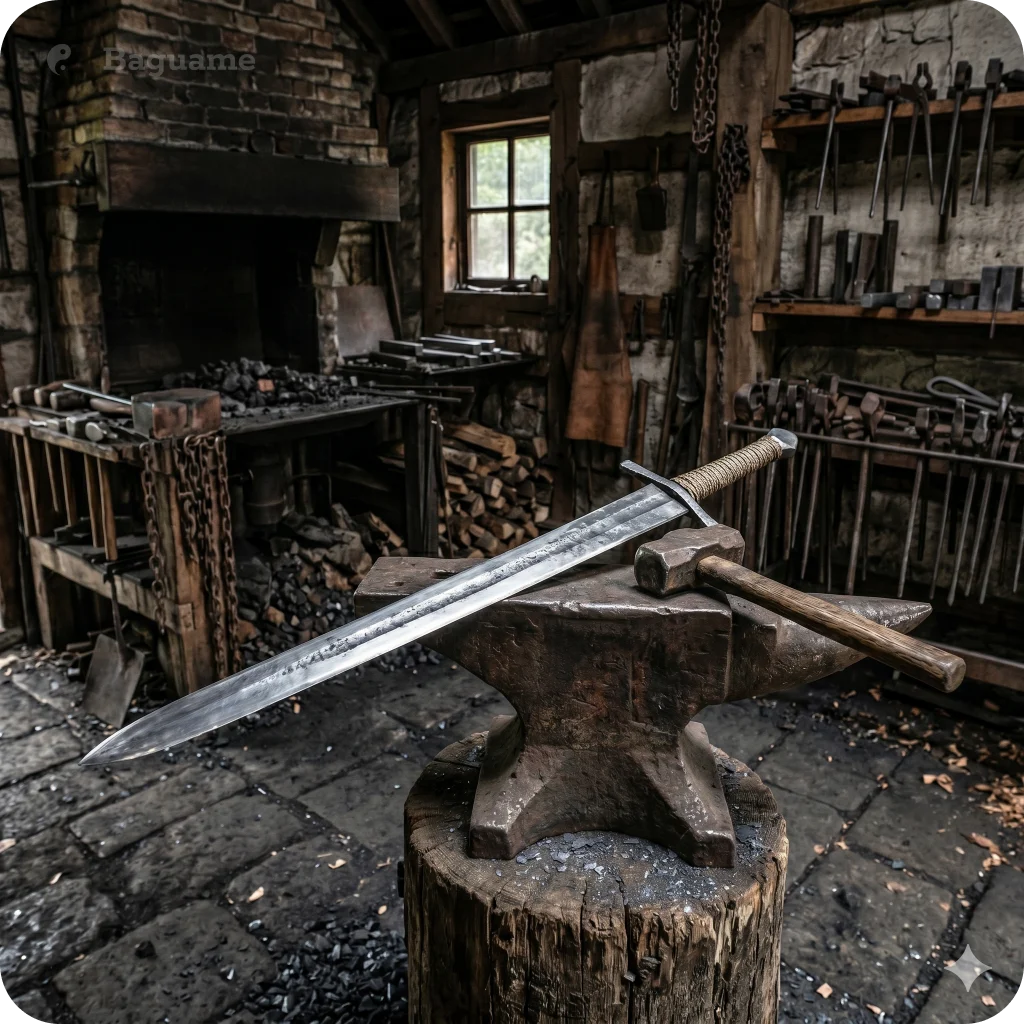
Geng is pure Yang energy within the Metal element — direct, forceful, and fundamentally oriented toward cutting through, deciding, and completing. In contrast to Yin Metal (辛 Xin), which is the refined jewel or polished blade — already shaped and precise — Yang Metal is the raw material: enormous potential, uncompromising hardness, and a natural drive toward the kind of decisive action that changes situations permanently.
In classical texts, Geng is associated with justice, courage, and a capacity for directness that can be either magnificent or brutal depending on how it is applied. Geng people do not soften difficult truths, do not delay necessary decisions, and do not adapt themselves to make others comfortable. In practice, this makes them natural commanders, reformers, and surgeons of situations — people who do what needs to be done when others are still debating whether to begin.
Key Attributes at a Glance
Element
Metal (Yang)
Natural Image
Great Sword · Axe · Raw Ore · Cannon
Season / Direction
Autumn · West
Polarity
Yang (odd)
The Five Element Relationships
Understanding Geng requires mapping it against all five elements. The interactions below form the foundation of BaZi analysis when Yang Metal appears in any pillar.
Earth Produces Metal (生)
Producing element. Earth (戊 Wu, 己 Ji) generates Geng and acts as its resource. For Yang Metal, Wu Yang Earth is the most natural pairing — the great mountain containing vast deposits of raw ore, the bedrock from which the sword is extracted. In particular, a chart with strong Wu supporting Geng carries the image of an inexhaustible mine: Metal with both raw power and deep, stable backing. As a result, Geng people with strong Earth resource tend to combine decisiveness with a structural solidity that makes them genuinely formidable.
Metal Produces Water (生)
Output element. Water (壬 Ren, 癸 Gui) is produced by Metal and represents Geng’s output and intellectual expression. Furthermore, Ren Yang Water is the ideal output for Geng — metal condensing into a great flowing river, the sword’s power translated into strategic intelligence. In a well-structured chart, strong Water output channels Geng’s raw force into decisive, wide-ranging strategic action. In practice, Geng people who develop their output tend to become formidable strategists and commanders rather than merely forceful individuals.
Metal — Same Element (比)
Parallel / Companion. Other Metal stems (Geng or Xin) share the pillar. Two swords in the same chart — the energy is formidable but potentially undirected, competing for the same cutting action. That said, Geng alongside Xin is a classically interesting pairing: the great sword and the refined blade side by side, raw force and precision in the same chart. Furthermore, too much Metal without Fire to forge or Water to channel creates an overwhelming harshness that cuts indiscriminately rather than purposefully.
Fire Melts Metal (克)
Controlling element. Fire (丙 Bing, 丁 Ding) restrains Geng. In BaZi, Fire is the Officer or Power star for Geng. However, the pairing distinction is critical: Ding Yin Fire is the ideal controller — the forge fire that melts the raw ore into a precisely shaped sword. In contrast, Bing Yang Fire is often too overwhelming for Yang Metal — a blast furnace rather than a forge, which melts everything without shaping anything. As a result, Geng Day Masters respond best to focused, intelligent authority rather than broad, imposing power.
Metal Cuts Wood (克)
Dominated element. Wood (甲 Jia, 乙 Yi) is dominated by Metal. In BaZi, Wood represents Wealth for Geng. Specifically, Jia Yang Wood is the most significant Wealth target — the axe meeting the great tree is the definitive image of Yang Metal’s power applied to Yang Wood’s ambition. Consequently, Geng people are naturally drawn to large-scale, ambitious targets — the wealth they pursue is rarely small or subtle, but rather the kind of significant, structural acquisition that only a great blade can accomplish.
The Sword and the Fire
The most transformative pairing for Geng: 庚 Geng (Yang Metal, Great Sword) meeting 丁 Ding (Yin Fire, Forge Fire). When the forge shapes the sword, raw ore becomes an instrument of extraordinary precision and purpose. Consequently, this combination appears frequently in the charts of surgeons, military strategists, engineers, and legal professionals: people who apply the sharpest kind of focused force to produce outcomes that serve a clear, disciplined purpose. Without the forge, the ore is just raw material. With it, it becomes something genuinely remarkable.
Personality Traits
The sword does not negotiate. It cuts or it does not — and Geng people carry precisely this quality in how they engage with the world. That said, this is not cruelty; it is a form of radical clarity. Below are the core traits observed in individuals with Geng as the Day Master or prominent in the chart.
Strengths
- Decisiveness. Geng people act when action is needed. In particular, they do not delay difficult decisions, do not soften necessary cuts, and do not allow sentiment to override what they have clearly identified as the right course of action.
- Courage. The sword is not afraid of what it must cut through. Consequently, Geng people face confrontation, pressure, and adversity with a directness and composure that others find both reassuring and formidable in high-stakes situations.
- Loyalty. Yang Metal is extremely hard — and once committed, equally difficult to break. As a result, Geng people are among the most loyal in the Ten Stems: their allegiances, once formed, are as durable as forged steel and rarely abandoned without serious cause.
- Justice. The sword cuts without favoritism. Moreover, Geng people carry a strong instinct for fairness — they apply the same standard to everyone, including themselves, and are deeply uncomfortable with special treatment or inconsistency in how rules are applied.
- Clarity under pressure. Above all, when situations become most complex or most dangerous, Geng becomes most focused. The blade is at its most useful precisely when circumstances are most demanding.
Challenges
- Bluntness. The sword does not soften its edge for sensitive situations. In many cases, Geng people deliver difficult truths in ways that cause unnecessary damage — not because they are cruel, but because precision of delivery is simply not their primary concern.
- Inflexibility. Raw ore is extremely hard to reshape. However, this same hardness means that Geng people can resist necessary adaptation long after the evidence has made the need for change clear.
- Aggression under pressure. When the sword meets resistance, it cuts harder. Consequently, Geng people can escalate in situations where de-escalation would produce a better outcome — defaulting to force when finesse would serve them better.
- Difficulty with emotional nuance. The blade is not designed for delicate work. For this reason, Geng people can be genuinely poor at managing the emotional dimensions of relationships — not from indifference, but because their natural mode of engagement is clear, direct, and structural rather than sensitive and adaptive.
- Over-cutting. Furthermore, a sword that is always drawn eventually damages what it was meant to protect. Geng people must develop the discipline to know when not to cut — when restraint and patience are more powerful than immediate decisive action.
Geng in the Four Pillars
The position of 庚 in the BaZi chart changes its expression significantly. The same stem operates differently depending on whether it appears in the Year, Month, Day, or Hour pillar.
| Pillar | Domain | Expression of Yang Metal |
| Year (年) | Ancestors, social environment, early life | Strong or militaristic family background; early environment that valued discipline, justice, and decisive action — often a family with a tradition of service, law, or structured authority |
| Month (月) | Career, parents, prime years (20–40) | Career built on decisiveness, structural authority, and the capacity to make and enforce difficult decisions; works best in roles that require clear command rather than consensus-building |
| Day (日) | Self, spouse palace | Day Master — defines core character as described above. Spouse palace suggests a partner who provides warmth, refinement, or the Fire energy that shapes Yang Metal’s raw force into something more precise and purposeful |
| Hour (时) | Children, later life, hidden thoughts | Direct or highly principled children; late-life legacy built on what was cut away and what was built through disciplined, decisive effort; inner world oriented around justice, clarity, and the question of what truly deserves to be preserved |
Geng as Day Master — the Sword Identity
When 庚 is the Day Master, the entire chart is read through the lens of the great sword. The key questions are: has this sword been forged into something purposeful, or is it still raw ore — powerful but unshapen? You can calculate your own chart using the Baguame BaZi calculator.
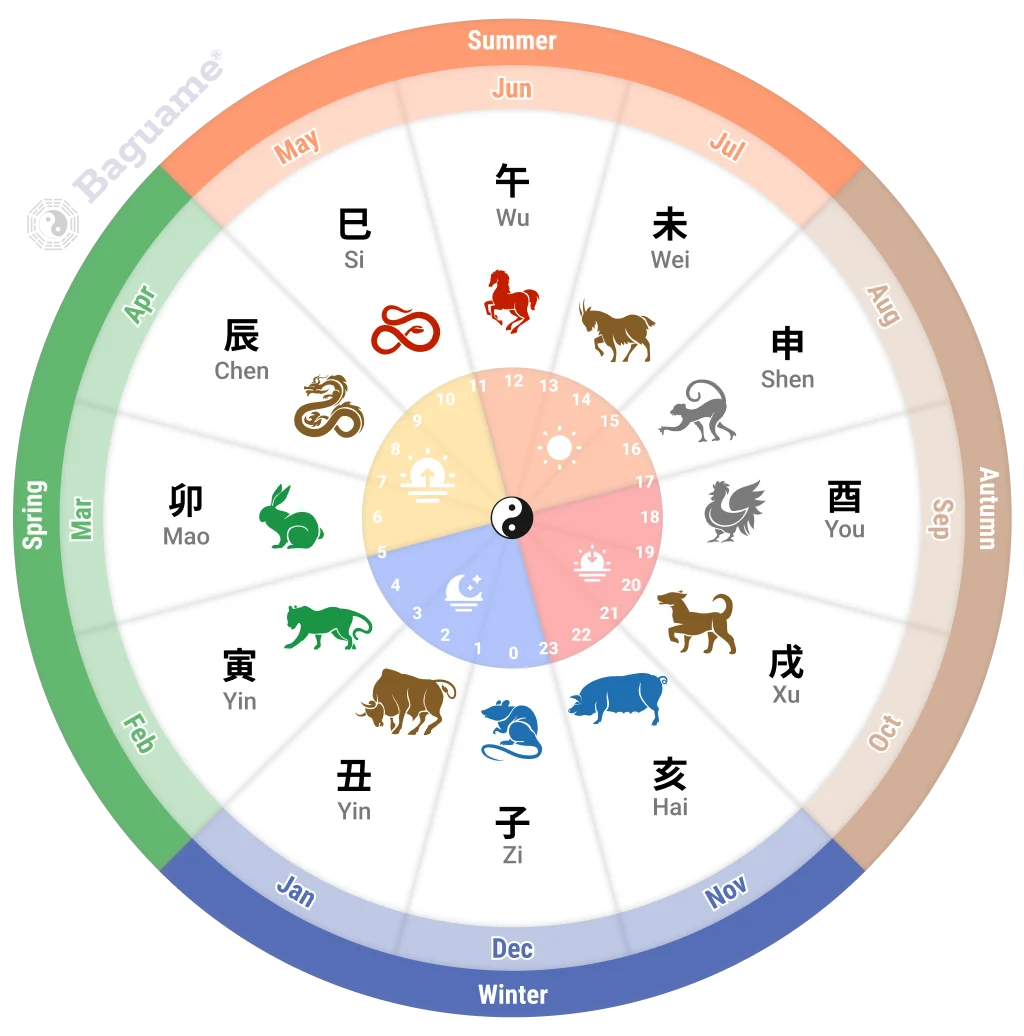
The central question for a Geng Day Master is: is this sword forged and purposeful, or raw and uncontrolled? Season determines the starting conditions and the nature of the forge available.
Autumn (申 Shen · 酉 You · 戌 Xu)
Geng in its home season — Metal energy at full strength. Consequently, the sword is at its hardest and sharpest. However, without Fire to forge it into shape, strong autumn Geng can be overwhelming — too much cutting force with insufficient direction. That said, an autumn Geng with Ding Fire forging and Ren Water as output is one of the most celebrated configurations in classical BaZi: the sword, forged at its hardest, flowing into strategic brilliance.
Spring (寅 Yin · 卯 Mao · 辰 Chen)
Wood season — Geng’s Wealth energy is active and abundant. As a result, this is the most wealth-oriented configuration for Yang Metal: the axe surrounded by trees, a vast field of opportunity for decisive action. In practice, spring Geng charts tend toward ambitious accumulation and strategic acquisition. Furthermore, Earth resource is important here to ensure the sword retains its structural backing as it works through the available Wood.
Summer (巳 Si · 午 Wu · 未 Wei)
Fire season — the Officer and controlling element at full strength. In this configuration, the forge is fully active. On one hand, summer Geng charts carry the potential for extraordinary refinement — raw Metal being shaped under the most intense possible conditions. On the other hand, excessive Fire without Earth to moderate it risks melting the sword entirely rather than forging it. Therefore, Wu Yang Earth as resource becomes critical in summer Geng configurations.
Winter (亥 Hai · 子 Zi · 丑 Chou)
Water output season — the sword flowing into strategic intelligence. Overall, this configuration is characterized by Geng’s decisive energy being channeled outward through Ren Yang Water: force becoming strategy, cutting becoming navigation. In particular, winter Geng charts often produce people who combine the sword’s clarity of decision with the ocean’s breadth of strategic reach — commanders as much as fighters.
Special Combinations Involving Geng
庚乙合 — Geng + Yi Combination
Yang Metal and Yin Wood (乙 Yi) form a Heavenly Stem combination — one of the six stem combinations (天干合, Tiangan He). When these two meet, their energies merge and — if Metal season supports it — can transform into Metal. In classical interpretation, this is the sword meeting the vine: force encountering the flexible and adaptive. Furthermore, this combination often appears in people who achieve significant outcomes by working within and through existing structures — the decisive cutting of Geng finding its most effective application in the relational, adaptive context that Yi provides.
庚甲对冲 — Geng vs. Jia Clash
Yang Metal and Yang Wood (甲 Jia) are in direct opposition — a Heavenly Stem clash (天干冲). This is the axe meeting the great tree: the most direct and structurally significant clash in the Ten Stems. When this clash appears, the weaker element is cut down or the blade is broken — the outcome depends entirely on which is stronger in the chart. As a result, this clash in Luck Pillars often brings decisive, irreversible confrontations — the kind that permanently alter the landscape of a life, for better or worse, in a single sharp movement.
Geng in Feng Shui and Annual Stars
Beyond BaZi, 庚 appears in Flying Stars and annual cycle analysis. Understanding its directional and temporal associations adds depth to any Feng Shui practice involving Metal energy and the West sector.
Direction
Geng corresponds to a specific mountain in the West sector of the 24 Mountains system (庚 mountain, 247.5°–262.5°). The West is the home of Metal energy — the direction of autumn, harvest, and the cutting away of what is no longer needed. Activating the Geng sector brings forceful, decisive Yang Metal energy into a space, supporting reform, structural change, and any environment where clarity of decision and disciplined action are the primary needs.
Annual Cycle
The 庚 year carries strong Yang Metal energy — decisive, reforming, and forceful. Historically, 庚 years tend to bring significant structural changes, the cutting away of what has outlasted its usefulness, and the kind of sharp turning points that create new landscapes from old ones. For individuals whose charts are strengthened by Metal, 庚 years represent windows for decisive action, major restructuring, and the kind of bold moves that require both courage and clarity to execute.
24 Mountains
In the 24 Mountain system, Geng mountain carries the qi of Yang Metal. A main door or sitting direction aligned to 庚 brings forceful, structural Metal energy into the environment. The West sector overall is governed by the Dui trigram (☱), representing the lake, joyful expression, and the harvest that comes after a season of disciplined effort — the moment when Metal’s work reveals what it has produced.
Summary
Yang Metal 庚 Geng is the great sword — the seventh of the Ten Heavenly Stems and the most forcefully decisive energy in the entire cycle. The sword does not hesitate, does not apologize, and does not leave its work half done. Specifically, Geng’s power lies in the clarity of its action: when it is well-forged and purposefully directed, there is no more effective instrument in the Ten Stems for cutting through what needs to be cut and preserving what deserves to remain.
In BaZi, a strong Geng Day Master chart belongs to someone built for decisive authority and structural transformation. However, the chart must provide a forge — without Ding Fire to shape the raw ore into a purposeful instrument, Yang Metal’s power remains undirected and potentially destructive. Furthermore, Water output gives Geng’s decisiveness a strategic dimension that elevates it far beyond simple force.
Moreover, understanding 庚 is foundational to reading Metal-dominant charts, the Geng-Ding forging dynamic, and west-sector Feng Shui activations — including the Eight Trigrams that govern each directional zone. Overall, Geng represents what disciplined, purposeful force looks like when it is properly directed: not destruction, but the precise cutting that makes everything else possible. Explore all Ten Heavenly Stems or open the BaZi calculator to see where 庚 Geng appears in your own chart.
Frequently Asked Questions
Yang Metal 庚 Geng represents the great sword, axe, and raw ore — the most forceful and decisive form of Metal energy. In BaZi, it is the seventh Heavenly Stem. People born with Geng as their Day Master tend to be courageous, direct, deeply loyal, and capable of the kind of decisive action that others find both impressive and occasionally intimidating. Like the sword, they are defined by the clarity and finality of their cuts.
Yang Metal (Geng) is the great sword or raw ore — forceful, unrefined, and built for decisive large-scale action. Yin Metal (Xin) is the jewel, the refined blade, or the needle — precise, already shaped, and capable of the kind of delicate, targeted work that brute force cannot accomplish. In personality terms, Geng people tend to be more directly forceful, structurally authoritative, and decisive under pressure, while Xin people are often more aesthetically refined, strategically precise, and effective in situations requiring subtlety rather than power.
For a Geng Day Master, Ding Yin Fire as the Officer star is the single most transformative element — the forge fire that shapes raw ore into a purposeful sword. Additionally, Wu Yang Earth as resource provides the structural backing that ensures the sword has depth and durability behind its cutting edge. Ren Yang Water as output translates Geng’s decisive force into wide-ranging strategic intelligence. Without the forge, Geng remains raw material: powerful, but unshapen and potentially destructive.
The 庚丁 dynamic — Yang Metal and Yin Fire — is one of the most discussed forging relationships in classical BaZi. Ding is the only fire precise enough to shape Geng without destroying it: a forge fire, not a wildfire. When Ding acts as the Officer star for Geng, the raw sword becomes a finished weapon — purposeful, balanced, and capable of its most refined work. Furthermore, this dynamic appears frequently in the charts of people who achieve significant things through disciplined external structure applied to natural force: talent shaped by training, power directed by principle.
Geng (Yang Metal) and Yi (Yin Wood) form one of the six Heavenly Stem combinations (天干合). When these two appear adjacent in a BaZi chart, their energies merge. If the seasonal qi of Metal is present, this combination can transform into Metal. On a character level, this pairing brings together decisive force (Geng) with adaptive flexibility (Yi) — the sword meeting the vine. The result is often someone who achieves outcomes that direct confrontation would never produce: the decisive actor who has also mastered the art of working through rather than simply cutting through.