
Yang Wood (甲 Jia) — The First Heavenly Stem
Yang Wood, written 甲 and pronounced Jia, is the first of the Ten Heavenly Stems and the first of the two Wood stems. It stands at the very beginning of the cycle — the most primal, direct, and upward-reaching energy in the entire system. In the natural world, Jia is the towering tree: singular, vertical, rooted deep in the ground, and growing relentlessly toward the light regardless of what stands in its way.
Core Identity
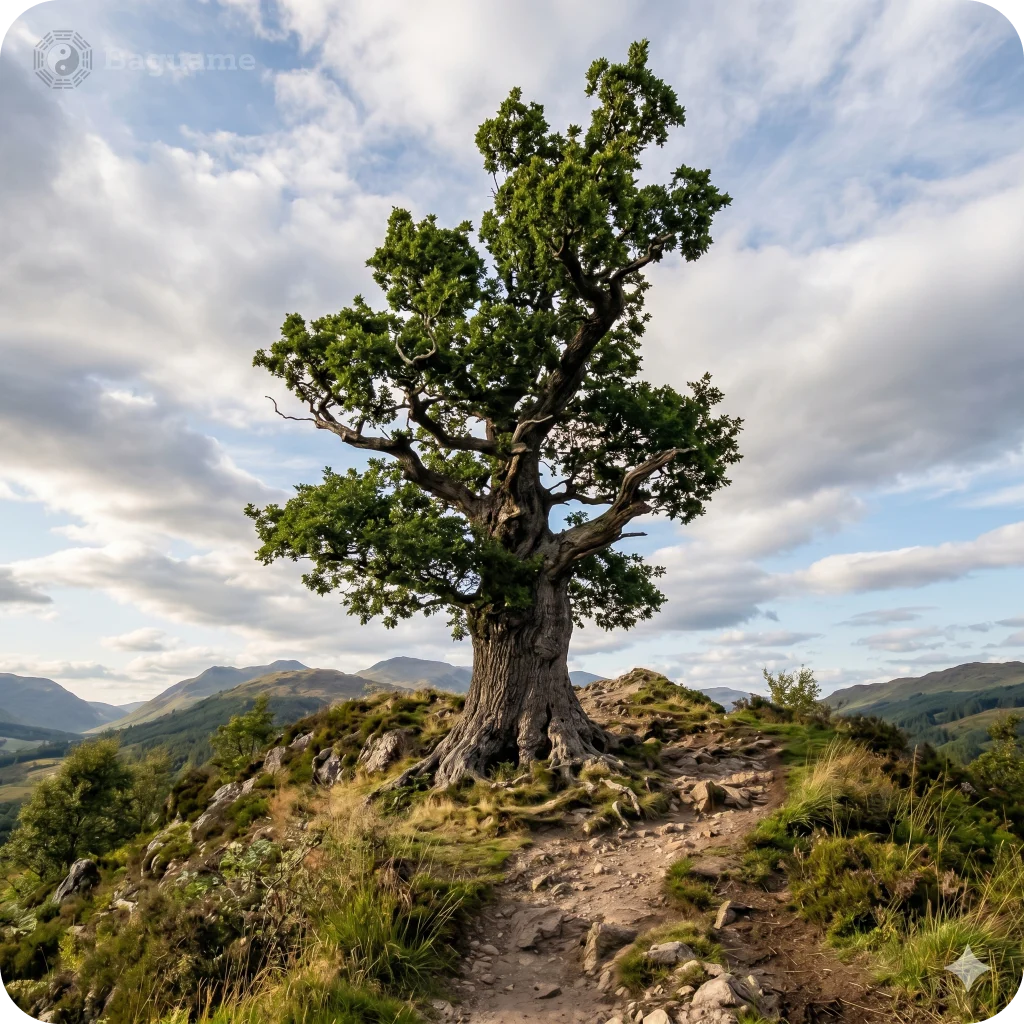
Jia is pure Yang energy within the Wood element — direct, ambitious, and fundamentally oriented toward growth. In contrast to Yin Wood (乙 Yi), which is the vine that winds and adapts around obstacles, Yang Wood is the oak that pushes straight through them. Furthermore, where Yi bends with the wind, Jia stands firm — sometimes to its own detriment.
In classical texts, Jia is associated with leadership, integrity, and an almost inflexible moral directness. Jia people know where they are going and move toward it in a straight line. In practice, this makes them natural pioneers and initiators — the people who start things, establish direction, and inspire others by the sheer clarity of their forward momentum.
Key Attributes at a Glance
Element
Wood (Yang)
Natural Image
Towering Tree · Ancient Oak · Cedar
Season / Direction
Spring · East
Polarity
Yang (odd)
The Five Element Relationships
Understanding Jia requires mapping it against all five elements. The interactions below form the foundation of BaZi analysis when Yang Wood appears in any pillar.
Water Produces Wood (生)
Producing element. Water (壬 Ren, 癸 Gui) generates Jia and acts as its resource. For Yang Wood people, strong Water in the chart means deep nourishment, strong intellectual support, and access to wisdom and knowledge. In particular, Gui Yin Water is the most natural pairing — morning dew and rain feeding the roots of a great tree quietly and consistently.
Wood Produces Fire (生)
Output element. Fire (丙 Bing, 丁 Ding) is produced by Wood and represents Jia’s output and creative expression. Furthermore, Bing Yang Fire is the ideal output for Jia — the towering tree feeding a great sun, producing light on the grandest possible scale. In a well-structured chart, strong Fire output channels Jia’s upward energy into visible, public expression and lasting impact.
Wood — Same Element (比)
Parallel / Companion. Other Wood stems (Jia or Yi) share the pillar. A forest of trees — multiple Jia in a chart creates strong ambition and forward drive. That said, too much Wood without Fire or Metal to channel it creates an overbearing, stubborn energy that can overwhelm those around it. Furthermore, Jia alongside Yi is a classic pairing: the great tree and the vine growing together, each supporting the other in different ways.
Metal Cuts Wood (克)
Controlling element. Metal (庚 Geng, 辛 Xin) restrains Jia. In BaZi, Metal is the Officer or Power star for Jia. However, the key distinction is critical: Geng Yang Metal is the axe that cuts and shapes the great tree into something useful — a builder’s tool, not a destroyer. As a result, Geng is the preferred controller for Jia Day Masters. In contrast, too much Metal without Water to moderate it risks destroying the tree entirely.
Wood Controls Earth (克)
Dominated element. Earth (戊 Wu, 己 Ji) is dominated by Wood. In BaZi, Earth represents Wealth for Jia — the tree’s roots spreading through the soil, claiming territory and extracting nourishment. Specifically, Ji Yin Earth is the preferred Wealth target: soft, fertile soil that a great tree can penetrate and transform. Jia people are naturally drawn to building, acquiring, and developing — accumulating wealth through sustained growth rather than sudden accumulation.
The Tree and the Axe
The most discussed pairing for Jia in classical literature: 甲 Jia (Yang Wood, Great Tree) meeting 庚 Geng (Yang Metal, Axe or Sword). When these two appear together — especially in adjacent pillars — the axe shapes the tree into timber, a mast, a great pillar. Consequently, this combination appears frequently in the charts of builders, architects, surgeons, and military strategists: people who take raw natural power and give it precise, functional form through disciplined application of force.
Personality Traits
The towering tree is not simply an image of size — it is an image of direction. Jia energy moves upward, always. It does not circle back, does not spread sideways, and does not compromise its vertical trajectory. Below are the core traits observed in individuals with Jia as the Day Master or prominent in the chart.
Strengths
- Natural leadership. Jia people lead by standing upright and moving forward. In particular, they do not manage from behind — they are at the front, setting direction by example and inspiring others through the clarity of their own momentum.
- Integrity and directness. The tree does not bend to please. Consequently, Jia people are known for moral consistency, straightforwardness, and a refusal to compromise their core values under social pressure.
- Ambition and drive. Yang Wood grows relentlessly toward light. As a result, Jia people set large goals and pursue them with a sustained energy that outlasts most obstacles — not through cleverness, but through sheer forward persistence.
- Generosity. A great tree provides shade, oxygen, and shelter without being asked. Moreover, Jia people are often naturally generous — sharing resources, knowledge, and support with those in their orbit as a matter of course.
- Resilience. Trees survive storm, drought, and cold by being deeply rooted. For this reason, Jia people tend to recover from setbacks with a fundamental groundedness that others find stabilizing and dependable.
Challenges
- Rigidity. The same directness that makes Jia trustworthy can become inflexibility. In many cases, Jia people struggle to change course even when the evidence clearly suggests a different path is needed.
- Stubbornness. Yang Wood does not naturally bend. However, this refusal to yield can become obstinacy — a fixed attachment to being right that damages relationships and closes off better solutions.
- Difficulty with detail. The great tree sees the canopy, not the root system. Consequently, Jia people can be impatient with process, administration, and the granular work required to sustain what they have built.
- Overwhelming presence. Large trees block out light for smaller plants. For this reason, Jia people can unintentionally dominate environments — taking up so much space and direction that others feel unable to contribute.
- Pride. Above all, Jia finds retreat genuinely difficult. Admitting error or changing a stated position requires a conscious effort that does not come naturally to the first and most upright of the Ten Stems.
Jia in the Four Pillars
The position of 甲 in the BaZi chart changes its expression significantly. The same stem operates differently depending on whether it appears in the Year, Month, Day, or Hour pillar.
| Pillar | Domain | Expression of Yang Wood |
| Year (年) | Ancestors, social environment, early life | Strong or principled family lineage; early environment that valued integrity, achievement, and upward striving; often a prominent or respected family background |
| Month (月) | Career, parents, prime years (20–40) | Career built on leadership, pioneering roles, and the ability to initiate and direct; works best at the front of an organization rather than in support roles |
| Day (日) | Self, spouse palace | Day Master — defines core character as described above. Spouse palace suggests a partner who provides grounding, practical support, or the Earth energy that nourishes and contains the tree’s roots |
| Hour (时) | Children, later life, hidden thoughts | Ambitious or independent children; late-life legacy built on what was created and established; inner world oriented toward purpose, direction, and the question of what one’s life will ultimately amount to |
Jia as Day Master — the Tree Identity
When 甲 is the Day Master, the entire chart is read through the lens of the great tree. The key questions are: how deep are the roots, how much light does the tree have, and what is shaping its growth? You can calculate your own chart using the Baguame BaZi calculator.
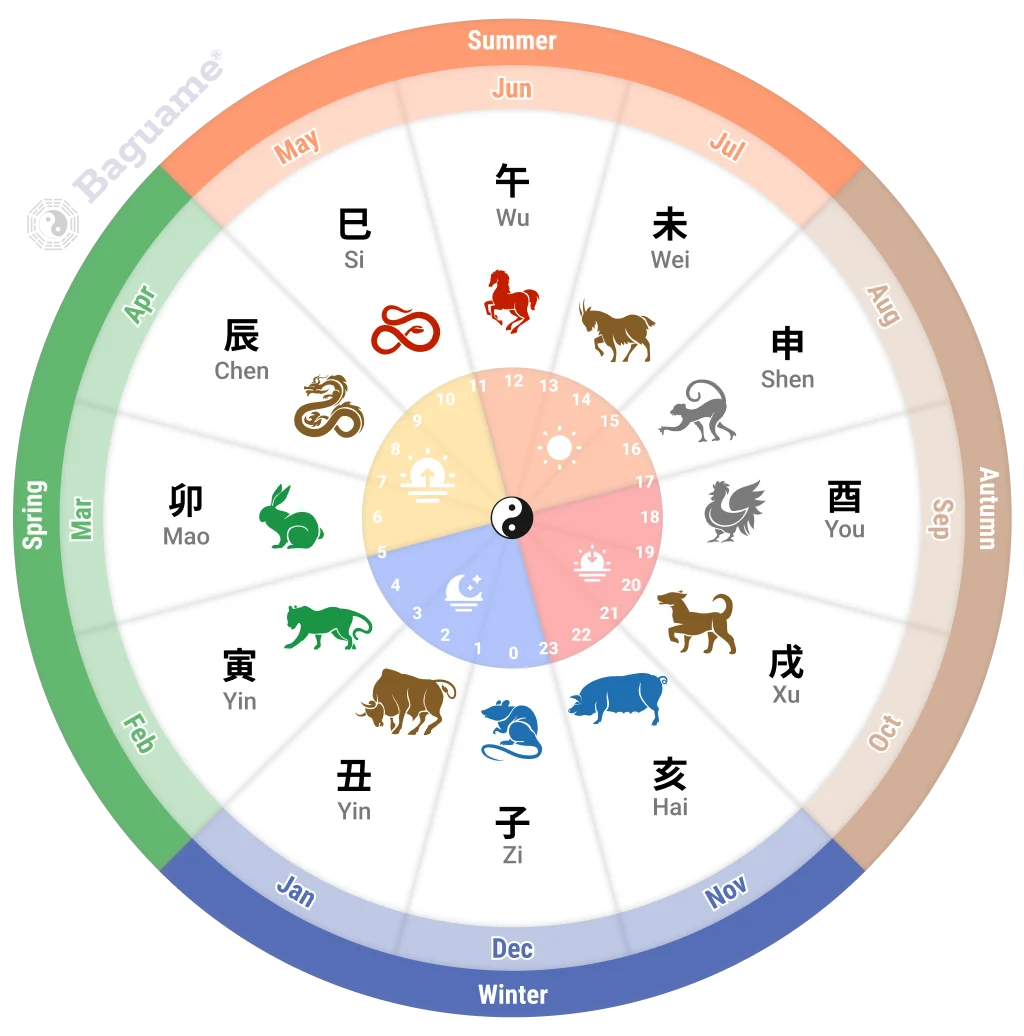
The central question for a Jia Day Master is: is this tree well-rooted, well-lit, and purposefully shaped — or is it growing wild without direction? Season determines the starting conditions.
Spring (寅 Yin · 卯 Mao · 辰 Chen)
Jia in its home season — Wood energy at full strength. Consequently, the tree is vigorous and growth is rapid. However, strong Jia in spring may be too dominant if Fire, Metal, or Earth are absent. That said, a spring Jia with Geng Metal as the Officer and Bing Fire as output is one of the most celebrated configurations in classical BaZi: the great tree, shaped by the axe, illuminating the world.
Autumn (申 Shen · 酉 You · 戌 Xu)
Metal dominates autumn — the season of the axe. As a result, this is Jia’s most challenging season: the tree faces its controlling element at full strength. In practice, this configuration produces people of exceptional discipline when Water is present to moderate the Metal. Furthermore, autumn Jia charts often show a recurring theme of being shaped by external pressure into something more useful than the raw growth alone would produce.
Summer (巳 Si · 午 Wu · 未 Wei)
Fire output season — the tree feeds a great blaze. In this configuration, Jia’s energy flows outward into expression, visibility, and impact. Overall, summer Jia charts tend to be highly outward-facing, with strong Fire creating natural charisma and public presence. In particular, Water resource is essential here to prevent the tree from being consumed by its own output.
Winter (亥 Hai · 子 Zi · 丑 Chou)
Water resource season — deep nourishment from below. On one hand, winter provides Jia with rich intellectual and supportive resources. On the other hand, excessive Water without Fire warmth can leave the tree cold and slow. Therefore, Fire in the chart becomes critical in winter Jia configurations to provide the light and warmth that drives upward growth.
Special Combinations Involving Jia
甲己合 — Jia + Ji Combination
Yang Wood and Yin Earth (己 Ji) form a Heavenly Stem combination — one of the six stem combinations (天干合, Tiangan He). When these two meet, their energies merge and — if Earth season supports it — can transform into Earth. In classical interpretation, this is the tree taking deep root in soft, fertile soil: ambition grounded in abundance. Furthermore, this combination often appears in people who combine natural leadership with a strong practical instinct for building sustainable, lasting structures rather than chasing short-term gains.
甲庚对冲 — Jia vs. Geng Clash
Yang Wood and Yang Metal (庚 Geng) are in direct opposition — a Heavenly Stem clash (天干冲). This is the tree meeting the axe in conflict rather than cooperation. When this clash appears in a chart, the weaker element is damaged: either the tree is cut down or the axe is broken. However, when both are balanced, the clash produces extraordinary tension — a driven, highly competitive energy that can achieve remarkable things under the right conditions. As a result, this clash in Luck Pillars often brings decisive confrontations, major career turning points, or significant tests of character.
Jia in Feng Shui and Annual Stars
Beyond BaZi, 甲 appears in Flying Stars and annual cycle analysis. Understanding its directional and temporal associations adds depth to any Feng Shui practice involving Wood energy and the East sector.
Direction
Jia corresponds to a specific mountain in the East sector of the 24 Mountains system (甲 mountain, 67.5°–82.5°). The East is the home of Wood energy — the direction of rising sun and new growth. Activating the Jia sector brings expansive Yang Wood energy into a space, supporting initiatives, new beginnings, leadership development, and upward career momentum.
Annual Cycle
The 甲 year carries strong Yang Wood energy — initiating, pioneering, and forward-moving. Historically, 甲 years mark the beginning of new sixty-year cycles and tend to bring energy of fresh starts, ambitious new directions, and the establishment of foundations that will define the years ahead. For individuals whose charts are strengthened by Wood, 甲 years represent significant windows for initiating major projects and claiming new territory.
24 Mountains
In the 24 Mountain system, Jia mountain carries the qi of Yang Wood. A main door or sitting direction aligned to 甲 brings strong, upward-reaching Wood energy into the environment. The East sector overall is governed by the Zhen trigram (☳), representing thunder, initiation, and the explosive energy of new beginnings.
Summary
Yang Wood 甲 Jia is the first of the Ten Heavenly Stems — and in many ways, the most archetypal. The towering tree is not a metaphor for ambition; it is ambition itself made visible: rooted, vertical, patient, and unstoppable in its upward reach. Specifically, Jia does not need to be told where to go. It already knows. The only question is whether it has the right conditions to grow.
In BaZi, a strong Jia Day Master chart belongs to someone built for leadership and lasting impact. However, the key is always purposeful shaping — an uncut tree is just timber waiting. The ideal chart provides Water to nourish the roots, Metal to give form and direction, and Fire to channel growth into visible, public expression.
Furthermore, understanding 甲 is foundational to reading Wood-dominant charts, the Jia-Geng dynamic of creation through controlled force, and east-sector Feng Shui activations — including the Eight Trigrams that govern each directional zone. Overall, Jia represents the full potential of what directed, purposeful growth looks like when given the right environment. Explore all Ten Heavenly Stems or open the BaZi calculator to see where 甲 Jia appears in your own chart.
Frequently Asked Questions
Yang Wood 甲 Jia represents the towering tree — the most upright, direct, and growth-oriented energy among the Ten Heavenly Stems. In BaZi, it is the first Heavenly Stem and the initiator of the entire cycle. People born with Jia as their Day Master tend to be natural leaders: principled, ambitious, generous, and fundamentally oriented toward forward movement and upward growth.
Yang Wood (Jia) is the towering tree — singular, vertical, and growing straight up regardless of what is in the way. Yin Wood (Yi) is the vine or grass — flexible, adaptive, and able to grow around and through obstacles rather than through them. In personality terms, Jia people tend to be more direct, principled, and leadership-oriented, while Yi people are often more adaptable, strategically flexible, and effective in complex social environments.
For a Jia Day Master, the most important combination is Geng Yang Metal as the Officer star (the axe that shapes the tree into something purposeful) and Gui Yin Water as resource (rain nourishing the roots). Additionally, Bing Yang Fire as output allows the tree’s energy to be expressed visibly on the largest scale. Without Metal to provide direction and discipline, even a strong Jia chart can become unfocused and domineering.
The 甲庚 pairing — Yang Wood and Yang Metal — is one of the most discussed dynamics in the Ten Stems. When Geng acts as the Officer star for Jia, it functions as the axe that shapes the great tree into a mast, a pillar, or a fine piece of timber. In contrast to unshapable wild growth, Jia refined by Geng becomes purposeful and structurally significant. This is why the combination appears frequently in the charts of people who achieve large, lasting things through disciplined effort applied to natural talent.
Jia (Yang Wood) and Ji (Yin Earth) form one of the six Heavenly Stem combinations (天干合). When these two appear adjacent in a BaZi chart, their energies merge. If the seasonal qi of Earth is present, this combination can transform into Earth. On a character level, this pairing brings together natural leadership and ambition (Jia) with practical, fertile groundedness (Ji) — the tree taking deep root in soft soil. The result is often someone who builds things that last.