
Fu Wei (伏位) Feng Shui: The Ultimate Guide to Stability and Personal Growth
Three of your four auspicious directions in the Ba Zhai (Eight Mansions) system point somewhere specific: Sheng Qi to the money, Tian Yi to the doctor, Yan Nian to the people who stay. The fourth points at you. It is called Fu Wei — the "resting position," your own direction — and it is the quietest and most personal energy in the system.
What Is Fu Wei (伏位)?
Fu Wei (伏位) translates roughly as "lying position," "crouching position" or "resting place" — the place where something settles and stays. It is governed by the Zuo Fu (左辅) star, the "Left Assistant," and belongs to the Wood element. Wood here is not the aggressive spring growth of Sheng Qi; it is the patient growth of a tree that adds a ring a year.
Every person's Fu Wei is the compass direction of their own trigram — your personal direction. Kua 1 sits on Kan and its Fu Wei is North; Kua 2 sits on Kun and its Fu Wei is Southwest; and so on for all eight numbers. This is why Fu Wei is sometimes described as "your own mansion inside your own house": the direction that simply matches you, with no relationship to fix and nothing to negotiate.
Its quality is stability. Fu Wei does not accelerate anything: it consolidates. Used well, it supports study, meditation, rest, planning, and the kind of steady, unglamorous progress that compounds — the direction of the person who keeps going while others burn out.
What Fu Wei Governs
- Stability and continuity. Not sudden change for the better or worse, but the ability to remain on course — in a job, a project, a practice.
- Study and learning. Fu Wei is the classic direction for desks of people who are learning rather than trading: students, researchers, anyone preparing for exams or writing a thesis.
- Meditation, rest and mental peace. Because it is calming, it suits rooms where you want the mind to settle — meditation corners, reading chairs, therapy rooms.
- Personal growth in the private sense. Self-discipline, habit-building, inner work: the improvements nobody sees.
- Consolidating what Sheng Qi brought. Money earned in Sheng Qi is kept in Fu Wei, which is why the two are used as a pair — accelerate at the desk, hold at the savings and the study.
How to Find Your Fu Wei Direction
Fu Wei is determined by your Ming Gua (Kua) number and, like the other three good directions, it never changes: it is your personal direction for life. It is ranked fourth among the four auspicious energies, which does not mean it is weak — it means you turn to it when you want steadiness rather than gain.
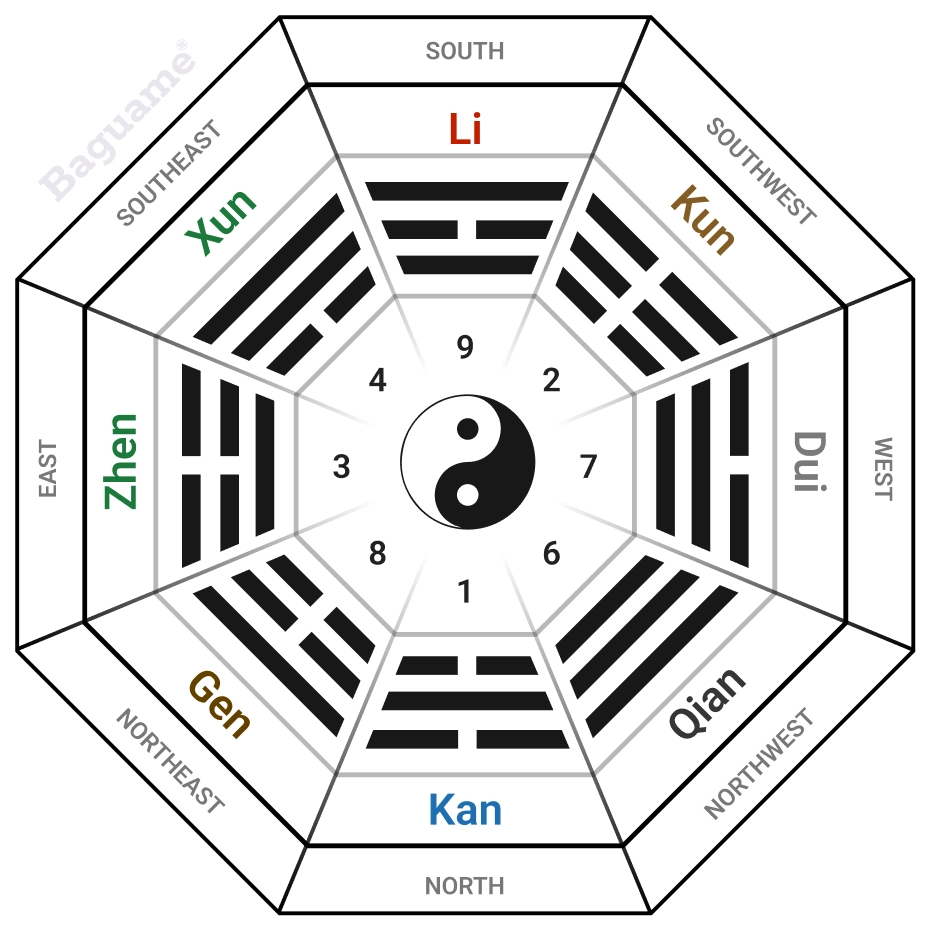
If you don't know your Kua number yet, you can calculate it with our free online calculator.
Your Fu Wei direction is the direction of your own trigram:
- Kua 1 (Kan): North
- Kua 2 (Kun): Southwest
- Kua 3 (Zhen): East
- Kua 4 (Xun): Southeast
- Kua 6 (Qian): Northwest
- Kua 7 (Dui): West
- Kua 8 (Gen): Northeast
- Kua 9 (Li): South
Because Fu Wei is literally the direction of your own trigram, it always falls among the four directions of your group — East group (Kua 1, 3, 4, 9) on North, East, South or Southeast; West group (Kua 2, 6, 7, 8) on West, Northwest, Southwest or Northeast. To see where that direction lands in your home, overlay it on your floor plan — the Ba Zhai calculator does it from your birth data and a plan upload.
Best Ways to Activate Fu Wei
1. The Study or Homework Desk
This is Fu Wei's home ground. Position the desk so that you sit facing your Fu Wei direction, or place the whole study in that sector of the house. Students who are revising for years rather than weeks benefit most: the direction rewards repetition.
2. The Meditation and Reading Corner
A chair, a cushion, a low table in the Fu Wei sector, kept deliberately plain. Fu Wei is the direction where the mind is meant to stop producing, so avoid screens and noise-generating equipment there.
3. Sleep for the Restless
Where Sheng Qi over-stimulates sleep and Yan Nian holds a couple together, Fu Wei is the direction for someone who cannot switch off — the person who lies awake running scenarios. Pointing the bed head into Fu Wei for a period is a common remedy for restlessness and for recovery from burnout.
4. Wood Cures, Gently Applied
Fu Wei is Wood, so it responds to living plants, green and pale tones, natural materials and, above all, books. The correct scale is modest: one healthy plant, not a jungle. This is the direction of quiet growth, and excess defeats its purpose.
What to Avoid in the Fu Wei Sector
- Heavy Metal. Metal cuts Wood: large metal furniture, metal shelving, metallic wall art and industrial finishes weaken the sector. If the room is unavoidably metallic, soften it with wood and fabric.
- Excessive Fire. Too much red, strong lighting or a fireplace burns Wood. A single warm lamp is fine; a wall of red is not.
- Clutter and noise. Fu Wei is the direction of stability, and clutter is visual noise. Storage rooms, laundries and utility areas waste the direction's potential — if Fu Wei falls there, keep it orderly and consider using the direction for the desk instead.
- Water features. Wood absorbs Water and swells — a large aquarium or fountain in Fu Wei over-stimulates it and undermines the calm that is its whole value.
- Aggressive activation. Crystals, mirrors, fountains and rotating devices belong to the other directions. In Fu Wei they turn a settling place into a busy one.
Where Fu Wei Sits Among the Four Good Directions
Use the ranking to decide what a room is for:
- Sheng Qi — wealth and career. The desk, the front door, the ambition.
- Tian Yi — health and recovery. The bed for the unwell, the kitchen, the dining table.
- Yan Nian — love, marriage and longevity. The master bedroom.
- Fu Wei — stability, study and peace. The study, the meditation corner, the long project.
A simple sequence for a house that has to compromise: earn in Sheng Qi, heal in Tian Yi, keep the people in Yan Nian, and finish what you started in Fu Wei.
Conclusion
Fu Wei is easy to overlook because it promises nothing dramatic. It is the direction of finishing a degree, of a meditation practice that survives its first month, of a business that is still there in ten years. Find your personal direction from your Kua number, give it the desk or the quiet corner, and let it do the one thing no other direction does: keep you steady while everything else moves.
Frequently Asked Questions
What does Fu Wei mean in Feng Shui?
Fu Wei (伏位) means "resting position" or "lying position" — it is your personal direction in the Ba Zhai system, governed by the Zuo Fu (左辅) star and the Wood element. It carries stability, peace, study and steady personal growth, and it is the fourth of your four auspicious directions.
How is Fu Wei different from my other good directions?
Sheng Qi governs wealth, Tian Yi health and Yan Nian relationships — all of them are about a result you want. Fu Wei is about you as you are: it is the direction of your own trigram, so it simply supports stability, learning and rest rather than pursuing anything. It is the direction of consolidation, not acquisition.
How do I find my Fu Wei direction?
It is the direction of your own trigram, which follows from your Kua number: Kua 1 North, Kua 2 Southwest, Kua 3 East, Kua 4 Southeast, Kua 6 Northwest, Kua 7 West, Kua 8 Northeast, Kua 9 South. The Kua calculator gives you the number, and the Ba Zhai calculator maps it onto your floor plan.
Which element activates Fu Wei?
Wood — living plants, green and pale natural tones, wooden furniture and books. Keep it restrained, because Fu Wei works through calm rather than intensity. Avoid heavy Metal, which cuts Wood, and avoid pushing the sector with strong Fire, which burns it.
Is Fu Wei good for a bedroom?
Yes, particularly for anyone who sleeps badly or is recovering from exhaustion. Fu Wei is calming where Sheng Qi is stimulating, so a bed head pointing into Fu Wei suits restless sleepers, while couples usually prefer Yan Nian for the master bedroom.
Can I use my Fu Wei direction for a home office?
Yes, and it is the right choice for work that requires persistence rather than sales: study, research, writing, coding, long projects, exam preparation. For work that depends on winning clients or expanding income, Sheng Qi is the stronger direction.
