
Bagua Map full guide: How to make a Feng Shui Map (2 methods)
Do you want to enhance your wealth, improve your relationships, or boost your career? The ancient art of Feng Shui offers a powerful tool to help you do just that: the Bagua map. Think of the Feng Shui Bagua map as an energy "blueprint" of your home. By understanding this blueprint, you can identify which parts of your space affect specific areas of your life and learn how to optimize them for success, health, and harmony. In this guide, we'll walk you through two different methods to create your own Bagua map: the traditional "9-sector grid" method and the modern, simple "online calculator" method.
What exactly is a Feng Shui Bagua map?
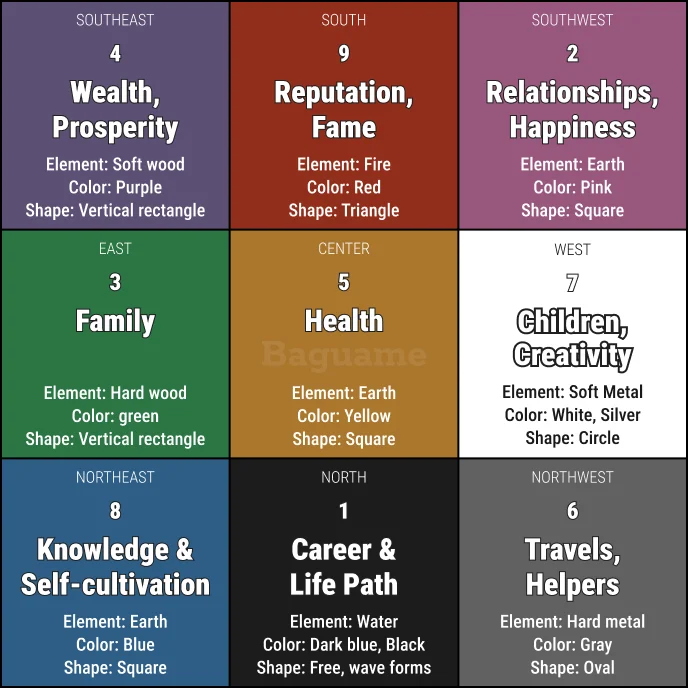
The Bagua (also spelled Pa Kua) is a fundamental concept in Feng Shui. It translates to "eight trigrams," which represent the foundational energies of life. These are organized into a grid, which, when including the center (Tai Chi), creates nine distinct sectors. Each of these nine sectors corresponds to a specific "Life Area":
- Wealth & Prosperity (Zhen): This sector governs material well-being, abundance, affluence, and the flow of finances into your life. Activating this area helps attract money and good fortune.
- Fame & Reputation (Li): This area is connected to how others see you, your social status, recognition, reputation, and inspiration. It supports your efforts to gain respect and achieve prominence.
- Love & Relationships (Kun): This sector is responsible for romantic relationships, marriage, and harmonious partnerships. It also governs self-love and your overall relationship with others.
- Family & Ancestors (Zhen): This sector symbolizes your roots, relationships with family, parents, and ancestors. It is also associated with health, growth, and new beginnings.
- Health (Tai Chi - The Center): This is the heart of the home, the central point that connects and grounds all other zones. It is responsible for overall physical and spiritual health, vitality, balance, and harmony.
- Creativity & Children (Dui): This area relates to creative self-expression, new projects, hobbies, and the joy of life. It also governs children, their well-being, and your relationship with them.
- Knowledge & Self-Cultivation (Gen): This sector is responsible for learning, wisdom, introspection, spiritual growth, meditation, and making wise, informed decisions.
- Career & Life Path (Kan): This zone represents your career, your mission in life, professional development, and the journey you are on. It's about finding and following your true path.
- Travel & Helpful People (Qian): This sector governs the support you receive from others—mentors, friends, clients, and unseen helpers. It also rules travel, new opportunities, and synchronicity.
By overlaying this 9-sector map onto your home's floor plan, you can pinpoint exactly where your "Wealth" area is, where your "Love" corner is, and so on.
Before you start: the two main Bagua schools
Before you can draw your map, you must make a key decision. There are two primary schools of thought in Feng Shui for how to align the Bagua map
The Classical (Compass) School
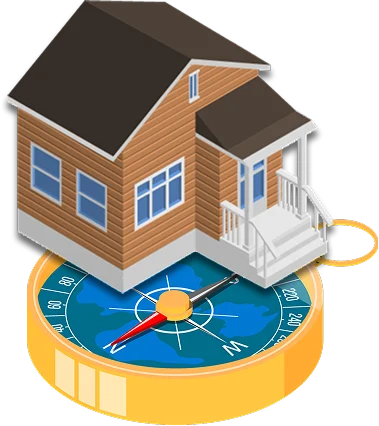
This traditional method aligns the Bagua map with the cardinal directions. It requires you to take an accurate compass reading of your home. The "Career" sector, for example, is always located in the North, the "Fame" sector in the South, etc. This method is considered more complex but is favored by many classical Feng Shui practitioners.
The BTB (Western) School
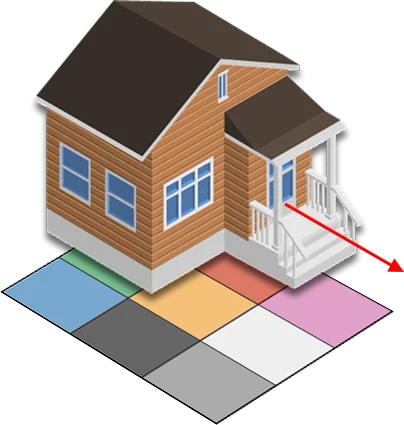
This modern approach (popularized as Black Sect Tantric Buddhism Feng Shui) aligns the map based on the location of your main entrance door. This method does not use a compass. The bottom of the Bagua grid (the row containing Knowledge, Career, and Travel) is always aligned with the wall that contains your front door.
Which should you choose? There is no "wrong" answer, but consistency is key. The BTB (Front Door) method is often easier for beginners. The Classical (Compass) method is more complex but is tied to the energies of the cardinal directions. Choose the one that resonates most with you and stick with it.
Method 1: How to create a Bagua map manually
This is the traditional, hands-on way to apply the Bagua map to your home with 9 areas Grid.
Step 1: Get your floor plan
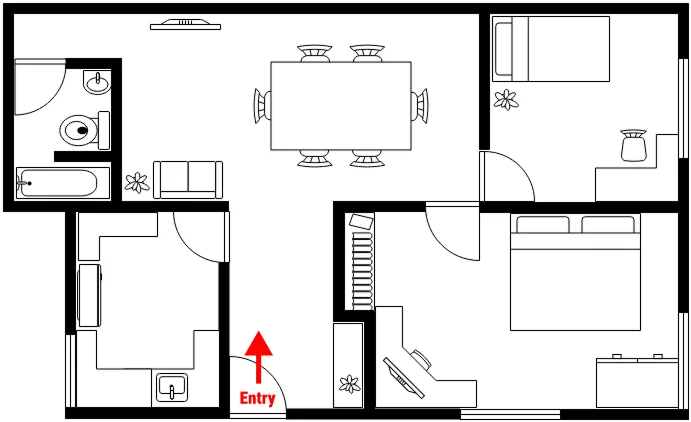 You'll need a basic floor plan of your home. You can print one out if you have a digital copy, or you can draw one by hand. If you draw it, it's very important to maintain accurate proportions (draw it "to-scale") so that all rooms are the correct relative size to each other. A simple sketch showing all the rooms, doors, and windows on one level is perfect. If your home has multiple stories, you will apply the Bagua map to each floor separately.
Step 2: Draw Your 9-Sector Bagua Grid
 Now that you have your floor plan, your next goal is to overlay the 3x3 Bagua grid on top of it.
- Define the Shape: First, draw a perfect square or rectangle that encompasses the entire outline of your home.
- Handle Irregular Shapes: If your home is irregular (like an L-shape), you must still draw a complete square or rectangle that encloses the whole building. The parts of this grid that fall outside your actual floor plan are known as "missing areas."
- Divide the Grid: Take this main square or rectangle and divide it into nine equal sectors by drawing two vertical and two horizontal lines, exactly like a tic-tac-toe board.
You now have your 9-sector Bagua map grid ready to be aligned.
Step 3: Align Your Grid
This is the most important step, and there are two primary schools of thought on how to do it. To help you understand both approaches, we will describe each method in detail. Both perform the same core function—aligning the Bagua's life areas to your home—but they are based on different principles. After reading the descriptions, you can decide for yourself which method suits you best. Before you align, it's important to understand a key point. The Bagua map itself (with its nine life areas like Wealth, Love, and Career) is the same for all Feng Shui schools. The only difference is in how these sectors are aligned or distributed over your floor plan. While both methods are valid and widely used, from our perspective, the Classical (Compass) School is preferable. The reason is that a Bagua map aligned using the Compass method is also compatible with other powerful Feng Shui techniques, such as Flying Stars (Xuan Kong), allowing for a deeper and more layered analysis to attract good fortune. Now, let's look at both options.
Option A: Aligning with the BTB (Front Door) Method
- Orient your floor plan so that the wall containing your main entrance is at the bottom of the page.
- Place the 9-sector grid over your floor plan.
- The front door will now fall into one of the three bottom sectors:
- Knowledge & Self-cultivation (bottom left)
- Career (bottom center)
- Travels & Helpers (bottom right)
The rest of the sectors are now identified. The "Wealth" corner, for example, will be the far-left back corner of your home, and the "Love" corner will be the far-right back corner. 
Option B: Aligning with the Classical (Compass) Method
- Stand at your home's front door with a reliable compass (your smartphone's compass app will work).
- Find the cardinal directions (North, South, East, West) for your entire home.
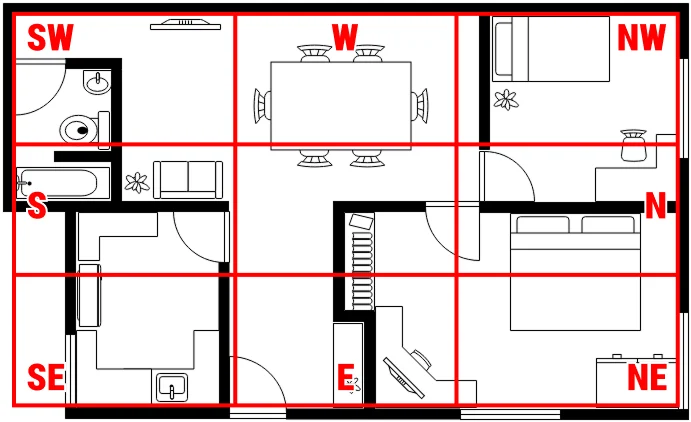
- Align the 9-sector Bagua map with the compass directions. The Bagua map's sectors have fixed directions:
- Career: North
- Knowledge: Northeast
- Family: East
- Wealth: Southeast
- Fame: South
- Love: Southwest
- Children: West
- Travel: Northwest
- Health: Center

The Bagua map can be applied in two different ways, and each is correct in its own context. The method of orienting by the front door (BTB) is a bit simpler and is often used by practitioners for small or non-standard spaces. It has its own advantages. However, a conflict can arise if you later want to apply other Feng Shui formulas, like the Flying Stars (Xuan Kong), to the same chart. The BTB alignment method may conflict with this other system. For this reason, we recommend using the Classical (Compass) alignment method. From a metaphysical perspective, this layout reflects where and how your home is actually situated relative to the Earth's magnetic directions, and this scheme does not conflict with other classical Feng Shui systems.
Method 2: Using an Online Bagua Map Calculator
If the manual method seems confusing, or if you have an irregular-shaped home, modern technology offers a far simpler solution. An online Bagua map calculator does all the heavy lifting for you, providing a perfect, accurate, and interactive map in minutes.
This digital approach uses a specialized online Feng Shui Bagua map calculator. The process is designed to guide you step-by-step, creating a precise, interactive map that is then saved to your secure personal account. This allows you to access, view, and get insights from your map anytime, from any device. Here is a step-by-step guide on how to get your professional, interactive Bagua map in minutes.
Register to create your secure account
This digital approach uses a specialized online Feng Shui Bagua map calculator. The entire process is incredibly fast—you can get your professional, interactive map in just 2-3 minutes. To begin, you will first need to register for a secure account. it's the foundation that creates your personal, private space where your floor plans and analysis will be saved. You can typically sign up using an email address and a secure password, after signing up, you will usually need to confirm your email. Or you can use a one-click social login like Google. Once registration completed, the guided process begins. The step-by-step instructions below describe all the steps you'll take to create your perfect map.
Step 1: Start the Onboarding Process
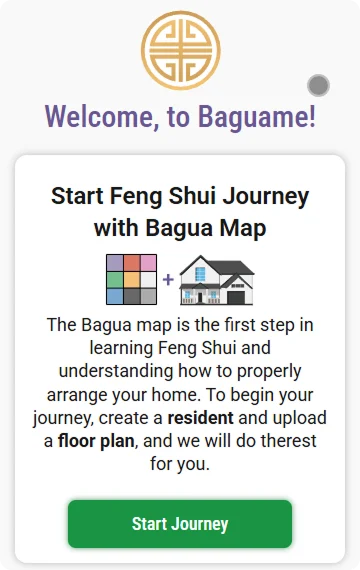 After confirming your email and logging in, you will land on your main dashboard. An onboarding process will launch to help you get started. Follow the prompts to begin creating your first building.
Step 2: Create a Resident Profile
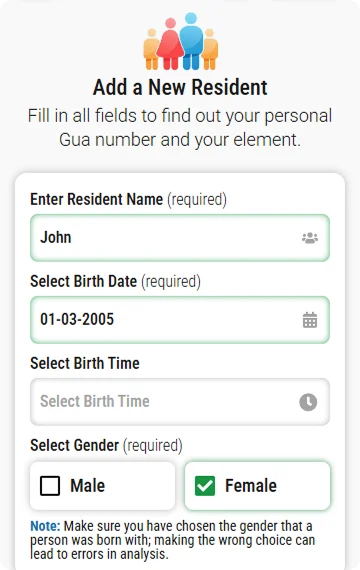 First, you'll be asked to create a "resident" profile by filling in the date of birth and gender. This quick but important step allows the system to calculate your personal Kua Number, a key piece of your personal Feng Shui. Click 'Next' to proceed.
Step 3: Upload Your Floor Plan
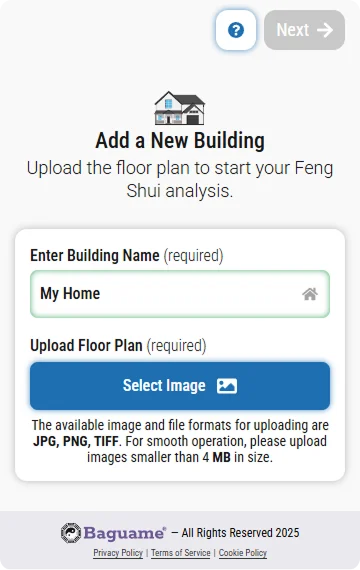 Now it's time to add your space. Click the upload button. You can take a new photo of your plan with your phone, or upload an existing image (like a JPG, PNG,) from your device's gallery or files. Once uploaded, click 'Next'.
Step 4: Crop Your Floor Plan
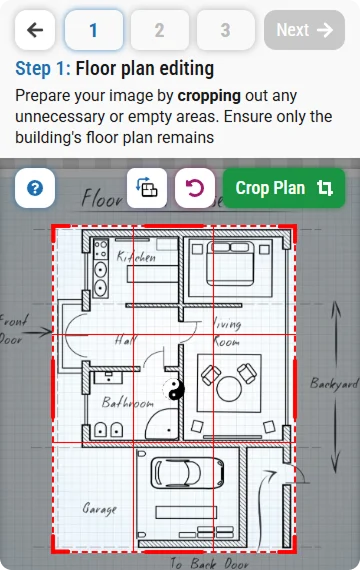 To ensure an accurate map, you can now edit your plan. Use the red frame to crop out any unnecessary areas, such as empty white space, legends, or parts of the property you don't want to include. Adjust the frame until it tightly encloses the building's outer walls. When you are satisfied, click 'Next'.
Step 5: Define the Energetic Center (Tai Qi)
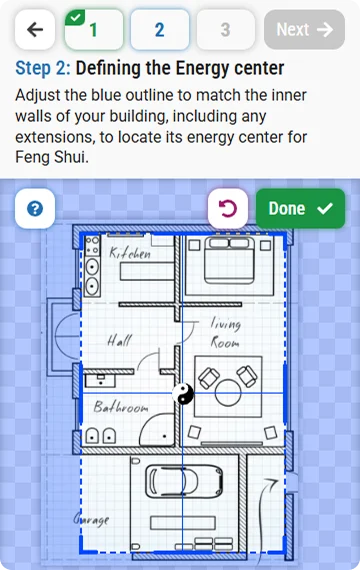 This step is crucial for an accurate calculation. You will use a blue frame to define the inner boundaries of your home. Adjust the frame so it aligns perfectly with the inner edges of the building's walls. The system will use these boundaries to determine the exact size and energetic center (Tai Qi) of your Bagua map. When the frame is set, click 'Done', and then 'Next' to continue.
Step 6: Set Your Compass Direction
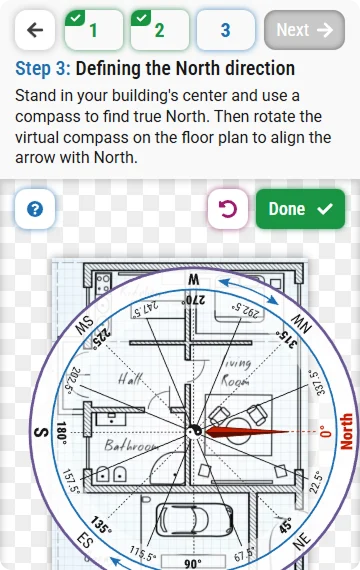 This is the final setup step. You must determine how your building is oriented relative to the cardinal directions. Use a compass app on your phone to find your home's true North direction. Once you know where North is, return to the app and rotate the virtual compass on your floor plan so that its North arrow points in that same direction. Click 'Done' to lock in the orientation, and then 'Next' to complete the building setup.
Step 4: Select the "Bagua Map" Calculator
 Your building is now saved and ready! From your dashboard or the main list of available calculators, simply select the "Bagua Map" calculator.
Step 8: Choose Your Building
 A window will appear asking you to select which of your saved buildings you want to analyze. Choose the one you just created.
Step 9: Your Bagua Map is Ready!
 Instantly, your personal, interactive Bagua map is generated. It is automatically and perfectly overlaid on your floor plan. The map is now permanently saved in your personal account for you to access anytime, anywhere.
The Power of an Interactive Bagua Map
But the process doesn't end there. The real power of a digital tool lies in its interactivity. Unlike a static paper drawing, your online Bagua map is a dynamic tool that allows you to:
- Click on Any Sector: Simply tap directly on the "Wealth," "Love," or any other sector on your floor plan.
- Get Instant Insights: A panel will instantly provide a detailed description of that life area, its element, and its significance.
- Receive Actionable Tips: The platform provides specific Feng Shui advice on how to enhance, activate, or balance that particular sector of your home.
- Access Anywhere: You can access your saved map from your phone while shopping for decor or from your computer while planning renovations, making informed decisions on the go.
- Layer Other Analyses: This digital foundation allows you to easily apply other calculators, like Annual Flying Stars, and see how they interact with your home's fixed Bagua map.
Prefer to watch a video? This step-by-step tutorial will walk you through the entire process described in Method 2—from registering your account to generating your final, interactive Feng Shui Bagua map. See how simple it is to get a professional analysis in just a few minutes.
Frequently Asked Questions
How do I create a Bagua map for my home?
You have two main options. The manual method is to get your floor plan, draw a nine-sector Bagua grid over it, and align it using either a compass direction or your front door (see the two schools below). The easier modern option is the online Bagua Map calculator, which generates an accurate, interactive map of your home automatically from your floor plan.
Which Bagua school should I use — Classical or BTB?
The Classical (Compass) method aligns the map with true cardinal directions and requires a compass reading — the Career sector is always North, Fame South, and so on. The BTB (Western) method aligns the map with your main entrance, with no compass needed. There is no wrong answer, but consistency matters: pick one school and use it for the whole analysis. BTB is easier for beginners; the Classical method is tied more closely to energetic directions.
Do I need a compass to make a Bagua map?
Only if you use the Classical (Compass) school, which requires an accurate reading of your home's facing direction to place the sectors correctly. The BTB (front door) method does not use a compass at all — you simply align the bottom row (Knowledge, Career, Travel) with the wall containing your main entrance. See the compass accuracy guides for Android and iOS if you take the Classical route.
Which direction should be at the top of my Bagua map?
It depends on the school you chose. In the Classical method, the top of the grid corresponds to the correct compass sector once you align the map to your home's facing. In the BTB method, the bottom row (Knowledge, Career, Travel) is always aligned with the front-door wall, and the top follows from that. Whichever method you use, keep the grid consistent and aligned to your floor plan.
How many sectors does the Bagua map have and what do they mean?
The map has nine sectors. Around the perimeter are eight trigram-based areas — Wealth (Southeast), Fame (South), Love (Southwest), Family (East), Center (health/balance), Children (West), Helpful People (Northwest), Career (North), and Knowledge (Northeast). Each sector corresponds to a specific life area you can activate or balance, as detailed in the Bagua guide.
Can I use a Bagua map for an apartment or an office?
Yes. The Bagua map applies to any occupied space — a house, an apartment, or an office — by overlaying the same nine-sector grid over the floor plan. The principles of aligning with compass directions (Classical) or the entrance (BTB) are identical for every space, so you can map your workplace as easily as your home to support career and reputation areas.
