
What is the Bagua? The Complete Guide to Feng Shui’s Energy Map
If you’ve ever explored Feng Shui, you’ve undoubtedly come across the term “Bagua.” But what is it, really? Is it just a mystical symbol? A floor plan diagram? A compass?
The Bagua (八卦, pronounced “bah-gwah”) is all of these things and more. It is the single most important concept in Feng Shui—the foundational energy map that allows us to read, understand, and harmonize the invisible life force energy, or Qi (氣), that flows through our environment and our lives.
This guide will demystify the Bagua, exploring its profound origins, its structure, and why it remains a powerful tool for personal transformation today.
The Origins: More Than Just a Map

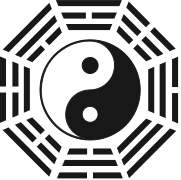
The Bagua originates from the I Ching (The Book of Changes), one of the oldest and most influential classical texts in Chinese history. It is an octagonal diagram, with each of its eight sides representing a trigram—a combination of three stacked lines (either solid or broken).
- A solid line (⚊) represents Yang energy: active, masculine, creative.
- A broken line (⚋) represents Yin energy: passive, feminine, receptive.
These eight trigrams are not random symbols; they are archetypes representing all the fundamental forces of nature and life: Heaven, Earth, Thunder, Water, Mountain, Wind, Fire, and Lake. The interaction between these forces describes the constant state of change and flux in the universe. The center of the Bagua represents the unity of all things—the Tai Qi.
The Two Foundational Arrangements of the Bagua

1. The Early Heaven Bagua
This is the primordial arrangement. It represents the universe in its ideal state—a state of perfect balance, harmony, and stillness. In this sequence, opposite forces are perfectly aligned: Heaven is opposite Earth, Fire is opposite Water. This version is considered static and “yin.” It describes the source of creation and is often used for protection. You might see the Early Heaven Bagua on mirrors and amulets placed outside homes to create a field of ideal harmony and ward off negative influences.

2. The Later Heaven Bagua
This is the Bagua of the manifest world—the world we live in, full of cycles, change, and movement. Its arrangement is dynamic and “yang,” reflecting the flow of the seasons, the cycle of life, and the way energy moves within our homes and lives. The Later Heaven Bagua is the sequence used for all practical Feng Shui analysis. When Feng Shui practitioners talk about applying the “Bagua map” to a home, they are referring to this version.
The Fundamental Meanings of the Eight Trigrams (八卦, Bagua)
The eight trigrams are the foundation of the I Ching (Book of Changes) and represent all fundamental forces, phenomena, and states of being in the universe. Each is a symbolic combination of three lines (solid for Yang, broken for Yin).
☴ XUN (xùn)
- Trigram: ☴ (Two solid lines above one broken line)
- Image in Nature: Wind (风), Wood.
- Key Attributes: Penetrating, gentle, flexible, adaptable, influence.
- Fundamental Meaning: This is Yin gently penetrating beneath Yang. Xun is the power of the wind, which has no form but permeates everywhere. It acts not with force, but with persistence and gentleness (like wind eroding stone or tree roots penetrating soil). It symbolizes influence, communication, flexibility, and gradual but steady progress.
☲ LI (lí)
- Trigram: ☲ (One broken line between two solid lines)
- Image in Nature: Fire (火), The Sun.
- Key Attributes: Clarity, radiance, awareness, attachment, intelligence.
- Fundamental Meaning: This is Yin at the center of Yang (like the dark wick in a bright flame). Li is the light that makes things visible. It is the symbol of clarity, consciousness, intellect, and beauty. But like fire, Li cannot exist on its own—it must “cling” to something (like fuel). This signifies interdependence and social bonds.
☷ KUN (kūn)
- Trigram: ☷ (Three broken lines)
- Image in Nature: Earth (地)
- Key Attributes: Receptive, yielding, accepting, nurturing, devotion.
- Fundamental Meaning: This is pure Yin, the ultimate receptivity. Kun is the fertile soil that accepts the seed from Heaven (Qian) and gives it form, nurturing and cultivating it. It is the archetype of the mother, the earth, and service. It represents endurance, devotion, adaptability, and the ability to bring things to completion.
☳ ZHEN (zhèn)
- Trigram: ☳ (Two broken lines above one solid line)
- Image in Nature: Thunder (雷)
- Key Attributes: Arousing, movement, shock, initiative, growth.
- Fundamental Meaning: This is the symbol of a sudden, awakening jolt. It is Yang arising from beneath Yin. Imagine the first stirrings of life in spring pushing up from the earth, or a clap of thunder that shakes everything. Zhen is the impulse, the start of a new cycle, and the decisive action that overcomes inertia. It is the energy of the “start.”
☱ DUI (duì)
- Trigram: ☱ (One broken line above two solid lines)
- Image in Nature: Lake (澤), Marsh.
- Key Attributes: Joy, pleasure, openness, communication, gathering.
- Fundamental Meaning: This is Yin (openness) above Yang (strength). Dui represents the joy that comes from open exchange and interaction, like the surface of a lake joyfully reflecting the sky. It is the symbol of pleasure, celebration, sociability, and collection (as water collects in a lake). It is an open, receptive, and joyous energy.
☶ GEN (gèn)
- Trigram: ☶ (One solid line above two broken lines)
- Image in Nature: Mountain (山)
- Key Attributes: Stillness, stopping, immovability, contemplation, solitude.
- Fundamental Meaning: This is Yang completing its movement and reaching a state of rest (the peak of the mountain). Gen represents immovability, firmness, and boundaries. It is the symbol of a pause for contemplation and introspection. It is an unshakeable point of support, a meditative state, and the completion of a cycle before a new beginning.
☵ KAN (kǎn)
- Trigram: ☵ (One solid line between two broken lines)
- Image in Nature: Water (水), The Abyss, Gorge.
- Key Attributes: Danger, depth, mystery, adaptability, flow.
- Fundamental Meaning: This is Yang trapped within Yin (like a strong current beneath a dark water surface). Kan represents the abyss or a danger that must be overcome. It is a symbol of trials, risks, and uncertainty. At the same time, it is the fluidity of water, which always finds a path, adapts, and keeps moving. It also represents the depth of the subconscious, emotions, and the wisdom gained through hardship.
☰ QIAN (qián)
- Trigram: ☰ (Three solid lines)
- Image in Nature: Heaven (天)
- Key Attributes: Creative, strength, active, persistent, divine power.
- Fundamental Meaning: This is pure Yang, the unceasing creative principle. It represents the power of creation, initiative, leadership, endurance, and authority. It is the archetype of the father, the ruler, the sky—all that initiates, leads, and governs. It is the energy that begins but does not form.
The Origins: More Than Just a Map

So, how does this ancient diagram relate to your apartment or office?
The fundamental principle is that your physical space is a mirror of your life. The Later Heaven Bagua acts as a blueprint that is overlaid onto your home’s floor plan. This overlay named as Bagua Map and reveals how each of the nine life areas corresponds to a specific physical part of your home.
For instance, by mapping the Bagua, you might discover that your “Wealth & Prosperity” area (Southeast) is located in a cluttered bathroom, or your “Love & Relationships” area (Southwest) is in a neglected storage corner. These physical conditions can reflect and reinforce energetic blockages in those areas of your life.
The mapping process itself requires a precise compass reading of your home’s orientation to align the Bagua grid correctly. The South sector of the Bagua must align with the magnetic South of your home. This is why a simple sketch is often not enough for an accurate analysis.
Conclusion: The Bagua as a Tool for Conscious Living
At its heart, the Bagua is a profound tool for self-awareness. It teaches us that our external environment and our internal world are deeply interconnected. It provides a language to understand the energy of our homes and a practical framework to make intentional changes that support our goals and well-being.
By learning to see your home through the lens of the Bagua, you move from being a passive inhabitant to a conscious creator of your environment.
Ready to see what the Bagua of your home looks like? The precision required for an accurate map can be complex.
Our interactive calculators at Baguame.com are designed to do the work for you. Simply upload your floor plan to our Bagua Map or Natal Chart Map to get an instant, accurate visualization of your home’s unique energy blueprint.
Frequently Asked Questions
The Bagua is the octagonal diagram of eight trigrams; the Bagua Map is that same energy structure overlaid onto a rectangular room or floor plan. The Map translates the trigrams into nine practical life areas (Wealth, Fame, Love, Family, and so on) arranged around a central section, which is what you actually apply to a floor plan.
The Bagua has eight trigrams arranged around the perimeter, plus a central ninth section known as the Tai Qi — the point of balance that represents health and overall well-being. In an applied Bagua Map, the center is where all eight life areas converge, so it is treated as its own distinct sector.
For analysing a lived space — rooms, offices, floor plans — you use the Later Heaven Bagua. It maps the active, changing energies of daily life onto the directions of your home. The Early Heaven Bagua describes primordial balance and is used mainly for protection symbols, amulets and ritual placement rather than home mapping.
Yes — an accurate result depends on a correct compass reading of your home’s facing and mounting directions, because the Bagua sectors must align with true magnetic directions. Use a reliable phone compass (see the Android and iOS accuracy guides) or our Feng Shui tools, which overlay the Bagua on your floor plan for you.
The Bagua is the static energy map of your home’s nine life areas, while Flying Stars is a time-based system that tracks how a set of nine stars move through those same sectors each year and period. Together they let you see both where an area is and what energy is currently active there — the Flying Stars calculator combines both layers for you.
The Bagua is the octagonal map of eight trigrams, while the Lo Shu is a 3×3 magic square of numbers 1–9. They are related but not the same: the Lo Shu grid, when overlaid, becomes the nine-section Bagua Map used for home analysis, with a number and life area in each sector. The Lo Shu is also the numerical engine behind the Flying Stars system.
In the Later Heaven Bagua, the Southeast (Xun) sector is the Wealth & Prosperity area. Supporting it with the Wood element (plants, green, upright shapes that are alive and healthy) is the classic approach, while clutter, a toilet, or a broken object in that corner can weaken it. See the Bagua Map guide to locate it on your floor plan.